Most people set a standing desk by feel, then wonder why their shoulders creep up by 3 p.m. The fix is a number. A standing desk height calculator is really a bit of arithmetic about your elbows, and it takes a minute. Once you know your sit and stand heights, you can also tell whether a desk’s range will fit you before you buy it.
Quick answer: multiply your height by 0.63 for your standing desk height, and by 0.42 for sitting. Then check the result against a tape measure. The rest of this guide shows how.
The Standing Desk Height Formula
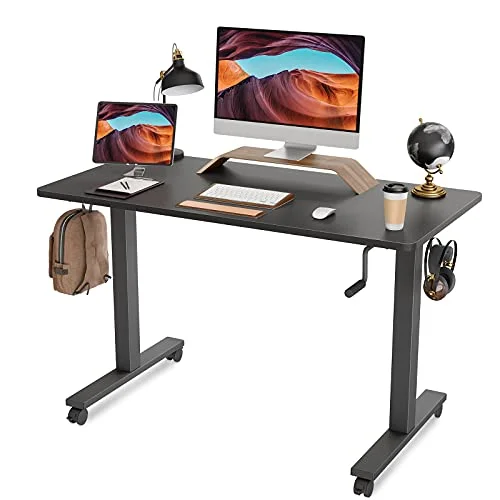
The goal is simple: forearms roughly parallel to the floor, elbows near 90 degrees, shoulders relaxed. That puts the desk surface (or your keyboard tray) at about elbow height.
For most adults, standing elbow height lands around 63% of total height. Seated, the surface should sit at roughly 42% of total height, though chair height and footrests change this. Treat both as a starting point, not a prescription. Arm proportions vary.
Worked example: someone 5’8” is 68 inches tall.
- Standing: 68 × 0.63 ≈ 43 inches
- Sitting: 68 × 0.42 ≈ 28.5 inches
The most accurate method skips math. Stand in your normal shoes, let your arms hang, bend your elbows to 90 degrees, and have someone measure from the floor to the underside of your forearm. That number is your standing keyboard height. Repeat seated, floor to forearm, with your feet flat.
Standing Desk Height Chart by Body Size
| Your Height | Standing Desk Height | Sitting Desk Height |
|---|---|---|
| 5’0” (152 cm) | 37–39” | 24–26” |
| 5’2” (157 cm) | 38–40” | 25–27” |
| 5’4” (163 cm) | 40–42” | 26–28” |
| 5’6” (168 cm) | 41–43” | 27–29” |
| 5’8” (173 cm) | 42–44” | 28–30” |
| 5’10” (178 cm) | 43–45” | 29–31” |
| 6’0” (183 cm) | 45–47” | 30–32” |
| 6’2” (188 cm) | 46–48” | 31–33” |
| 6’4” (193 cm) | 47–49” | 32–34” |
These are surface heights with shoes on. If your keyboard sits on a tray beneath the desktop, subtract the tray’s drop. And if you stand on a cushioned mat, remember that it adds a bit of height under your feet, so you may want the desk about the same amount higher. The setup details are in our guide to setting up a standing desk properly.
Why the Desk’s Range Matters More Than the Spec Sheet Headline
Here is the part most shoppers miss. A desk advertised as “up to 50 inches” says nothing about the bottom of the range. Your sitting height needs the minimum, and your standing height needs the maximum. Both have to fit.
- Shorter than about 5’4”: the minimum height is your problem. A desk bottoming out at 28 inches is too high for sitting, and you end up raising your chair and needing a footrest. Look for a minimum under 25 inches. Our petite-friendly standing desk roundup covers these.
- Taller than about 6’2”: the maximum is the issue. Many desks top out around 48 inches, which falls short of the 46–49 inches the chart suggests for the tallest users. See the tall-people standing desk picks.
- In between: nearly any dual-motor desk works. Pick on stability, desktop size, and price.
Desks Whose Height Ranges Fit
Ranges below come from the manufacturer listings. We compared them against the chart above.
UPLIFT V3: The Low-Minimum Pick
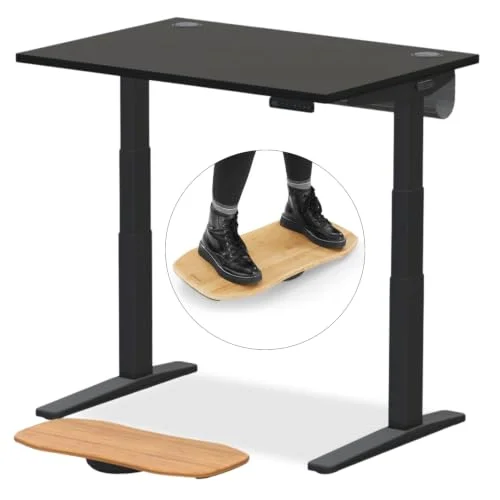
The UPLIFT V3 drops to 21.6 inches, which makes it the desk I’d point a shorter user toward first. A 5’0” person needs a sitting surface around 24 to 26 inches, and this clears it easily. The trade-off is the 47.7-inch ceiling. Anyone over 6’2” will run out of travel. Our full UPLIFT V3 review goes into the frame and keypad.
FlexiSpot E6: The Budget Middle
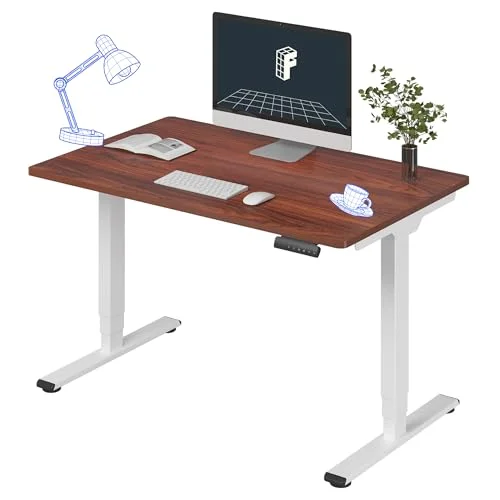
At 23.6 to 48.8 inches, the E6 covers the middle of the chart, from about 5’0” to 6’1”. It is the sensible choice if you do not need extremes and do want to keep the cost down. The desktop is included. The capacity is lower than pricier frames, so a heavy monitor setup deserves a look at the weight numbers.
Vari Electric 60x30: Extra Headroom on Top
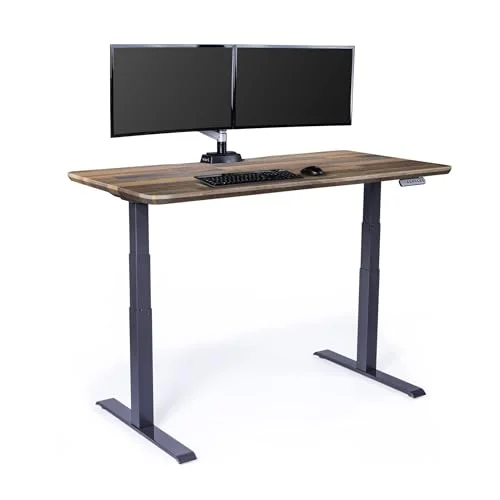
Vari tops out at 50.5 inches, which gives taller users more room than the previous two. The 25.5-inch minimum is the catch for shorter people. If you are 6’2” or above and want a wide surface, it fits. Our Vari review covers assembly and the build.
Fine-Tuning After You Set the Height
The calculator gets you within an inch or two. Then adjust:
- Keyboard: elbows at roughly 90 degrees, wrists neutral, shoulders down.
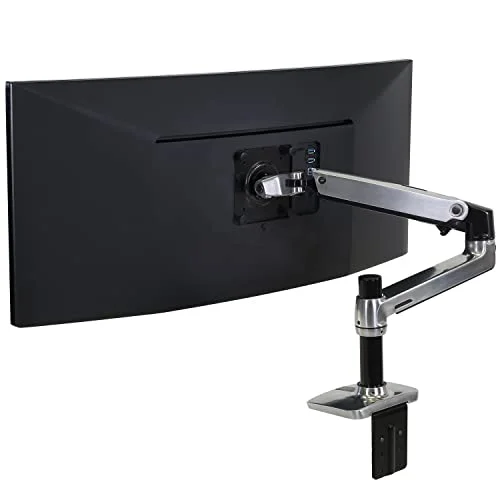
- Monitor: top edge of the screen at or just below eye level, about an arm’s length away. A monitor arm makes this easy to dial in separately from the desk.
- Feet: a mat takes pressure off your heels. We like the Ergodriven Topo for its uneven surface, and the anti-fatigue mat guide compares more options.
- Memory presets: save one sitting height and one standing height so you never have to hold the button again.
- Rotation: change position every 30 to 60 minutes. Standing all day is not the goal. See how long to stand at a standing desk.
Buying Guide: What to Check Before You Order
- Minimum and maximum height, not just the maximum.
- Desktop thickness. The listed range may refer to the frame only, so a thick top adds an inch or more at the high end.
- Weight capacity. Add up monitors, arms, and a PC if it sits on the desk.
- Memory presets. Four is typical. Two is the real minimum.
- Desktop size. 48 by 30 inches suits a single monitor, and 60 by 30 is better for two.
- Warranty. Frames with motors and controllers are worth covering for years, not months.
If you are unsure where you land, our complete standing desk buying guide walks through the full decision.
FAQ
What height should my standing desk be?
Stand with your elbows at 90 degrees and measure from the floor to your forearm. The desk surface should sit there. A good estimate is about 63% of your height, so roughly 43 inches for someone 5’8”.
What is the ideal sitting desk height?
About 42% of your height is a reasonable estimate, which is around 28 to 29 inches for someone 5’8”. Your chair height and footrest change this, so adjust until your forearms are parallel to the floor.
Does my desk height change if I wear different shoes?
Slightly. Measure in the shoes you usually wear while standing. Barefoot or in thin socks, you may want the desk about an inch lower.
Should my monitor be at the same height as my keyboard?
No. The keyboard goes at elbow height. The monitor’s top edge should sit near eye level, which is much higher. They need separate adjustments.
How tall a person can use a standard 48-inch maximum desk?
Based on the 63% estimate, a desk with a 48-inch maximum fits people up to about 6’2” to 6’3” comfortably. Beyond that, look for a taller range or a frame extension.
Do I need a footrest at a standing desk?
Only if your desk will not go low enough for your feet to rest flat while sitting. A footrest bridges the gap in that case, and our footrest roundup has options.
Conclusion
Multiply your height by 0.63 for standing and 0.42 for sitting, confirm with a tape measure, and buy a desk whose full range covers both numbers. Shorter than 5’4”, start with the UPLIFT V3. Taller than 6’2”, the Vari’s 50.5 inches gives you the most headroom here. Everyone in between can save money with the FlexiSpot E6. A few minutes with a tape measure beats months of sore shoulders.