Disclosure: PostureRanked is reader-supported. When you buy through links on our site, we may earn an affiliate commission at no additional cost to you. Our recommendations are based on independent research and testing.
| Product | Price | Rating |
|---|---|---|
| Humanscale F500K | — | 9.4 |
| HUANUO Adjustable Desk Footrest | — | 8.2 |
| iMovR Standing Desk Foot Rest | — | 8.6 |
| StrongTek Rocker Board | — | 8.8 |
| CasaZenith Adjustable Foot Rest | — | 7.8 |
PostureRanked is reader-supported. When you buy through links on our site, we may earn an affiliate commission at no additional cost to you.
You bought the standing desk. You got the anti-fatigue mat. Three hours in, your lower back still aches and you’re shifting weight from one foot to the other like you’re waiting in line at the DMV.
That’s where a footrest comes in. Resting one foot on a raised surface — like propping your foot on a bar stool rail — shifts your center of gravity, takes pressure off your lumbar spine, and gives your legs a break without sitting down. Physical therapists have recommended this position for decades. It works.
Short on time? The Humanscale F500K is the best standing desk footrest overall — premium build, smooth rocking action, and it looks great under any desk. On a budget, the HUANUO Adjustable gives you three height settings and a rocking tilt for under $40.
Quick Comparison: Best Standing Desk Footrests
| Footrest | Best For | Type | Height Range | Price |
|---|---|---|---|---|
| Humanscale F500K | Best Overall | Rocking Platform | Fixed 4.5” | $120-$145 |
| HUANUO Adjustable | Best Value | Tilting Platform | 4.3”-6.7” (3 settings) | $30-$40 |
| iMovR Foot Rest | Most Versatile | Tilting Platform | 3.3”-5.1” (4 angles) | ~$45 |
| StrongTek Rocker | Active Standing | Rocking Wood | Fixed (3.9”-6.5” rocker arc) | $35-$40 |
| CasaZenith Adjustable | Tightest Budget | Multi-height | 3.1”-7.3” (6 settings) | $25-$35 |
Humanscale F500K — Best Overall
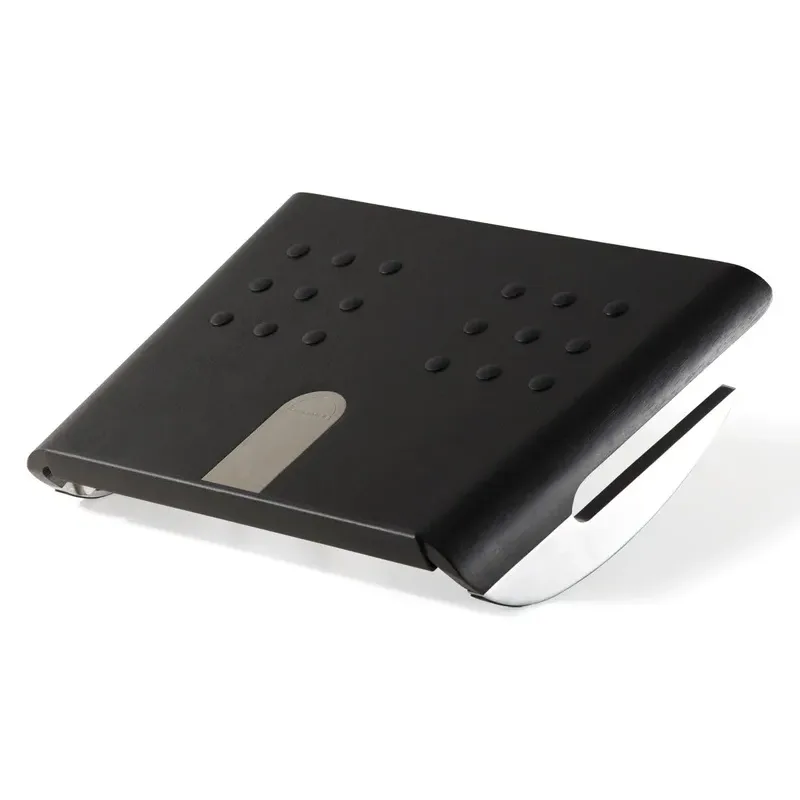
Humanscale F500K
Pros
- ✓ Premium molded plywood and metal construction
- ✓ Smooth rocking motion engages lower leg muscles
- ✓ Award-winning ergonomic design
- ✓ Fits premium office aesthetics
Cons
- ✗ Most expensive option at $120-$145
- ✗ No height adjustment — single fixed height
The F500K is what happens when an ergonomic furniture company with decades of experience designs a footrest. The molded plywood platform sits on a steel-and-aluminum frame with a smooth, weighted rocking motion. You rest your foot on it and it responds naturally — no clicking between positions, no fiddling with adjustment knobs.
At 16.75” wide and 12.25” deep, the platform is generously sized. The curved shape encourages a gentle rocking motion that engages your calf muscles and boosts circulation in your lower legs. Humanscale designed this to reduce the static loading that causes leg fatigue during long standing sessions.
Build quality is a clear step above everything else on this list. The plywood-and-metal construction feels solid and looks sharp — more like furniture than an office accessory. Available in black or cherry finish.
Who should buy this: Anyone who stands 4+ hours daily and wants a footrest that lasts years. It’s the best-built option and the rocking motion genuinely helps with fatigue.
Who should skip this: Casual standers who don’t stand more than an hour or two. At $120+, it’s hard to justify for occasional use. You also can’t adjust the height, so if you need something taller or shorter, look elsewhere.
Price: $120-$145
Check Humanscale F500K on Amazon
HUANUO Adjustable Desk Footrest — Best Value
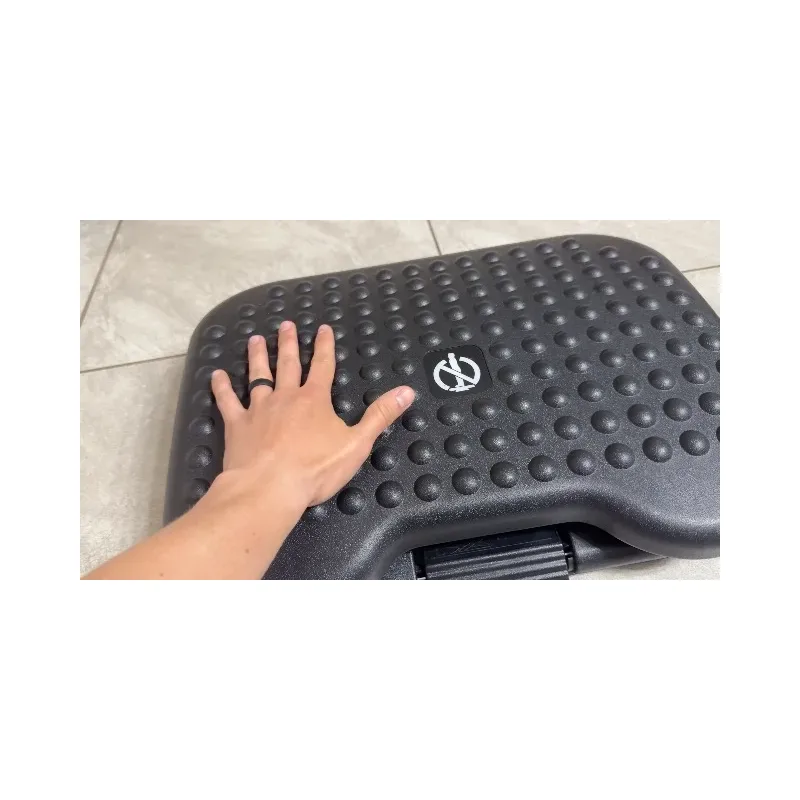
HUANUO Adjustable Desk Footrest
Pros
- ✓ Three height settings plus 30° tilt range
- ✓ Free-rocking motion encourages movement
- ✓ Massage-textured surface
- ✓ Best price-to-feature ratio under $40
Cons
- ✗ All-plastic construction feels less premium
- ✗ May wear faster under heavy daily use
The HUANUO packs a surprising amount of adjustability into a sub-$40 footrest. Three height settings (4.3”, 5.5”, 6.7”) let you dial in the right elevation, and the ±30° tilt range means you can rock your foot back and forth throughout the day.
The platform surface has a geometric bump texture that provides mild massage stimulation — your feet won’t slide around, and the texture feels decent through socks. At 17.3” x 13.4”, the platform is actually larger than the Humanscale F500K.
It’s all plastic, and it feels like it. The HUANUO doesn’t have the heft or premium feel of the Humanscale or StrongTek. But the adjustment range is better than either of those, and the free-floating rocking motion works well for encouraging the micro-movements that prevent standing fatigue.
Arrives pre-assembled. Pull it out of the box, set the height, and you’re done.
Who should buy this: Budget-conscious buyers who want real adjustability. The three height settings make this work across different desk heights and user heights. Great for shared workspaces.
Who should skip this: Anyone who prioritizes build quality and aesthetics. The all-plastic construction won’t impress anyone, and it may not hold up to 5+ years of daily use.
Price: $30-$40
Check HUANUO Adjustable Footrest on Amazon
iMovR Standing Desk Foot Rest — Most Versatile
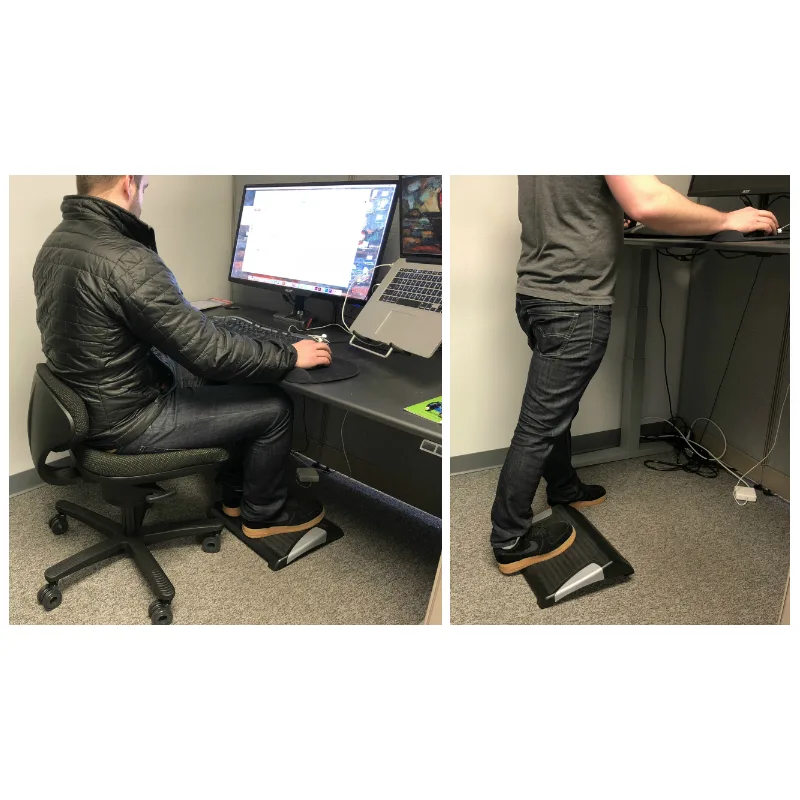
iMovR Standing Desk Foot Rest
Pros
- ✓ Four tilt angles for fine-tuned positioning
- ✓ Foldable legs for easy storage and portability
- ✓ Anti-fatigue rubber surface is comfortable
- ✓ 15-year warranty
Cons
- ✗ Not available on Amazon — direct purchase only
- ✗ Smaller platform than competitors
iMovR’s footrest splits the difference between the premium Humanscale and budget options. Four tilt angles (6°, 12°, 16°, 25°) give you more positioning options than most competitors, and the anti-fatigue rubber surface on the platform is genuinely comfortable.
The standout feature is the foldable design. The legs fold flat, making this the only footrest on this list that travels well. If you work from multiple locations or need to stow the footrest in a drawer when company comes over, that’s a real advantage.
At 15.7” x 10”, the platform is the smallest here, which could be a pro or con depending on your space. It takes up less floor real estate, but larger feet may find it cramped. The four height positions (3.3” to 5.1”) skew shorter than the HUANUO, so taller users may want more elevation.
iMovR backs this with a 15-year warranty, which is exceptional for an accessory in this price range. The catch: it’s only sold through iMovR’s website, not Amazon.
Who should buy this: People who want a portable, well-made footrest with fine-tuned angle adjustment. The foldable design is unmatched if you need to move or store it frequently.
Who should skip this: Anyone who wants the convenience of Amazon ordering, or who needs a taller footrest (maxes out at 5.1”).
Price: ~$45
Check iMovR Foot Rest on Official Site
StrongTek Rocker Board — Best for Active Standing
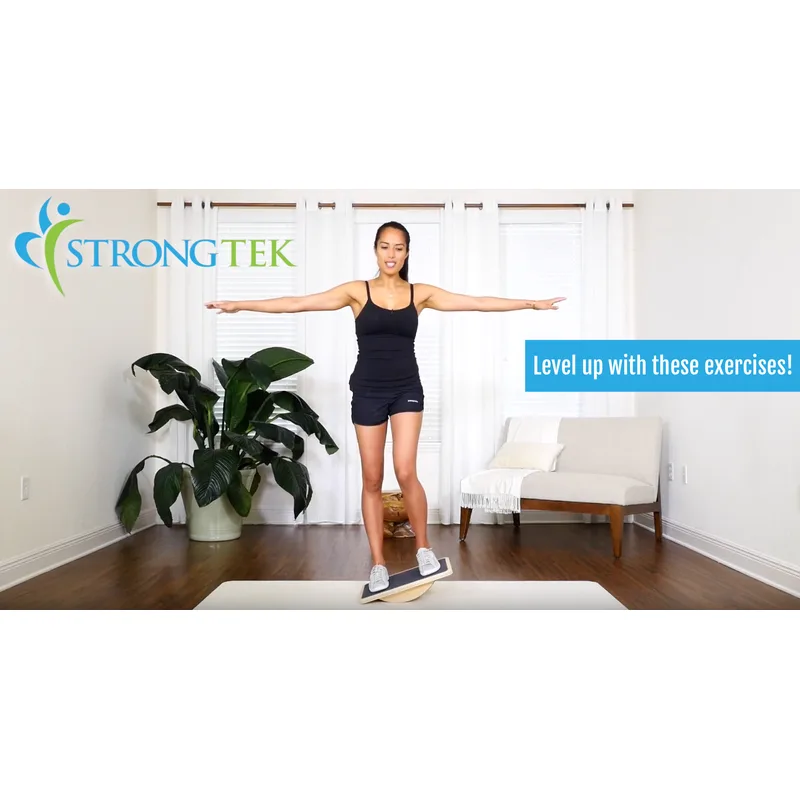
StrongTek Rocker Board
Pros
- ✓ Solid hardwood construction built to last
- ✓ 350 lb weight capacity
- ✓ Curved rocker encourages active micro-movements
- ✓ No assembly needed
Cons
- ✗ Fixed height — no adjustment
- ✗ Rocking motion takes a few days to get used to
- ✗ Larger footprint than compact platforms
The StrongTek takes a completely different approach. Instead of a static platform with adjustable angles, you get a curved hardwood board that rocks under your foot. Plant one foot (or both) and the board tilts side to side or front to back, depending on your positioning.
Made from solid Lauan hardwood plywood with rubber grips on the bottom and a textured anti-slip top surface. The 350 lb weight capacity is the highest on this list — this thing is overbuilt, and that’s a compliment. No assembly required; it’s one piece of shaped wood.
The rocking motion takes a day or two to feel natural. It engages your core and calf muscles in a way static footrests don’t. If you’ve ever used a balance board, this is a gentler version of that concept — enough instability to encourage movement without requiring real concentration.
At 17.5” x 10.5”, it needs a bit more floor space than compact footrests. And since the rocker is the whole design, there’s no height adjustment. You get whatever height the rocker arc provides (roughly 3.9” to 6.5” depending on tilt angle).
Who should buy this: Active standers who want their footrest to encourage movement and light muscle engagement. Anyone who finds static standing boring.
Who should skip this: People who want a stable, non-moving platform to rest their foot on. The rocking motion isn’t for everyone, and there’s no way to lock it flat.
Price: $35-$40
Check StrongTek Rocker Board on Amazon
CasaZenith Adjustable Foot Rest — Best Budget Option
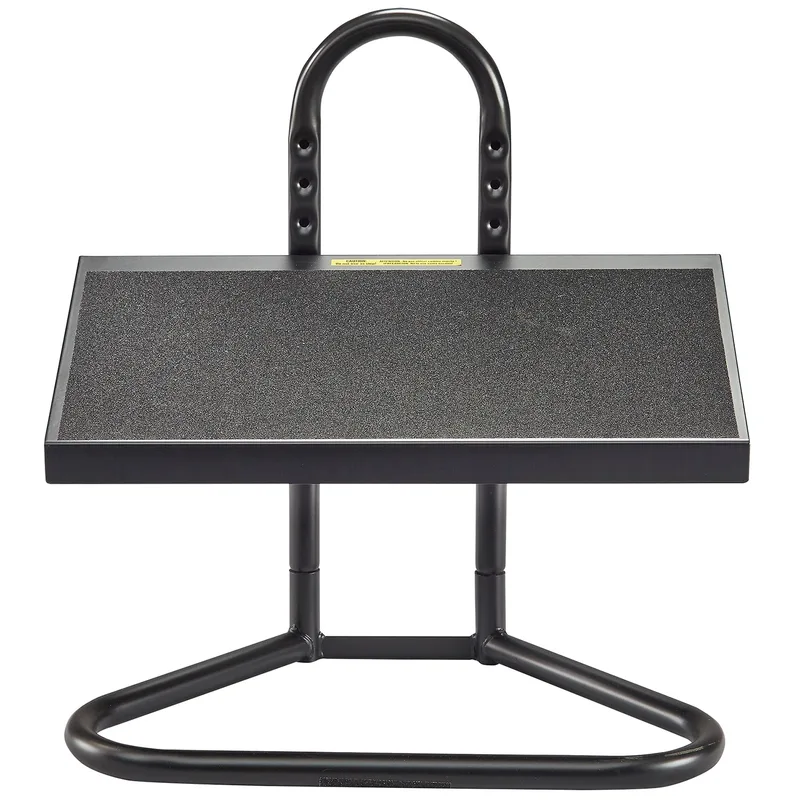
CasaZenith Adjustable Foot Rest
Pros
- ✓ Six height positions — most adjustable option
- ✓ Built-in massage roller surface
- ✓ Cheapest option under $30
- ✓ Lightweight and portable
Cons
- ✗ Basic plastic build quality
- ✗ Massage texture isn't comfortable for everyone
- ✗ Lower weight capacity than premium options
Six height settings from 3.1” to 7.3” give the CasaZenith the widest adjustment range on this list. You change the height by turning screws on both sides — not as quick as the HUANUO’s snap-in system, but it holds firmly once set.
The massage roller surface adds targeted stimulation for tired feet. Some people love it; others find the bumps uncomfortable after extended use, especially in thin-soled shoes or socks. Try it both ways before deciding.
At 3.1 lbs, it’s the lightest option here and easy to move around. The ABS plastic construction keeps the price rock-bottom but won’t win any durability awards. For occasional standing use or someone testing whether a footrest is worth it at all, the CasaZenith is an easy recommendation at under $30.
Who should buy this: First-time footrest buyers who aren’t sure they’ll use it enough to justify spending more. The low price makes it a low-risk experiment.
Who should skip this: Heavy daily users who need something built to last. The plastic construction and lower weight capacity mean this is better suited for lighter, occasional use.
Price: $25-$35
Check CasaZenith Adjustable Foot Rest on Amazon
Why Use a Footrest at a Standing Desk?
Weight Distribution
Resting one foot on a raised surface shifts your center of gravity and takes pressure off your load-bearing leg and hip joint. Physical therapists call this the “captain’s stance” — and it’s the same reason bars have foot rails.
Micro-Movements
Footrests encourage subtle weight shifts throughout the day. These small movements boost circulation, reduce muscle fatigue, and prevent the stiffness that comes from standing rigid like a soldier at attention.
Lower Back Relief
Elevating one foot slightly flexes the hip, which reduces the curve in your lower spine and eases pressure on lumbar discs. It’s one of the most reliable non-medication strategies for standing-related back pain.
Pairing with Anti-Fatigue Mats
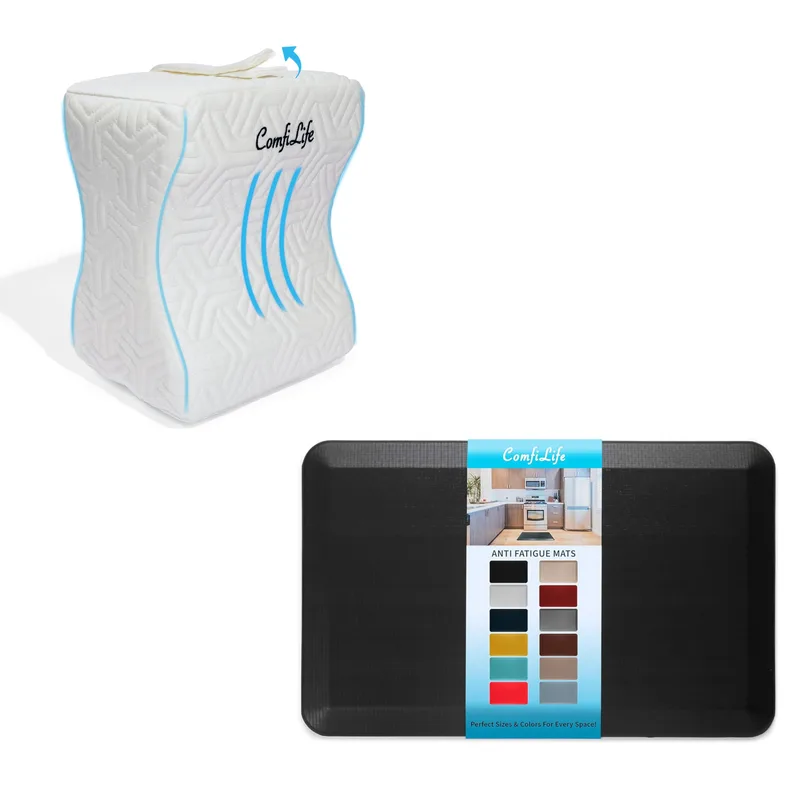
A footrest doesn’t replace an anti-fatigue mat — they solve different problems. The mat cushions both feet; the footrest gives you an active position change. Using both together is more effective than either alone.
Buying Guide: What to Look for in a Standing Desk Footrest
Height and Adjustability
Most standing footrests sit 4-8 inches off the ground. If you’re under 5’6”, a lower footrest (3-5 inches) may feel more natural. Taller users often prefer 5-7 inches. Adjustable models like the HUANUO and CasaZenith let you experiment.
Platform Size
Bigger platforms give your foot more room to shift position, which matters during long standing sessions. Look for at least 15” wide. Smaller platforms save floor space but can feel cramped.
Rocking vs. Static
Rocking footrests (Humanscale F500K, StrongTek) encourage continuous micro-movements that fight fatigue. Static or tilt-adjustable footrests (iMovR, CasaZenith) provide a stable platform. Neither is objectively better — it depends on whether you want active movement or a steady rest.
Build Material
Wood and metal last longest. Premium options like the Humanscale and StrongTek will easily survive 5-10 years of daily use. Plastic footrests cost less but may crack or wear down faster, especially under heavier users.
Surface Texture
Rubber and textured surfaces grip your foot and prevent slipping. Massage bumps on the CasaZenith add stimulation but aren’t for everyone. If you stand barefoot or in socks, surface comfort matters more.
Portability
If you move between workstations or need to store the footrest, weight and foldability matter. The iMovR’s foldable legs and the CasaZenith’s light weight (3.1 lbs) make them the most portable options.
Footrest Types Explained
| Type | How It Works | Best For | Examples |
|---|---|---|---|
| Tilting Platform | Adjustable angle, some rock freely | General use, adjustability | HUANUO, iMovR |
| Rocking Board | Curved base creates instability | Active standing, muscle engagement | StrongTek |
| Rocking Platform | Weighted platform tilts smoothly | Premium comfort, circulation | Humanscale F500K |
| Multi-Height Static | Screw or snap height adjustment | Budget, flexibility | CasaZenith |
| Foot Rail/Bar | Mounts to desk frame | Minimalist setup | (various brands) |
How to Use a Standing Desk Footrest
Positioning: Place the footrest 6-12 inches in front of where you stand. You should be able to rest one foot on it without leaning or shifting your torso.
Alternating feet: Switch every 10-15 minutes. Keeping one foot elevated too long can create asymmetric strain. Set a mental timer or just switch whenever you notice.
Start early: Don’t wait until your back hurts. Use the footrest proactively — ideally within the first 20-30 minutes of standing.
Combine with other tools: Use a footrest on top of your anti-fatigue mat. Adjust your standing desk height slightly if the footrest changes your elbow angle at the keyboard.
Frequently Asked Questions
Do I need a footrest if I already have an anti-fatigue mat?
They solve different problems. The mat cushions both feet while you stand normally. The footrest gives you an active position change — one foot up, weight shifted — that relieves different muscle groups. Using both is more effective than either alone.
What height should my standing desk footrest be?
4-8 inches is the typical range. You want enough elevation to meaningfully shift weight off your standing leg but not so high that it feels awkward or unstable. Start around 5 inches and adjust from there.
Can I use a sitting footrest for standing?
Sometimes. If it’s tall enough, stable enough, and doesn’t slide around, it can work. But standing footrests are designed for the different weight distribution and posture of standing. A sitting footrest under your desk is usually too short and flimsy.
How often should I switch feet on the footrest?
Every 10-15 minutes. The goal is frequent position changes, not parking one foot up for an hour. Think of it like fidgeting — small, frequent shifts keep your muscles and joints happy.
Will a footrest help with lower back pain from standing?
For many people, yes. Elevating one foot reduces the lumbar curve in your lower spine and takes pressure off your discs. It’s a position physical therapists commonly recommend. If your back pain persists after two weeks of consistent footrest use, see a professional.
What’s better — a rocking footrest or an adjustable one?
Depends on what you want. Rocking footrests (Humanscale F500K, StrongTek) encourage active movement and muscle engagement. Adjustable footrests (HUANUO, CasaZenith) let you dial in the exact height for your body. Neither is wrong — it’s personal preference.
The Bottom Line
For most standing desk users, the HUANUO Adjustable delivers the best balance of features and price. Three height settings, a rocking tilt, and a sub-$40 price make it the easiest recommendation.
If you want the best-built footrest that’ll last a decade, the Humanscale F500K justifies the higher price. The rocking motion is smoother than anything else here, and the plywood-and-metal construction is in a different league.
For active standers who want movement, the StrongTek Rocker Board turns standing into subtle exercise. And if you just want to try a footrest without committing much money, the CasaZenith at under $30 is a no-risk starting point.
A footrest is one piece of a complete standing desk setup. See our best desk accessories for remote work guide for the full picture — and if you’re not yet using a lumbar support pillow in your chair, that’s another inexpensive upgrade that pairs well with proper foot positioning.