Sore feet and stiff calves are the number one reason people quit standing at their standing desk after the first month. In 2026, the ergonomics conversation around this has shifted: instead of treating a balance board and an anti-fatigue mat as competing purchases, more ergonomists are recommending you think of them as solving two different problems — cushioning versus movement — and that the effect of using both is additive rather than redundant. Simply standing still on a hard floor for hours does little for fatigue; what actually helps is a mix of cushioning and small, frequent position changes throughout the day.
That reframes the buying decision. If your main complaint is sore feet and aching heels, you want a mat. If you find yourself locking your knees and going stiff by 2pm, you want something that keeps you moving. Some readers genuinely need both. Below, we compare two balance boards and two anti-fatigue mats across comfort, movement, price, and who each one actually fits — plus what to do if you want the benefits of both without buying two separate products.
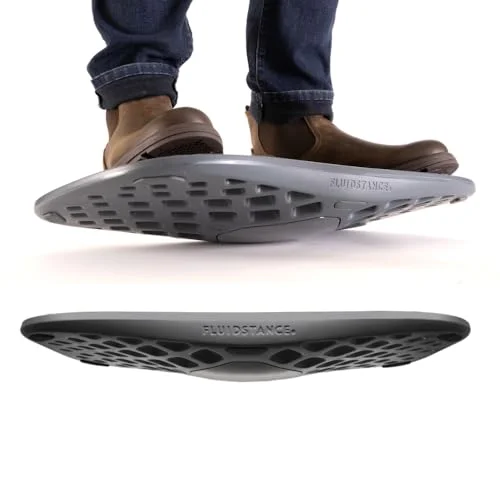
FluidStance Balance Board: Best for Active Movement
FluidStance Balance Board
Pros
- ✓ Full 360-degree tilt keeps your ankles, calves, and core engaged all day instead of letting you lock into one static position
- ✓ Non-slip deck holds up under socks or bare feet, which matters more than it sounds once you're rocking for hours
- ✓ Made in the USA from recycled materials — a genuine sustainability angle, not a marketing footnote
- ✓ Compact footprint slides under most desks when you sit back down
Cons
- ✗ No fixed listing price on Amazon at the time of writing — check the live listing before buying
- ✗ 360-degree movement has a learning curve; expect a wobbly first few days
- ✗ Offers zero cushioning for your feet, so it doesn't help with flat-footed standing fatigue the way a mat does
FluidStance built its reputation on encouraging constant, low-amplitude movement rather than static standing, and this board still delivers that: a full 360-degree rocking deck that keeps your ankles and calves cycling instead of locking into one position. It’s made in the USA from recycled materials, which is a genuine point of difference from the wall of generic wobble boards on Amazon.
The catch is that a balance board is a commitment. There’s a real learning curve — expect a few wobbly, slightly awkward days before it feels natural to type and take video calls while standing on it. It also offers essentially zero cushioning, so if flat-footed fatigue is your main complaint, this alone won’t fix it. Check the current FluidStance listing on Amazon for live pricing, since it fluctuates.
Best for: People who already stand comfortably but want to add active movement and light balance training to their workday.
FEZIBO Standing Desk Mat Balance Board: Best Value Hybrid
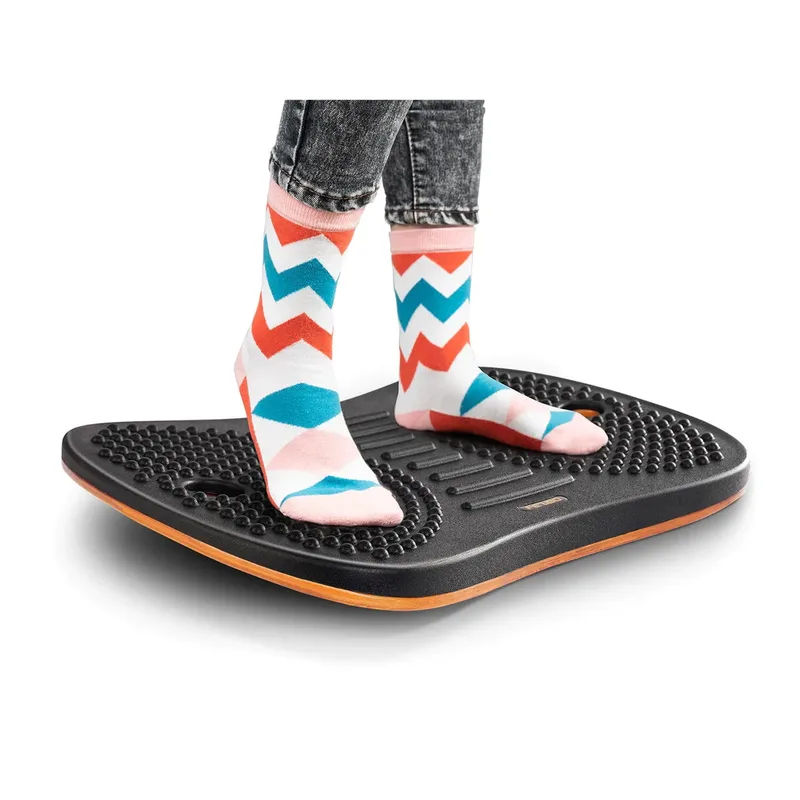
FEZIBO Standing Desk Mat Balance Board
Pros
- ✓ Hybrid design gives you cushioned standing comfort and a gentle wobble in one $70 product
- ✓ 8.5-degree tilt is subtle enough that it doesn't throw off your typing accuracy or mouse aim
- ✓ Cheapest way to try both categories at once before committing to a dedicated board or mat
- ✓ Compact and light enough to store standing against a wall when you sit down
Cons
- ✗ The wobble is much gentler than a dedicated balance board like the FluidStance — don't expect a real balance workout
- ✗ The foam base is thinner than a dedicated anti-fatigue mat, so all-day standers may still want a separate mat
- ✗ Only available in one finish (Obsidian Black) at the time of writing
If you don’t want to choose between a mat and a board, FEZIBO’s hybrid at $69.99 splits the difference. It pairs a cushioned foam base with a gentle 8.5-degree wobble deck, so you get some cushioning underfoot and some movement without buying two separate products. The tilt angle is deliberately mild — most of the motion happens from the hips down, so it doesn’t throw off your typing or mouse accuracy the way a more aggressive balance board can.
It’s a compromise product, and it shows on both ends: the wobble isn’t as engaging as a dedicated board like the FluidStance, and the foam base isn’t as thick as a purpose-built mat like the Ergodriven Topo. For most people testing the waters on either category for the first time, that compromise is exactly the point.
Best for: Buyers who aren’t sure which category they’ll actually use and don’t want to spend twice to find out.
Ergodriven Topo Comfort Mat: Best Premium Anti-Fatigue Mat
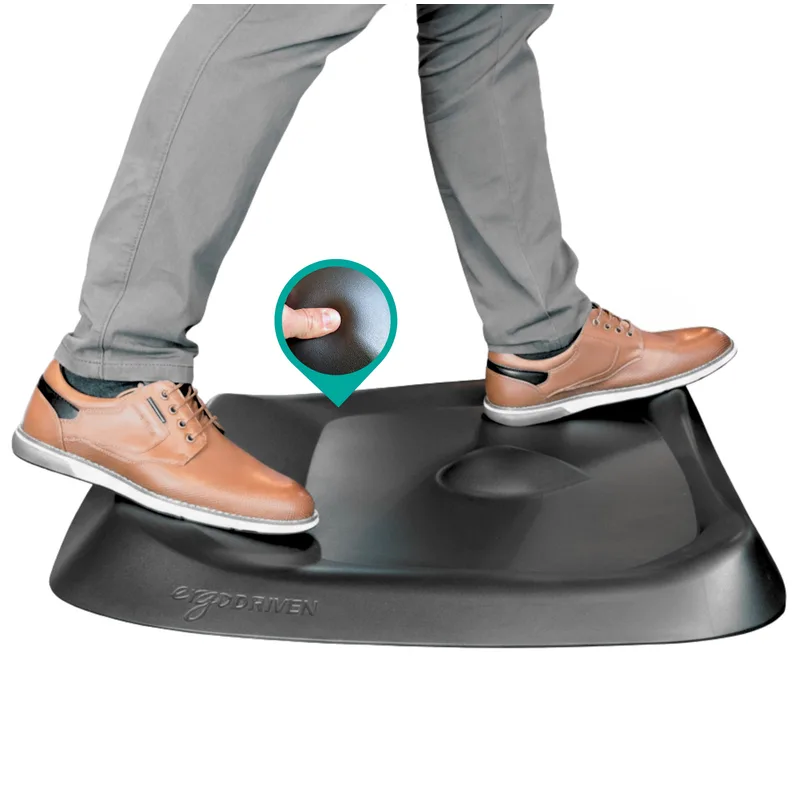
Ergodriven Topo Comfort Mat
Pros
- ✓ The 'not-flat' terrain design means your feet naturally shift position throughout the day without you thinking about it
- ✓ Can be repositioned with a single foot — no bending down to drag a heavy mat around
- ✓ PVC-free foam construction is a genuine step up from budget mats made with harsher materials
- ✓ A longtime favorite among ergonomics reviewers for standing desk setups specifically, not repurposed kitchen mats
Cons
- ✗ At $109, it costs roughly double what a flat anti-fatigue mat runs
- ✗ The uneven terrain takes some getting used to if you're coming from a completely flat mat
- ✗ No true balance-training motion — the terrain is subtle, not a wobble board substitute
The Topo takes a different approach to the same movement-versus-cushioning problem. Instead of a wobble deck, it uses a “not-flat” terrain design — a series of gentle ridges and slopes molded into ultra-thick, PVC-free foam — so your feet naturally shift position throughout the day without you consciously balancing on anything. You can reposition the mat with one foot instead of bending down, a small detail that matters more than it sounds like it would after the tenth time you’ve nudged it back into place.
At $109 it’s the most expensive product in this comparison, roughly double a flat mat like the ComfiLife. That premium buys genuinely different terrain, not just a thicker version of a flat mat, and it’s been a consistent favorite among ergonomics reviewers specifically for standing desk use rather than mats repurposed from kitchens or garages.
Best for: All-day standers who want passive movement encouragement without a learning curve.
ComfiLife Anti-Fatigue Floor Mat: Best Budget Pick
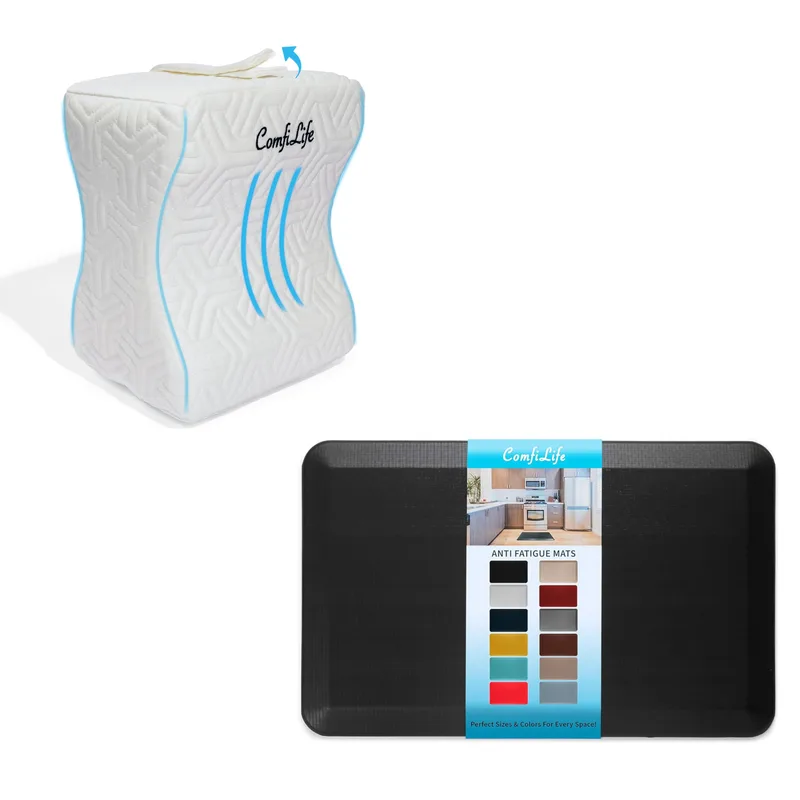
ComfiLife Anti-Fatigue Floor Mat
Pros
- ✓ 3/4-inch memory foam core delivers real cushioning for a fraction of the price of specialty standing desk mats
- ✓ Non-slip backing keeps it in place on hardwood and tile, not just carpet
- ✓ Stain-resistant surface holds up in a kitchen or garage as well as an office, so it's not a single-use purchase
- ✓ One of the highest-rated anti-fatigue mats on Amazon by review volume, which means returns and defects are well documented
Cons
- ✗ Completely flat — it cushions your feet but does nothing to encourage position changes
- ✗ Thinner cushioning than the Ergodriven Topo, noticeable after several hours of standing
- ✗ Available in several sizes and colors, so double-check the listing matches the footprint you need
The ComfiLife is the straightforward option: a 3/4-inch memory foam core, non-slip backing, and a stain-resistant surface, for $49.99. It’s completely flat, so it won’t encourage position changes the way the Topo or either balance board does — but if your priority is simply softening a hard floor under your feet, it does that job well and cheaply. It’s also one of the highest-rated anti-fatigue mats on Amazon by sheer review volume, which is worth something when you’re trying to gauge long-term durability and defect rates before buying.
Because it’s flat, stain-resistant, and comes in several sizes, it also pulls double duty in a kitchen or garage if you ever move it off desk duty.
Best for: Budget-conscious buyers who want cushioning first and don’t care about built-in movement.
Balance Board vs Anti-Fatigue Mat: What Actually Matters
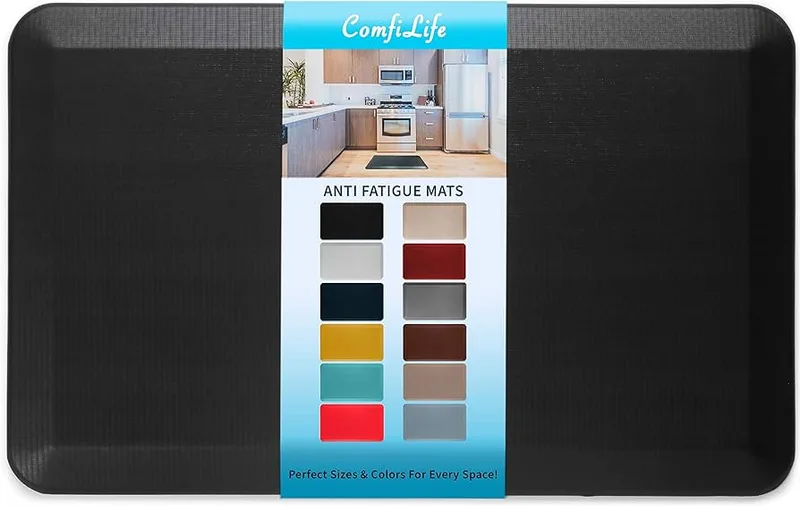
The core tradeoff is comfort versus movement, and it’s worth being honest about what each category can and can’t do:
Anti-fatigue mats (Ergodriven Topo, ComfiLife) cushion the impact of standing on a hard floor. They reduce the ache in your heels and lower back that comes from static pressure. A textured mat like the Topo adds mild movement encouragement on top of that cushioning; a flat mat like the ComfiLife doesn’t.
Balance boards (FluidStance, and to a lesser extent the FEZIBO hybrid) do the opposite: they force continuous small movements — ankle flexion, weight shifts, minor core engagement — but provide little to no cushioning. If your feet already hurt on a hard floor, a balance board alone won’t fix that.
Neither replaces the other’s core function, which is why more ergonomists are recommending a mat as the baseline and a balance board as an addition, not a substitute, if your budget and desk space allow for both. Combining a full standing desk setup — desk, mat, and monitor height — will do more for your posture than any single accessory in isolation.
What to Look For When Choosing
Your main complaint. Sore feet and heels point toward a mat. Stiffness and restlessness point toward a board. Both, honestly, point toward the FEZIBO hybrid or buying one of each.
Desk space and flooring. Hardwood and tile show wear from mats with weak non-slip backing faster than carpet does. Check the backing material before buying, especially for the ComfiLife on a hard floor.
Budget. A flat mat like the ComfiLife at $49.99 is the cheapest path to real relief. A dedicated board or premium terrain mat runs $70–$110, and a genuinely dialed-in setup with both will run more — factor that into whether you buy one now and add the other later.
Time standing per day. If you’re standing under two hours a day, a hybrid or budget mat is plenty. Past four or five hours, the gap between a $50 flat mat and a $109 terrain mat or dedicated board becomes noticeable in how your legs feel by evening.
If you’re still building out the rest of your station, our best standing desk mats roundup and best balance boards for standing desks both go deeper into each category individually, and our anti-fatigue mat buyer’s guide covers thickness and material tradeoffs in more detail. Pairing either with a good standing desk and clean cable management rounds out a setup that actually gets used instead of abandoned after a month.
FAQ
Can I use a balance board and an anti-fatigue mat together?
Yes, and it’s increasingly the recommended setup rather than an edge case. A mat under a balance board adds cushioning to the movement the board already provides, though most dedicated balance boards like the FluidStance aren’t designed to sit on top of a separate mat — check the product dimensions and stability rating before stacking them.
Do balance boards actually reduce standing fatigue?
They target a different kind of fatigue than mats do. A board keeps your calves and ankles cycling through small movements, which helps with the stiffness that comes from standing motionless. It does not cushion the impact of a hard floor, so it won’t help heel or arch pain the way a mat will.
Is a thicker anti-fatigue mat always better?
Not necessarily. Very thick, very soft mats can create instability that’s uncomfortable over a full workday, especially if you’re also wearing shoes with a soft sole. The terrain-based design on mats like the Ergodriven Topo is built around thickness that supports without feeling unstable — thicker isn’t automatically better if the foam density is wrong.
How long should I stand before switching to a mat or board?
Most guidance for 2026 points toward frequent position changes rather than long uninterrupted stretches — think in terms of switching between sitting, standing, and shifting your stance every 30 to 60 minutes rather than standing still for hours at a time. A mat or board makes the standing portion more comfortable, but it doesn’t replace changing position regularly.
Which is better for small desk spaces?
The FEZIBO hybrid or a flat mat like the ComfiLife take up less visual and physical space than a dedicated balance board, which needs enough clearance around it that you don’t step off the edge. If floor space is tight, start with a mat and add a board later if you want more movement.
Do these work on carpet?
Anti-fatigue mats work on carpet, though the cushioning effect is less noticeable since carpet already provides some give. Balance boards work on any flat surface but can feel slightly less stable on thick, plush carpet than on hardwood or tile — a firmer low-pile carpet or a hard floor is the better surface for a board.
Bottom Line
If your feet hurt by lunchtime, buy a mat — the ComfiLife if you’re budget-conscious, the Ergodriven Topo if you want the terrain design and don’t mind paying for it. If you find yourself restless and stiff instead, the FluidStance delivers real movement, learning curve and all. And if you’re not sure which camp you’re in yet, the FEZIBO hybrid is the cheapest way to find out before you commit to either category on its own.