Your standing desk is doing half the job. You adjusted the height, got your monitor at eye level, maybe even bought a decent keyboard tray. But you’re still standing on a hard floor, and by 3 PM your feet are screaming and your lower back is locking up.
An anti-fatigue mat fixes that. The right one reduces lower back strain, keeps blood flowing through your legs, and lets you actually stand for more than an hour without wanting to sit back down. The wrong one is a squishy waste of money that bottoms out in three months.
Short on time? The Topo by Ergodriven is our top pick. Its terrain design forces micro-movements that flat mats can’t match, and it’s been the NYT Wirecutter’s top standing desk mat since 2016. If you’re on a budget, the Sky Solutions mat gets the job done for under $40.
Topo by Ergodriven
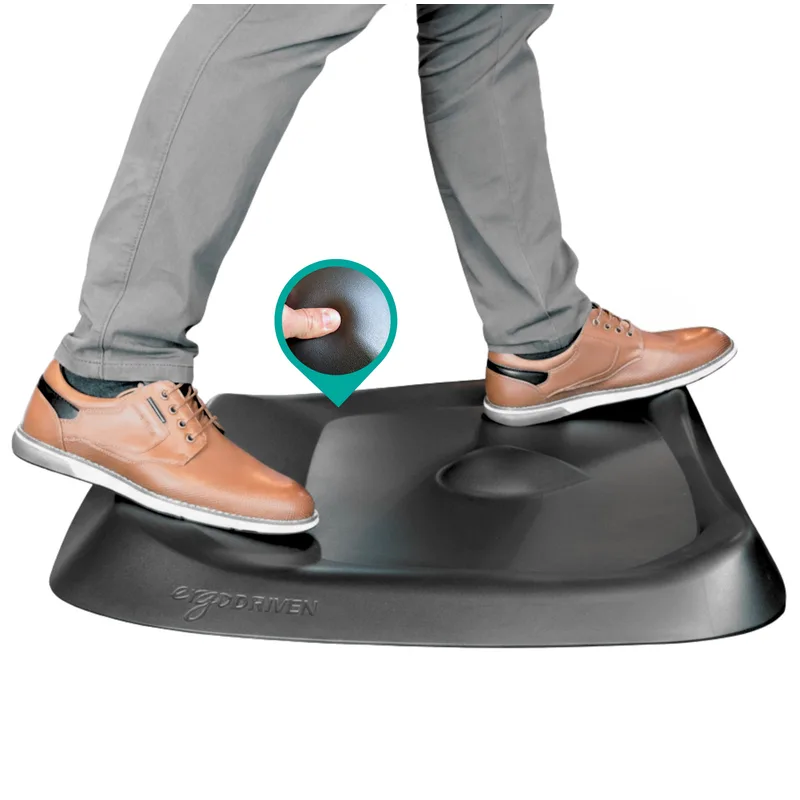
Topo by Ergodriven
Pros
- ✓ Calculated terrain encourages micro-movements
- ✓ Medical-grade polyurethane lasts years
- ✓ 7 distinct zones for foot positioning
- ✓ NYT Wirecutter top pick since 2016
Cons
- ✗ Requires 2-3 week adjustment period
- ✗ Too small for users over 6 foot 5
- ✗ Not ideal with stiletto heels
Price: $99–119 | Thickness: 2.7” | Dimensions: 26.2” × 29” | Weight: 6.4 lbs
The Topo isn’t flat. That’s the whole point. Its surface has seven distinct zones — massage mounds, power wedges for calf stretches, and a central balance bar — that force your feet to shift position constantly. Ergodriven claims 47 position changes per hour versus 18 on flat mats. Owner reports suggest that number is about right. You don’t think about moving. You just do.
The 100% polyurethane foam (no PVC, no plasticizers) is medical-grade and dense enough to hold its shape for years. Ergodriven backs it with a 7-year warranty, which is the longest in this category by a wide margin.
Who should buy this: Anyone standing 4+ hours daily who wants actual ergonomic benefit, not just cushioning. If you’ve tried flat mats and still get tired, this is your upgrade.
Who should skip this: People over 6’5” (the mat feels cramped), anyone who wears stiletto heels at their desk, or users who just want basic padding for light standing. Also, expect a 2–3 week adjustment period — your calves will notice the terrain at first.
The Topo has been the NYT Wirecutter’s “Best Standing Desk Mat” pick since 2016. That’s not a fluke. Nothing else in this price range combines terrain design with build quality this well.
CumulusPRO Commercial Couture
CumulusPRO Commercial Couture
Pros
- ✓ ACA (American Chiropractic Association) partner
- ✓ Eco synthetic leather top looks professional
- ✓ Beveled edges prevent tripping
- ✓ Lifetime satisfaction guarantee
Cons
- ✗ Only 0.75 inches thick
- ✗ Too firm for barefoot use
- ✗ Single size option
Price: $66–78 | Thickness: 0.75” | Dimensions: 24” × 36” | Weight: 6.5 lbs
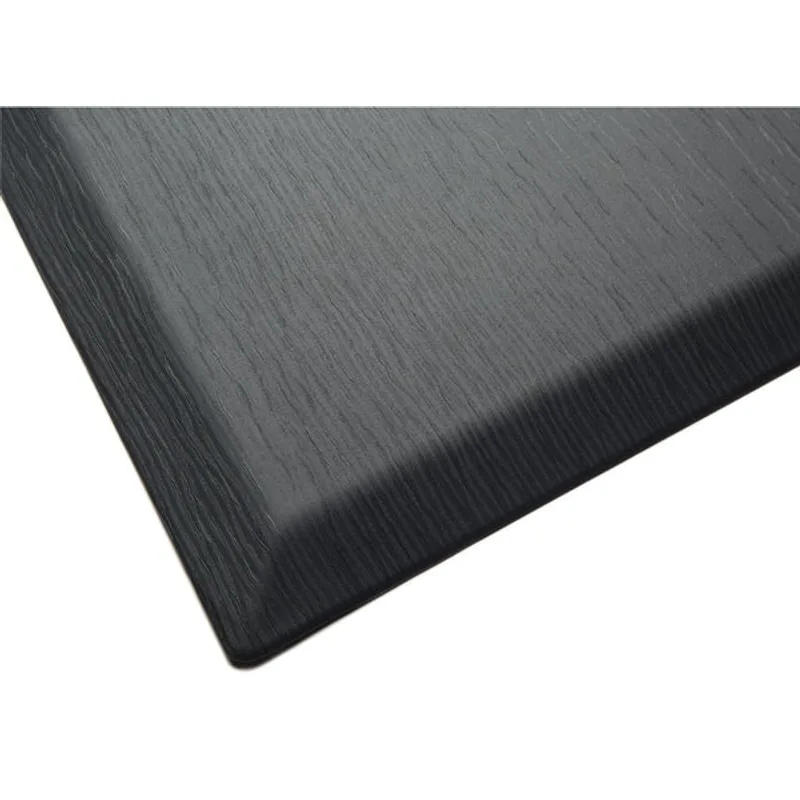
The CumulusPRO exists for one reason: it looks like it belongs in a corner office. The eco synthetic leather top layer is stain-resistant, puncture-resistant, and doesn’t scream “ergonomic accessory” when clients walk in. It’s the mat for people who care about workspace aesthetics.
Underneath that professional surface is a solid polyurethane core with what Imprint calls “Cushion-Core Technology.” It’s only 0.75 inches thick, which means less cushioning than the Topo or Vari, but the density is high enough that it won’t bottom out under normal use. Beveled edges prevent tripping — a real consideration in busy offices.
The CumulusPRO carries an ACA (American Chiropractic Association) partnership, NFSI certification for slip resistance, and a lifetime satisfaction guarantee. Its 4.9 Amazon rating (though from a smaller review pool) speaks to customer satisfaction.
Who should buy this: Professionals who need a mat that looks polished in client-facing environments. Also great for shared workspaces — the anti-microbial surface handles multiple users.
Who should skip this: Anyone who stands 6+ hours daily. At 0.75 inches, it’s not thick enough for marathon standing sessions. And if you prefer barefoot standing, the firm surface might not be comfortable enough.
Vari ActiveMat
Vari ActiveMat
Pros
- ✓ Terrain features at a mid-range price
- ✓ Lightweight and easy to move
- ✓ Raised sides for calf stretches
- ✓ 250 lb weight capacity
Cons
- ✗ Smaller footprint than competitors
- ✗ Shorter warranty than premium options
- ✗ Only 1-year warranty
Price: $79–99 | Thickness: 3.75” (at peak) | Dimensions: 27” × 20” | Weight: 4.32 lbs
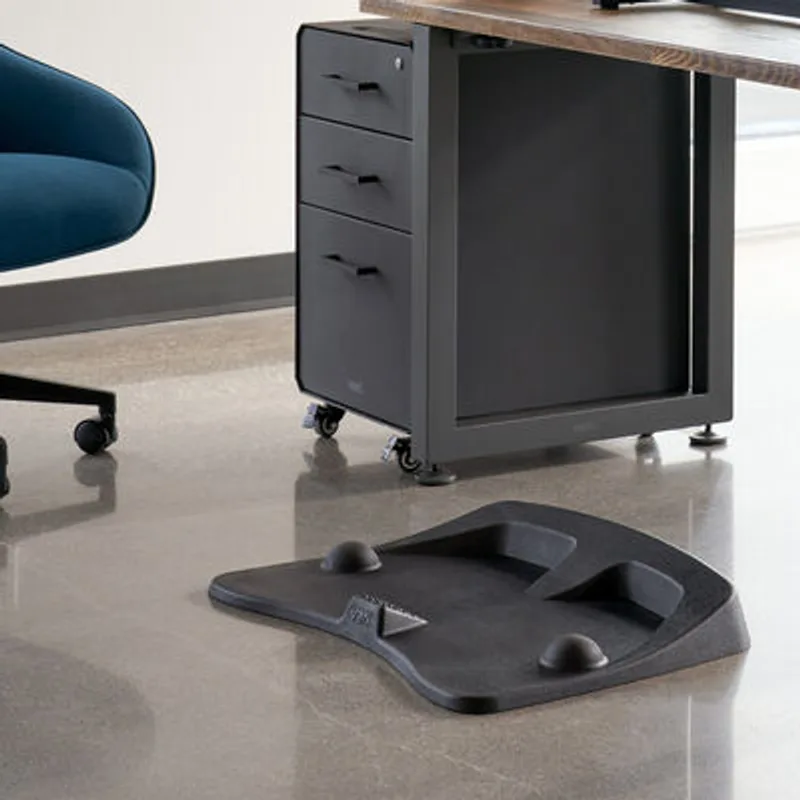
Vari (formerly VARIDESK) brought terrain features to a mid-range price point, and the ActiveMat delivers surprisingly well. The raised sides work for calf stretches, foot-flexor mounds provide light acupressure, and a power wedge lets you stretch your Achilles tendon during calls.
At 4.32 lbs, it’s the lightest mat here. Easy to slide out of the way when you want to sit, easy to move between rooms if you work from different spots. The 250 lb weight capacity covers most users, and the polyurethane construction holds up better than budget foam alternatives.
The tradeoff? It’s smaller than competitors at 27” × 20”, so you’re working with a tighter footprint. And the 1-year warranty is short compared to Topo’s 7-year or CumulusPRO’s lifetime coverage.
Who should buy this: Standing desk users who want terrain features without paying Topo prices. Particularly good if you move your mat frequently — it’s light and compact.
Who should skip this: Users with wide stances or who like to pace. The 20-inch depth is limiting. If you stand 6+ hours daily, consider spending more on the Topo for the longer warranty and larger surface.
Sky Solutions Anti-Fatigue Mat
Sky Solutions Anti-Fatigue Mat
Pros
- ✓ Under $40 for a quality mat
- ✓ Stain-resistant diamond-top surface
- ✓ Multiple sizes and colors
- ✓ Lifetime replacement guarantee
Cons
- ✗ PU foam breaks down faster than polyurethane
- ✗ Too thin for all-day standing
- ✗ Basic flat design with no terrain
Price: $30–40 | Thickness: 0.75” | Dimensions: 20” × 39” (multiple sizes) | Weight: ~2.8 lbs
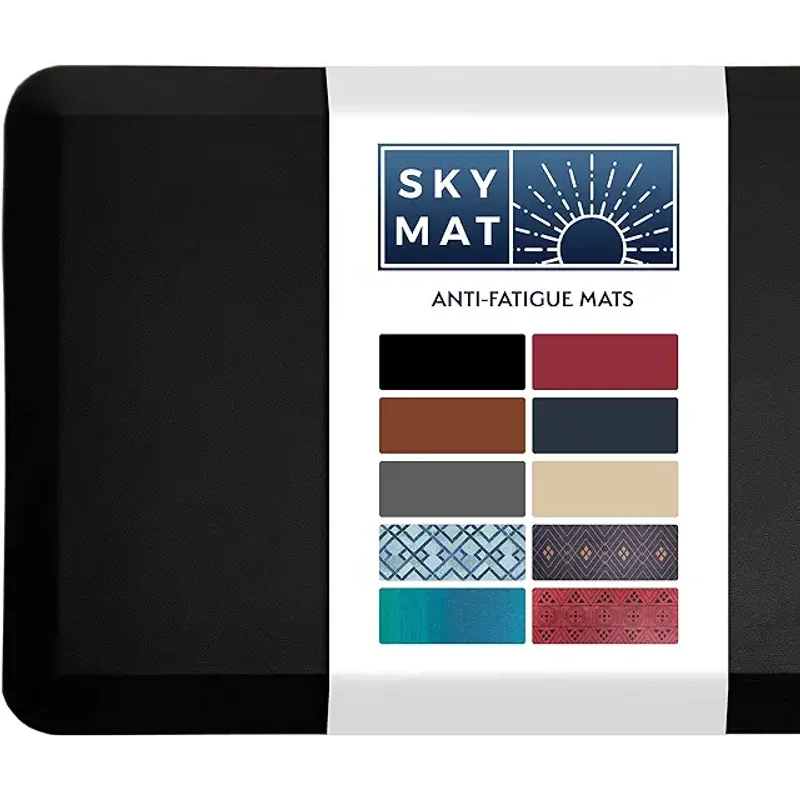
The Sky Solutions mat is the best-selling anti-fatigue mat on Amazon, and it’s easy to see why. Under $40, available in multiple sizes (20×32”, 20×39”, 24×70”), lifetime replacement guarantee. For light-to-moderate standing, it does what you need it to do.
The diamond-top surface resists stains and cleans easily. Beveled edges keep it flat against the floor. It’s not going to change your life, but it’s going to make 2–4 hours of daily standing noticeably more comfortable than standing on bare floor.
The material is high-density PU foam, which will break down faster than the polyurethane in premium mats. Expect 2–3 years of solid use before it starts compressing. At this price, replacing it every couple of years is still cheaper than buying one Topo.
Who should buy this: Home office workers who stand 2–4 hours daily, anyone who needs multiple mats for different locations (kitchen, garage, laundry room), or people testing whether they’ll actually use a standing desk before investing in a premium mat.
Who should skip this: All-day standers. At 0.75 inches with budget foam, this mat will bottom out during extended use. If your feet hurt after 4 hours on this mat, it’s not broken — you’ve outgrown it.
FluidStance Level
FluidStance Level
Pros
- ✓ 360-degree range of motion
- ✓ NEAT-certified by Mayo Clinic
- ✓ Made in USA with lifetime warranty
- ✓ Engages core and improves posture
Cons
- ✗ $250+ price tag
- ✗ 2-4 week learning curve
- ✗ Not a mat — won't cushion your feet
Price: $249–289 | Thickness: 2.5” | Dimensions: 26.5” × 12.2” | Weight: 7.75 lbs
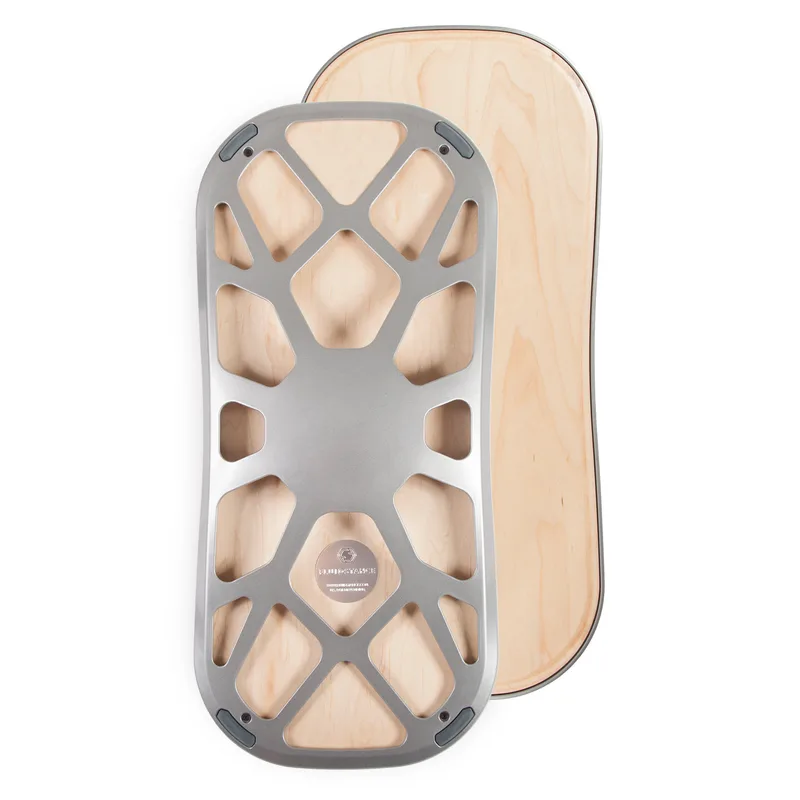
Let’s be clear: the FluidStance Level is not an anti-fatigue mat. It’s a balance board. You stand on it, it tilts 360 degrees, and your core muscles fire constantly to keep you upright. It’s the only product here that’s NEAT-certified by the Mayo Clinic (Non-Exercise Activity Thermogenesis), meaning it measurably increases calorie burn.
The die-cast aluminum base is military-grade with a GREENGUARD-certified powder-coat finish. Deck options include natural birch, bamboo, maple, or padded foam. It’s made in the USA and comes with a lifetime warranty. The build quality is unquestionable.
But it’s a fundamentally different tool. You’re not standing on cushioning — you’re standing on a platform that moves. This engages your core and improves posture, but it doesn’t cushion your feet the way a foam mat does. Some users pair it with a flat mat underneath.
Who should buy this: Fitness-minded professionals who want active standing, not passive comfort. People with good balance who’ve gotten bored with regular mats. Users who prioritize calorie burn and core engagement over foot cushioning.
Who should skip this: Anyone with balance issues, people who do detail-oriented work requiring total stillness, or those who just want their feet to stop hurting. This is a specialized tool, not a general-purpose anti-fatigue solution. The 2–4 week learning curve is real.
Comparison Table
| Feature | Topo by Ergodriven | CumulusPRO Commercial | Vari ActiveMat | Sky Solutions | FluidStance Level |
|---|---|---|---|---|---|
| Price | $99–119 | $66–78 | $79–99 | $30–40 | $249–289 |
| Thickness | 2.7” | 0.75” | 3.75” (peak) | 0.75” | 2.5” |
| Dimensions | 26.2” × 29” | 24” × 36” | 27” × 20” | 20” × 39” | 26.5” × 12.2” |
| Material | Polyurethane | Polyurethane + leather | Polyurethane | PU foam | Aluminum + wood |
| Weight | 6.4 lbs | 6.5 lbs | 4.32 lbs | ~2.8 lbs | 7.75 lbs |
| Terrain | 7 zones | Flat | 3 zones | Flat | 360° tilt |
| Warranty | 7 years | Lifetime | 1 year | Lifetime | Lifetime |
| Best For | All-day standing | Professional offices | Mid-range terrain | Budget / light use | Active fitness |
| Rating | 4.3 ★ | 4.9 ★ | 4.4 ★ | 4.3 ★ | 4.5 ★ |
What to Look for in an Anti-Fatigue Mat
Material Matters More Than Thickness
A 0.75-inch polyurethane mat will outlast a 1.5-inch PVC foam mat every time. The material determines how long the mat maintains its cushioning properties. Here’s the hierarchy:
- Polyurethane (best): Medical-grade, antimicrobial, resists compression. Found in the Topo and CumulusPRO. Expect 5–7+ years.
- Memory foam: Feels luxurious initially but compresses under sustained weight. Good for 2–3 years.
- PU/PVC foam (budget): Adequate for light use, breaks down faster. Replace every 1–2 years with heavy use.
- Natural rubber: Eco-friendly, good grip, but may have initial odor. 3–5 years.
Terrain vs. Flat
Terrain mats (Topo, Vari ActiveMat) encourage micro-movements that keep muscles engaged and blood circulating. Flat mats provide uniform cushioning but don’t prompt position changes. If you stand more than 4 hours daily, terrain mats make a measurable difference in fatigue reduction.
Size It Right
Measure your standing zone, not your entire desk width. Most people shift weight across about 24–30 inches of lateral space. Common sizing:
- Small desk (48”): 20” × 30” max to avoid overhang
- Standard desk (60”): 24” × 36” is the sweet spot
- Large workstation (72”+): Consider 30” × 48” or two mats
Thickness Guidelines
- 0.5–0.75”: Light use, 2–4 hours. Fine for occasional standers.
- 1–1.5”: Moderate use, 4–6 hours. The sweet spot for most office workers.
- 2–3”: Heavy use, 6+ hours. Worth the desk clearance trade-off.
Edge Design
Beveled edges prevent tripping and curling. This matters more than you’d think, especially in shared offices or if you roll a chair over the mat edge regularly. Both the CumulusPRO and Sky Solutions have beveled edges; the Topo’s contoured shape handles this differently.
Frequently Asked Questions
How long does it take to break in an anti-fatigue mat?
Flat mats feel comfortable immediately. Terrain mats like the Topo need 2–3 weeks as your foot and calf muscles adapt to the varied surface. Your calves may feel sore during the first week — that’s normal. It’s similar to switching from cushioned running shoes to minimal footwear.
Can I use an anti-fatigue mat with shoes on?
Yes, and most are designed for shoed use. The Topo works well with flat shoes and sneakers but not with stiletto heels (the narrow heel sinks into the terrain). The CumulusPRO works with all shoe types. For barefoot use, softer mats like the Vari ActiveMat are more comfortable than firm options like the CumulusPRO.
How do I clean an anti-fatigue mat?
Most mats wipe down with a damp cloth or standard household cleaner. The CumulusPRO’s synthetic leather surface is the easiest to clean — just wipe and go. Polyurethane mats like the Topo can be cleaned with mild soap and water. Avoid harsh chemicals on any mat, and never put them in a washing machine.
Should I get a mat or a balance board?
Different tools for different goals. A mat reduces fatigue and cushions your feet — it’s passive comfort. A balance board (like the FluidStance Level) actively engages your core and burns calories — it’s a fitness tool. Most people want a mat. Athletes and fitness enthusiasts might prefer the board. Some users buy both and alternate.
Do anti-fatigue mats work on carpet?
They work, but less effectively. Carpet already provides some cushioning, so the mat’s impact is reduced. On hard floors (hardwood, tile, concrete), the difference is dramatic. If your office has thin commercial carpet, a mat still helps. On thick residential carpet, you may not notice much improvement.
How often should I replace my anti-fatigue mat?
When it stops bouncing back. Press your thumb into the mat — if the indentation stays for more than a few seconds, the foam is compressed and you’ve lost most of the anti-fatigue benefit. Budget mats last 1–2 years with daily use. Premium polyurethane mats (Topo, CumulusPRO) last 5–7+ years. The warranty length is usually a good indicator of expected lifespan.
The Bottom Line
For most standing desk users, the Topo by Ergodriven is the mat to buy. The terrain design genuinely reduces fatigue in a way flat mats cannot, the build quality is excellent, and the 7-year warranty means you’re buying one mat instead of three budget replacements.
For professional offices where appearance matters, the CumulusPRO Commercial Couture looks the part with its synthetic leather top and beveled edges. Its 4.9 Amazon rating and lifetime guarantee back up the polish.
On a budget? The Sky Solutions mat under $40 is genuinely good for light-to-moderate standing. It won’t last forever, but at that price, it doesn’t need to.
Want terrain without the Topo price? The Vari ActiveMat brings terrain features to a mid-range budget, though the smaller footprint and shorter warranty are real trade-offs.
For active standing enthusiasts, the FluidStance Level is a different animal entirely — a balance board that engages your core and burns calories. It’s not a mat replacement, but it’s worth considering if fitness is your priority.
Pair your mat with a solid standing desk setup and consider desk accessories for remote work to round out your workspace ergonomics. A footrest complements an anti-fatigue mat by giving you an active position change — the mat cushions both feet while the footrest lets you shift weight and flex your hips throughout the day. If you’re also deciding which standing desk to buy, our best standing desks roundup covers every budget.