Disclosure: PostureRanked is reader-supported. When you buy through links on our site, we may earn an affiliate commission at no extra cost to you. Learn more
Standing desks took over home offices — but most people are using them wrong. The mistake isn’t usually not standing enough. It’s standing too much, too soon, or standing static for 90 minutes straight like a museum exhibit. Late 2025 ergonomics research confirmed what occupational health experts have argued for years: the ratio of sitting to standing matters more than raw standing time, and there’s a measurable sweet spot that boosts productivity without wrecking your legs. This guide covers the science, gives you a practical schedule, and explains which anti-fatigue mats and balance boards make sustained standing actually comfortable.
Quick pick: The Ergodriven Topo Comfort Mat is the single best addition to any standing desk setup. At $129, it’s the accessory that makes the habit stick.
Quick Comparison
| Product | Type | Price | Rating | Best For |
|---|---|---|---|---|
| Ergodriven Topo Comfort Mat | Anti-fatigue mat | $129 | 9.3/10 | Most standing desk users |
| ComfiLife Anti-Fatigue Floor Mat | Anti-fatigue mat | $30 | 8.8/10 | Value-focused buyers |
| FEATOL Extra Thick Mat | Anti-fatigue mat | $44 | 8.3/10 | Budget-conscious starters |
| FluidStance Plane Balance Board | Balance board | $199 | 8.8/10 | Active standers, focus seekers |
| FEZIBO Standing Desk Balance Board | Balance board | $65 | 8.0/10 | Budget active standing |
The Science: How Long Should You Actually Stand?
The 20-8-2 Rule
Cornell ergonomics professor Alan Hedge developed the 20-8-2 protocol based on research into musculoskeletal load and sustained productivity:
- 20 minutes sitting
- 8 minutes standing
- 2 minutes of light movement (walking, stretching, calf raises)
Repeat this cycle throughout the day. The math works out to 30–40% of total work time standing — roughly 2.5 to 3.5 hours across an 8-hour day. This isn’t a maximum. It’s the evidence-backed ideal range.
The 30:15 Ratio (Newer Research)
More recent ergonomics research supports a slightly different cadence: 30 minutes of sitting followed by 15 minutes of standing. This prescribed ratio improved focus, reduced musculoskeletal stress, and supported sustainable movement patterns in office worker studies. The underlying principle matches 20-8-2 — regular alternation matters more than exact minute counts.
Why Too Much Standing Is Also a Problem
Standing still for extended periods creates its own issues:
- Lower back compression from locking knees and hips in one position
- Leg and foot fatigue that leads to poor posture compensations (leaning, shifting weight to one side)
- Varicose vein risk from reduced circulation in the legs
- Cognitive fatigue — static standing consumes slightly more mental energy than sitting
The goal is movement, not stationary standing. Which is exactly why floor accessories matter so much.
Why Your Floor Setup Determines How Long You Can Stand
The single biggest predictor of whether someone keeps using a standing desk is whether they have an anti-fatigue mat. Without cushioning, standing on hard floors for 30-minute intervals creates enough discomfort that most people just sit back down permanently. Research by the Canadian Centre for Occupational Health and Safety found that anti-fatigue mats meaningfully reduce lower limb fatigue and discomfort compared to bare floors.
Balance boards go a step further. Instead of cushioning your feet in place, they introduce gentle multi-directional motion — your legs and core engage constantly to maintain balance, which actually reduces fatigue better than static standing on a mat.
Most committed standing desk users end up with at least one of each. But start with a mat. Get comfortable standing for 20-30 minute intervals first. Then add a board.
For a full comparison, see our guides on the best anti-fatigue mats for standing desks and the best balance boards for standing desks.
The 5 Best Products for Sustainable Standing
Ergodriven Topo Comfort Mat
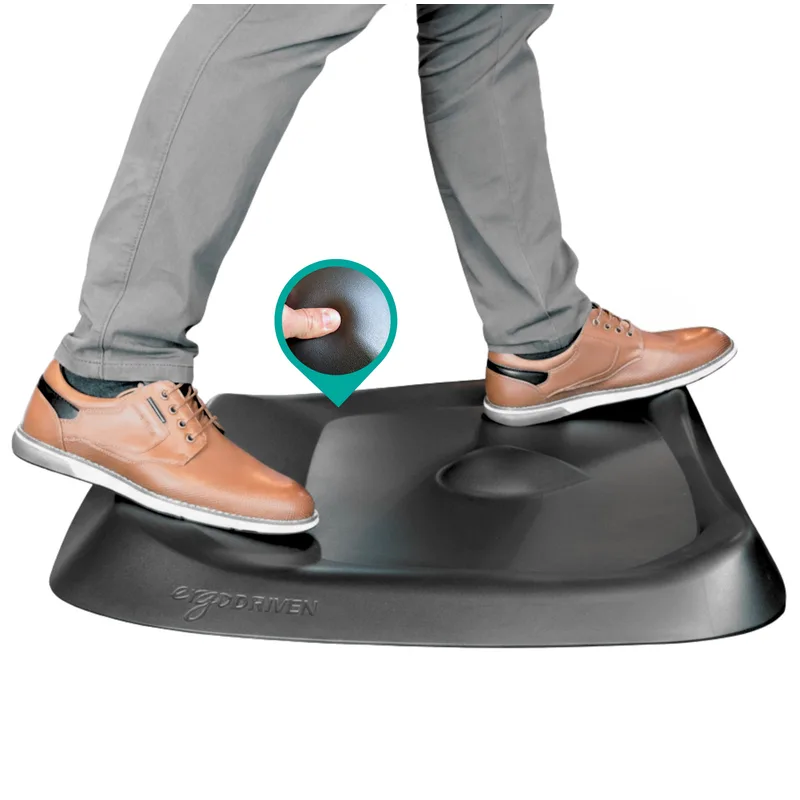
Ergodriven Topo Comfort Mat
Pros
- ✓ Contoured terrain encourages natural foot movement and micro-posture shifts
- ✓ PFA-free polyurethane holds its shape over years of daily use
- ✓ Large enough for most standing stances without feeling cramped
- ✓ Available in multiple colorways to match any desk setup
Cons
- ✗ At $129, it's the most expensive mat in this guide
- ✗ Terrain ridges feel unusual to some users who prefer a flat surface
- ✗ Heavier than flat mats at 8 lbs — less convenient to move frequently
$129 | Buy on Amazon
The Topo is the mat that ergonomics professionals consistently recommend — and owner reviews back it up. Its contoured terrain surface has ridges and raised sections that encourage subtle foot movement even when you’re standing still. You naturally shift weight, stretch your calves, and change foot position every few minutes without thinking about it. That constant low-level movement is exactly what separates comfortable long-term standing from the static fatigue that makes people abandon their desk heights.
The 100% polyurethane foam construction is PFA-free and holds its shape over years of daily use. Long-term owner reports consistently note the mat still feels firm and supportive after two or three years, unlike cheaper foam that pancakes within months. At 8 lbs, it stays in place on hard floors without additional grippers.
The main downside is cost. At $129, it’s significantly more than competing flat mats. But if you plan to stand 2-3 hours per day for years, this is the investment that makes the habit sustainable.
Best for: Anyone committed to regular standing desk use who wants the best flat mat available.
ComfiLife Anti-Fatigue Floor Mat
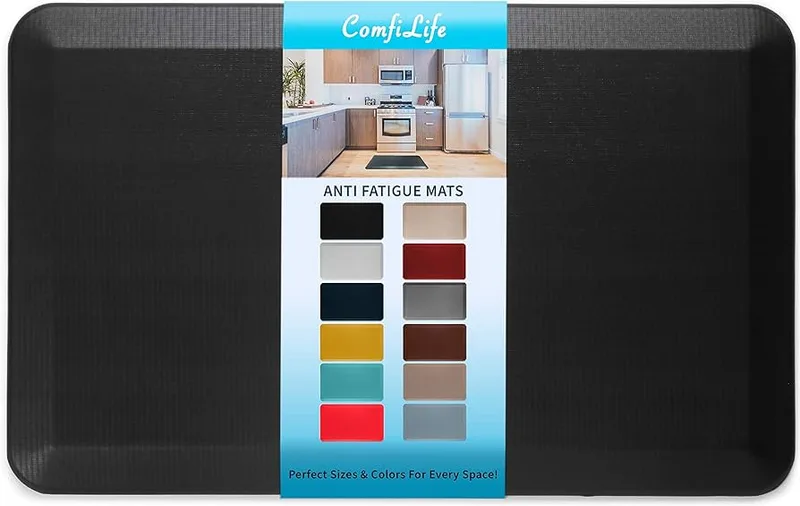
ComfiLife Anti-Fatigue Floor Mat
Pros
- ✓ Best price-to-quality ratio in this category at $30
- ✓ High-density memory foam provides genuine cushioning for multi-hour standing
- ✓ Non-PVC surface is durable and wipes clean easily
- ✓ Beveled edges eliminate tripping at the mat border
Cons
- ✗ Flat surface doesn't encourage foot movement the way contoured mats do
- ✗ Memory foam may compress slightly with heavy daily use after 12+ months
- ✗ Standard 20×32 size feels tight for wide-stance standers
$30 | Buy on Amazon
The ComfiLife hits the sweet spot between budget and performance. High-density memory foam compresses enough to cushion your feet but rebounds to stay supportive through a full workday. At $30, it’s a fraction of the cost of the Ergodriven at $129 — and for most people who stand 1-2 hours per day, the performance gap doesn’t justify the higher price.
The non-PVC coating holds up to spills and cleans with a damp cloth. Beveled edges eliminate tripping at the border, which matters when you’re stepping on and off the mat dozens of times daily. The flat surface is the one place it loses to the Topo — there’s no terrain to encourage foot movement, so you get cushioning without the active engagement.
Available in 20×32, 20×39, and 24×70 — the wider 24×70 is useful for L-shaped desk setups or standing treadmill stations.
Best for: Buyers who stand 1-2 hours per day and want genuine comfort without spending over $50.
FEATOL Extra Thick Anti-Fatigue Mat
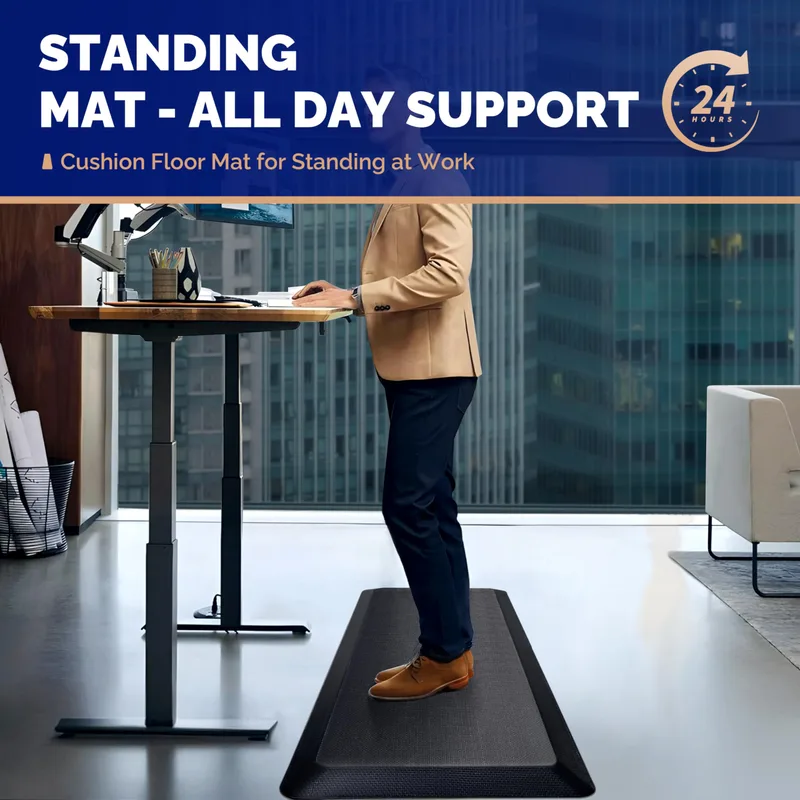
FEATOL Extra Thick Anti-Fatigue Mat
Pros
- ✓ Under $45 makes it the most accessible entry point in this guide
- ✓ 0.9-inch thickness delivers real cushioning at this price point
- ✓ PU leather surface wipes clean with a damp cloth
- ✓ Compact footprint works in tight desk setups
Cons
- ✗ Thinner than premium options — won't match Topo or ComfiLife for all-day comfort
- ✗ PU foam shows compression marks sooner than denser materials
- ✗ Limited size selection compared to premium alternatives
$44 | Buy on Amazon
The entry-level option that actually delivers. At $44 with 0.9-inch thickness, the FEATOL outperforms similarly priced mats that cut corners on foam density. The PU leather surface wipes clean easily, beveled edges prevent tripping, and the non-slip bottom keeps the mat anchored.
It won’t match the ComfiLife or Topo for extended standing sessions — the foam compresses faster under heavy daily use. But as a starter mat, or for a secondary workstation, it does exactly what needs doing at a price that removes every barrier to trying it.
Best for: Standing desk beginners and anyone not yet sure they want to invest more than $50.
FluidStance Plane Balance Board
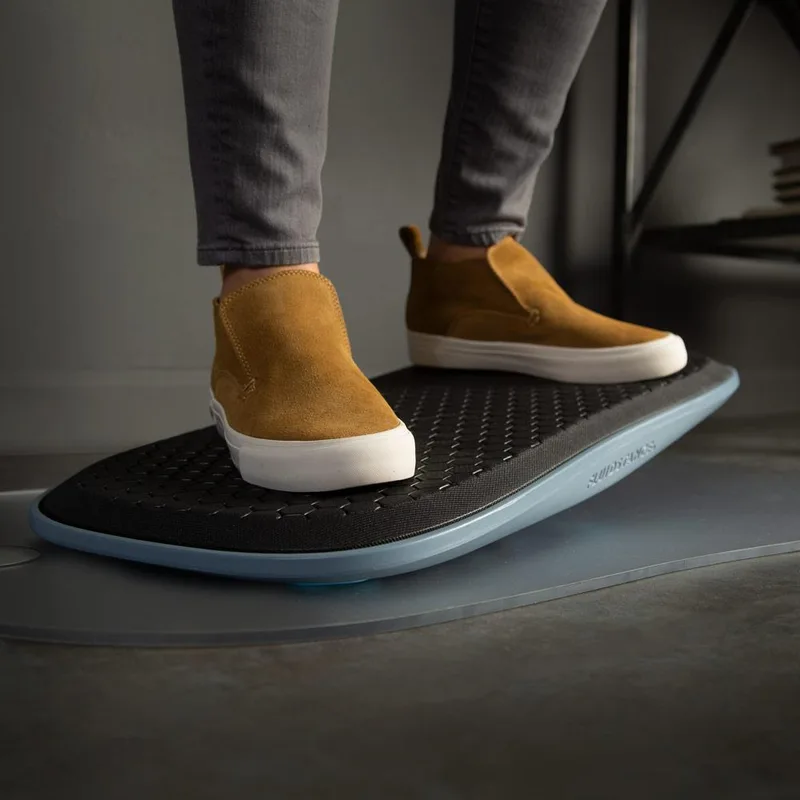
FluidStance Plane Balance Board
Pros
- ✓ 360-degree motion engages core and leg muscles constantly during standing
- ✓ Built from recycled materials — a genuine sustainability win in desk accessories
- ✓ Anti-slip recycled tire tread surface provides secure grip in socks or barefoot
- ✓ Low 2.5-inch profile minimizes required monitor height adjustment
Cons
- ✗ At $199, it's a significant investment compared to flat mats
- ✗ 250 lb weight limit is lower than some competitors
- ✗ Requires a 2-3 week adjustment period — start with short intervals
$199 | Buy on Amazon
Balance boards represent the next level of active standing. The FluidStance Plane has 360-degree motion — you can sway forward, backward, and side-to-side without instability. Your legs and core engage constantly to maintain balance, which reduces fatigue in a way a flat mat cannot replicate. FluidStance’s own research indicates this kind of active standing increases caloric burn and can improve sustained focus compared to static standing.
At 2.5 inches high, it won’t throw your monitor height off dramatically — you’ll raise your desk 2-3 inches from your seated position. The anti-slip recycled tire tread surface handles socks and barefoot equally well. Made from recycled materials, which is a genuine rarity in this category.
The learning curve is real. New users should start with 10-15 minute intervals and build up over two to three weeks. Using a balance board while on a critical deadline call is not recommended until you’re fully comfortable.
Best for: Experienced standing desk users who want active movement, or anyone who struggles to stay focused while standing.
FEZIBO Standing Desk Balance Board
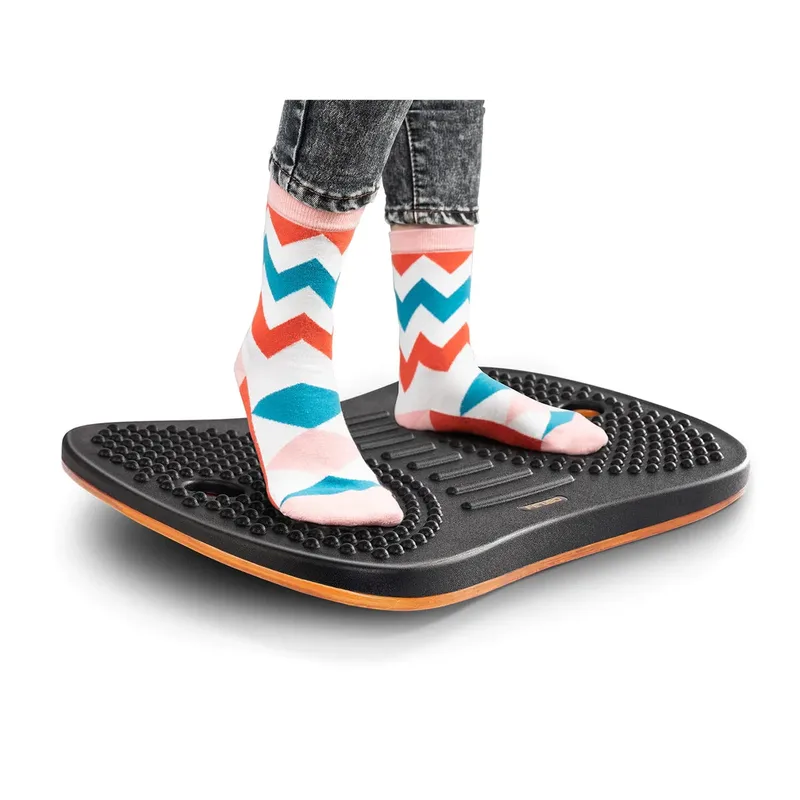
FEZIBO Standing Desk Balance Board
Pros
- ✓ At $65, delivers balance board engagement at a fraction of premium balance board pricing
- ✓ 8.5-degree tilt drives constant micro-adjustments that reduce leg fatigue
- ✓ 320 lb capacity handles virtually any user size
- ✓ Compact footprint slides under the desk easily when sitting
Cons
- ✗ Small 20×14 surface feels cramped for wide-stance users or larger feet
- ✗ Works best on hard floors — may slide on thick carpet
- ✗ More physically demanding than a flat mat — not ideal for beginners
$65 | Buy on Amazon
The FEZIBO brings balance board mechanics to a budget-friendly price point. The 8.5-degree tilt range provides front-to-back and side-to-side rocking that keeps your legs engaged throughout standing intervals. The 320 lb weight capacity is among the highest available at this price point.
The limitation is size. The 20×14 footprint is compact enough to stow under your desk, but can feel cramped for wide stances or larger feet. It also performs better on hard floors — on thick carpet, the curved base can slide slightly. Use this as a complement to a regular anti-fatigue mat: stand on the mat for longer intervals, switch to the board for 20-30 minute active sessions.
Best for: Budget-conscious buyers who want balance board engagement without the FluidStance price tag.
How to Build a Sustainable Standing Schedule
Weeks 1–2: Build the habit
Start with 10-15 minutes of standing per hour. Set a timer. When it goes off, stand for your interval, then sit. The goal is consistency, not duration. Your legs are not used to this. They will feel it at first.
Weeks 3–4: Extend intervals
Push standing intervals to 20-25 minutes. This is where the 20-8-2 rule starts to feel natural. The initial fatigue from Week 1 should be mostly gone. Your posture will also improve as your stabilizer muscles adapt.
Month 2 and beyond: Add movement
Start incorporating the 2-minute movement break in the 20-8-2 cycle — a short walk, calf raises, or a stretch. If you have a balance board, this is when to introduce it: one 15-minute board session per day to start. Build up from there.
Warning signs to reduce standing time
- Lower back pain that worsens during standing intervals — usually means your desk height is wrong or you need a mat. See our guide on how to set up a standing desk properly.
- Heel or foot pain after standing sessions — reduce intervals and get a mat before pushing further
- Varicose vein discomfort — cut static standing time and add more movement breaks
Buying Guide: Mat vs Balance Board
Get a mat first. It’s cheaper, requires zero adjustment period, and provides immediate comfort improvement. The Topo at $129 or the ComfiLife at $30 are the right starting points for 90% of people.
Add a balance board after 2-3 months if you’re standing comfortably for 30-minute intervals and want more active engagement. The FluidStance Plane Balance Board or FEZIBO are the two natural next steps.
Key specs to evaluate
| Spec | Why It Matters |
|---|---|
| Foam density | Higher density = longer lifespan and consistent support |
| Surface texture | Contoured surfaces encourage movement; flat surfaces cushion |
| Size | Should match your natural standing stance width |
| Non-slip base | Critical on hard floors to prevent shifting |
| Tilt range (boards) | 8–12 degrees is the practical usable range |
For desk selection itself, see our best standing desks guide for 2026. And if you’re evaluating whether a standing desk is worth it at all, the standing desk health benefits guide covers the research in full.
FAQ
How long should you stand at a standing desk per day?
Target 2-3 hours of total standing across an 8-hour workday, broken into intervals. The 20-8-2 rule (20 minutes sitting, 8 standing, 2 moving) gives you roughly 2.5 hours of standing with regular movement breaks built in. Don’t try to hit 4+ hours per day until you’ve been at it for several weeks.
Is it bad to stand at a standing desk all day?
Yes. Standing all day creates its own problems: varicose vein risk, lower back compression from locked hips and knees, leg fatigue, and cognitive overload. The research consistently shows that alternating between sitting, standing, and moving is healthier than any one static position held all day.
Do you need an anti-fatigue mat with a standing desk?
Not technically required, but practically essential for daily use. Without a mat, standing on hard floors for 30-minute intervals creates enough discomfort that most people stop using their standing desk within weeks. A mat is the cheapest, highest-impact accessory for any standing desk setup.
Are balance boards better than anti-fatigue mats?
Neither is strictly better — they serve different purposes. Mats cushion your feet for comfortable static standing. Balance boards add active movement to reduce fatigue and engage muscles. Most serious standing desk users end up with both. Start with a mat and add a board after you’ve built the standing habit.
Can a standing desk help with back pain?
It can, when used correctly. Research shows reduced upper and lower back pain when users alternate sitting and standing versus sitting all day. But standing with poor posture or for too long can make back pain worse. Start with short intervals, get your desk height right first, and use an anti-fatigue mat.
What is the 20-8-2 rule?
A protocol developed by Cornell ergonomics professor Alan Hedge: sit for 20 minutes, stand for 8, move for 2 — then repeat. The 2-minute movement break is as important as the sitting-to-standing ratio. This cycle reduces musculoskeletal fatigue, improves circulation, and is more sustainable than arbitrary standing targets.
The Bottom Line
Standing 2-3 hours per day in regular intervals beats both all-day sitting and all-day standing. The 20-8-2 rule gives you a practical framework to follow. The real question is whether you’ll stick with it — and that comes down almost entirely to whether standing is comfortable enough to keep doing.
For most people:
- Start with the Ergodriven Topo Comfort Mat at $129 — the mat that consistently gets long-term users to keep standing
- On a budget, the ComfiLife Anti-Fatigue Mat at $30 delivers most of the comfort at a fraction of the price
- Once standing comfortably for 30-minute intervals, the FluidStance Plane Balance Board adds active engagement that makes longer sessions feel easier
Still shopping for a desk? Our best standing desks roundup for 2026 covers every major option from budget frames to premium motorized setups.