Two of the most talked-about premium ergonomic chairs in 2026 take completely opposite approaches to the same problem: how do you build a chair that supports you without requiring constant manual fiddling?
The Herman Miller Embody gives you precise manual controls — BackFit lumbar, seat depth locking, 4D arms — and a pixelated support system that adapts to pressure across your entire back. The Humanscale Freedom takes the opposite route: strip out most of the knobs, rely on physics and weight-sensitive mechanics to do the work automatically, and add a headrest that actually moves with you as you recline.
Both chairs are self-adjusting in their own way. Both are expensive. The right choice depends entirely on how you work and what your body needs.
If you want the short answer: the Embody is the better pick for lean-forward desk workers who want precise lumbar control and don’t need a headrest. The Freedom wins for recliners, larger-framed users, and people who want a truly zero-fuss setup.
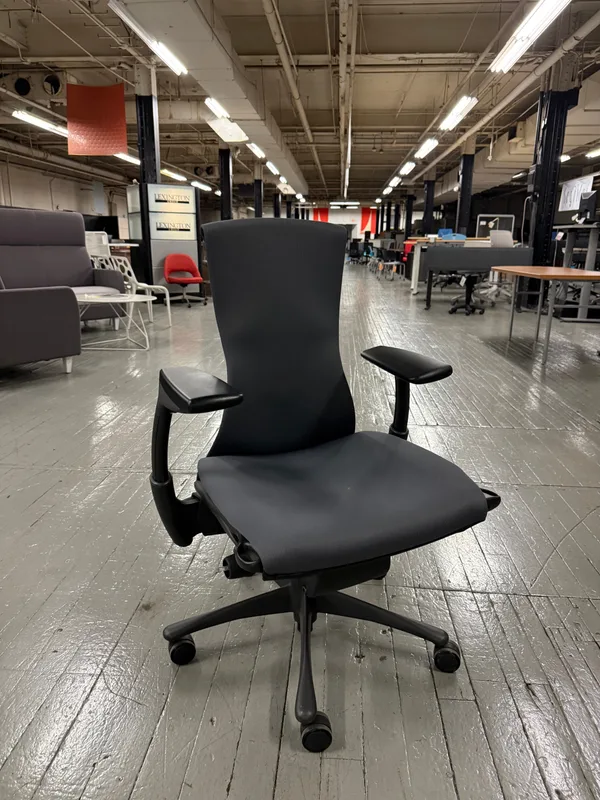
Herman Miller Embody Chair
Herman Miller Embody Chair
Pros
- ✓ Pixelated Support system distributes pressure across hundreds of individual cells — no hard points on long sits
- ✓ BackFit lumbar adjustment lets you align the backrest precisely to your spine's natural curve
- ✓ Supports forward lean, upright, and reclined postures equally — it moves with you rather than locking you in
- ✓ 12-year warranty covering 24/7 use with no excluded parts — best coverage-to-price ratio in premium seating
Cons
- ✗ At $2,095, it's a significant financial commitment — the most expensive option in this comparison
- ✗ No headrest on the standard model — tall users or frequent recliners will want to add one at extra cost
- ✗ Concave backrest geometry can push shoulders slightly forward, which bothers some users with tight chest muscles
The Embody launched in 2008 and has been continuously updated. Its defining feature is the Pixelated Support system — a matrix of individual cells across the back that flex independently to match your spine’s shape and movement. Unlike a standard mesh back, which applies even pressure across a flat surface, the Embody’s back contours to you in three dimensions.
The BackFit adjustment is what separates it from every other premium chair. A dial at the back of the backrest lets you align the lumbar zone to your specific spinal curve — not a generic S-shape, but your S-shape. For people with lower back sensitivity, this alone can justify the price.
It also supports posture change actively. Lean forward to type, sit upright for video calls, recline to read — the Embody tracks each position and maintains support throughout. The recline mechanism keeps constant contact between your back and the chair rather than letting you peel away from the backrest.
The downsides are real. $2,095 is a lot of money. There’s no headrest on the standard model — a notable omission for a chair this expensive. The weight (46 lbs) makes it less portable than competitors. And the concave back geometry, which is designed to wrap around your spine, can push your shoulders forward in a way that bothers some users. If you have tight pecs or anterior shoulder tilt, pay attention to this.
The 12-year warranty covering 24/7 use without component exclusions is genuinely excellent and one of the best in the industry.
Bottom line: Buy the Embody if you spend most of your day leaning toward your screen, have lumbar sensitivity that needs precise dialing-in, and don’t need headrest support.
Humanscale Freedom Chair with Headrest
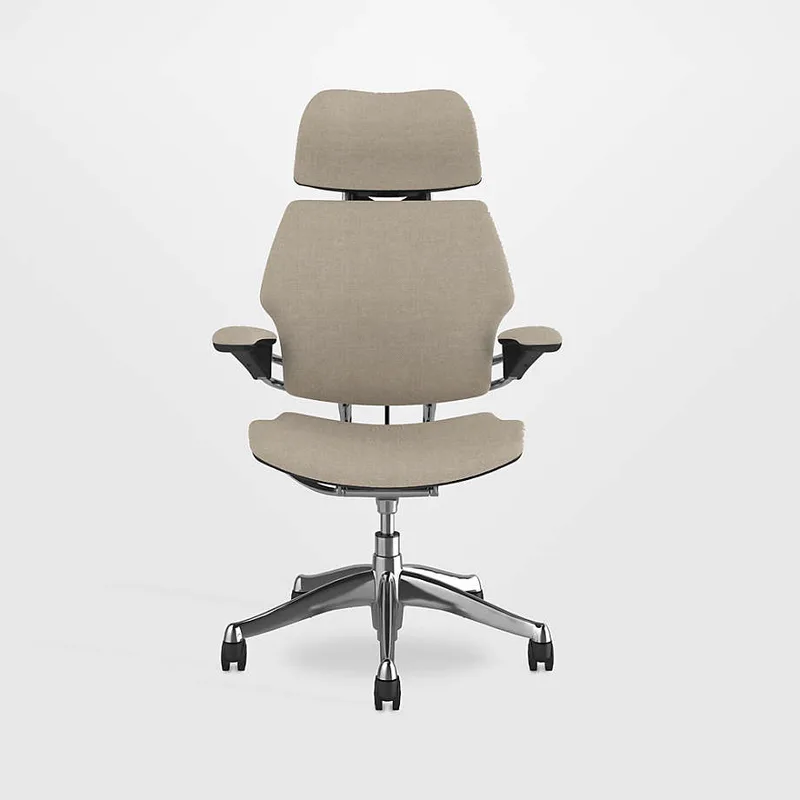
Humanscale Freedom Chair with Headrest
Pros
- ✓ Articulating headrest moves with you as you recline — no manual adjustment needed, which is genuinely rare at any price
- ✓ Passive weight-sensitive recline requires zero setup — the chair adjusts resistance automatically based on your body weight
- ✓ 400 lb weight capacity and 21" seat width accommodate a broader range of body types than the Embody
- ✓ 15-year warranty covering 24/7 use is the longest in the premium chair segment
Cons
- ✗ Fewer manual adjustments than the Embody — if you want precise lumbar dial-in, it's not here
- ✗ Weight-sensitive recline can feel unpredictable until you're used to it — first-time sitters often find it confusing
- ✗ No dedicated lumbar adjustment knob; lumbar support comes solely from the back's automatic flex
The Freedom is built around a single philosophy: the best adjustment is no adjustment. Its weight-sensitive recline doesn’t have a tension knob — it automatically calibrates resistance based on your body weight. Sit down, push back, and the chair responds proportionally. It sounds gimmicky. It isn’t.
The articulating headrest is the Freedom’s most distinctive feature. As you recline, the headrest moves with your head — pivoting to maintain contact without you ever reaching back to reposition it. For people who recline to read, think, or take calls, this is genuinely useful. It’s also the reason many buyers choose the Freedom over the Embody specifically.
The Freedom’s seat is wider (21” vs 18.75”) and accommodates up to 400 lbs, making it more accessible for larger-framed users. The seat depth adjusts with a button-press mechanism rather than the Embody’s locking pin system — slightly more convenient in practice.
Where the Freedom falls short is in manual tunability. There’s no dedicated lumbar knob. Lumbar support comes from the back’s automatic flex, which works well for most people but can feel insufficient if you have specific lower back needs. The passive recline mechanism also takes some getting used to — first-time sitters sometimes feel like the chair is reclining when they don’t want it to.
The 15-year warranty is the longest in the premium segment, beating the Embody by three years.
At $1,634 for the headrest model in a standard fabric configuration, it’s actually $461 less than the Embody — though high-end leather and polished aluminum configurations can push it past $2,000.
Bottom line: Buy the Freedom if you recline regularly, need headrest support, have a larger frame, or want a set-it-and-forget-it ergonomic experience.
Head-to-Head: Key Differences
| Category | Herman Miller Embody | Humanscale Freedom |
|---|---|---|
| Price | $2,095 | $1,634 |
| Lumbar support | BackFit dial (manual) | Passive auto-flex |
| Headrest | Not standard | Articulating, included |
| Recline | Constant-contact active | Weight-sensitive passive |
| Weight capacity | 300 lbs | 400 lbs |
| Seat width | 18.75” | 21” |
| Chair weight | 46 lbs | 38 lbs |
| Warranty | 12 years, 24/7 | 15 years, 24/7 |
| Made in | USA | USA |
| Best for | Forward-leaning typists | Recliners, larger frames |
Lumbar Approach
This is the biggest functional difference between the two chairs.
The Embody gives you a physical dial. You can align the lumbar zone to your exact spinal curve, then leave it. If your back changes — if you’re recovering from a flare-up, if you lose or gain weight — you can readjust. For people who know what lumbar support they need, this manual precision is valuable.
The Freedom gives you nothing to adjust, which is either a feature or a bug depending on your perspective. Humanscale’s argument is that the back should move with your spine rather than being set to a fixed position. In practice, the Freedom’s back does flex well and provides solid mid-lumbar support for most body types. But if you have specific lower back pathology or need to target a precise zone, you’ll miss the Embody’s dial.
Headrest Comparison
The Embody has no headrest at standard. You can add a third-party headrest, but it’s an afterthought — nothing designed specifically for the Embody’s backrest angle.
The Freedom’s headrest is integral to the design. It articulates as you recline, which is a meaningfully different experience from a static headrest that you ram your head into when you lean back. Long-session recliners will notice the difference immediately.
Who Should Buy the Embody
- You spend most of the day typing or focused work (lean-forward posture)
- You have lower back sensitivity and want precise lumbar control
- You run warm and want the most breathable back possible
- Sustainable manufacturing matters to you (USA-made, high recycled content)
- You don’t recline much and rarely need head support
Who Should Buy the Freedom
- You recline regularly for reading, calls, or thinking
- You need or want a headrest without buying one separately
- You have a larger frame (over 200 lbs or prefer a wider seat)
- You want zero knobs and a truly passive ergonomic experience
- You want the longer warranty (15 vs 12 years)
Buying Guide: What to Know Before Spending $1,600+
Try before you buy if possible. Both chairs are sold through authorized dealers who typically have floor models. An hour-long sit tells you more than any spec sheet. Herman Miller’s 30-day return window (through their direct store) is worth using if you’re on the fence.
Configuration matters. The Freedom’s base price of $1,634 is for a standard fabric, graphite frame. Polished aluminum frame and leather upholstery push the price significantly higher. The Embody’s $2,095 covers all standard fabric options — there’s less configuration variance at the entry level.
Budget for the long haul. At 12 and 15 years of warranty coverage respectively, both chairs are designed to outlast three or four budget chairs. The math on per-year cost favors premium chairs when you account for replacement cycles.
Check refurbished options. Both chairs have active refurbished markets. Certified refurbished Embody chairs can be found in the $900–$1,300 range. Refurbished Freedom chairs with headrest typically run $700–$1,100. At those prices, the calculus changes dramatically.
Consider the Humanscale Freedom for the ecosystem. If you’re building out a Humanscale setup — Float keyboard tray, M8.1 monitor arm — the Freedom fits visually and mechanically into that ecosystem in a way the Embody doesn’t.
For more context on whether spending this much on a chair is justified at all, see our guide: Are Expensive Office Chairs Worth It?
Both chairs appear in our Best Luxury Office Chairs roundup alongside the Steelcase Leap and Gesture.
FAQ
Which chair is more adjustable, the Embody or the Freedom?
The Embody has more manual adjustments: BackFit lumbar dial, 6-position seat depth locking, and 4D arm adjustment. The Freedom intentionally limits manual controls in favor of passive, weight-sensitive adjustment. If you want to dial in precise settings, the Embody wins. If you want the chair to adjust itself, the Freedom wins.
Does the Herman Miller Embody come with a headrest?
No. The standard Embody does not include a headrest. Humanscale’s Freedom includes an articulating headrest as part of the base design. If headrest support is important to you, the Freedom is the more natural choice without modification.
Which chair is better for tall users?
The Freedom accommodates users up to 6’6” with its taller back height range (up to 41.775” from seat to top of headrest). The Embody can work for tall users but the seat height tops out at 20.25” and the standard back may feel short for users over 6’3”. For users over 6’2”, the Freedom with headrest is generally the better fit.
Can I get a refurbished version of either chair?
Yes. Both chairs have active certified refurbished markets through authorized dealers and third-party refurbishers. Refurbished Embody chairs typically run $900–$1,300 depending on condition and configuration. Refurbished Freedom chairs with headrest often go for $700–$1,100. Quality varies — look for chairs with remaining warranty or a dealer warranty of at least one year.
Which warranty is better, Herman Miller or Humanscale?
Both warranties cover 24/7 use. Humanscale’s 15-year warranty is three years longer than Herman Miller’s 12-year warranty. In practice, both warranties are so long that you’re unlikely to push the limits in a typical work-from-home use case. Herman Miller’s warranty service is generally considered easier to navigate domestically.
Is the Embody worth paying $461 more than the Freedom?
It depends on your needs. The Embody’s BackFit lumbar dial is a genuine differentiator for back-sensitive users. But for most people who recline, need a headrest, or prefer passive adjustment, the Freedom delivers comparable (or better) real-world ergonomics for less money. If you want a headrest and don’t want to pay extra for it, the Freedom’s base price is actually the better value.
Conclusion
Neither chair is objectively better. They’re built for different working styles.
The Herman Miller Embody is the right chair if you know what you need from lumbar support, lean forward all day, and want manual control over your ergonomic setup. It’s the most precise premium chair at this tier.
The Humanscale Freedom with Headrest wins for recliners, larger users, and anyone who wants a genuinely passive ergonomic experience with a headrest baked in. At $461 less than the Embody in base configuration, it’s also the stronger value for most buyers.
For more on how these chairs stack up in the premium market, see the Herman Miller Embody Review, the Humanscale Freedom Review, and our comparison of Herman Miller’s Aeron and the Humanscale Freedom for another perspective on the self-adjusting vs manual-control debate.
Both chairs are worth the money. The question is which one is worth it for you.