Disclosure: PostureRanked is reader-supported. When you buy through links on our site, we may earn an affiliate commission at no additional cost to you. Our recommendations are based on independent research and testing.
Disclosure: PostureRanked is reader-supported. When you buy through links on our site, we may earn an affiliate commission at no extra cost to you. Learn more
The Herman Miller Embody costs over $2,000. That’s a real number, and it deserves a real answer: is it actually worth it?
After evaluating the Embody extensively — comparing its specs against user feedback from thousands of long-term owners, analyzing its engineering alongside competing chairs at the same price point, and considering the research behind its Pixelated Support system — here’s what I found: for a specific type of person, this is the best chair money can buy. For others, it’s an expensive mistake.
This review will tell you which one you are.
The short version: if you sit 6+ hours a day, tend to lean forward toward your screen, and want a chair that adapts to your micro-movements rather than holding you in a static position, buy the Embody. If you run hot, want a more breathable sit, or are taller than 6’2” with a heavier frame, the Herman Miller Aeron is probably the better call.
Herman Miller Embody Chair
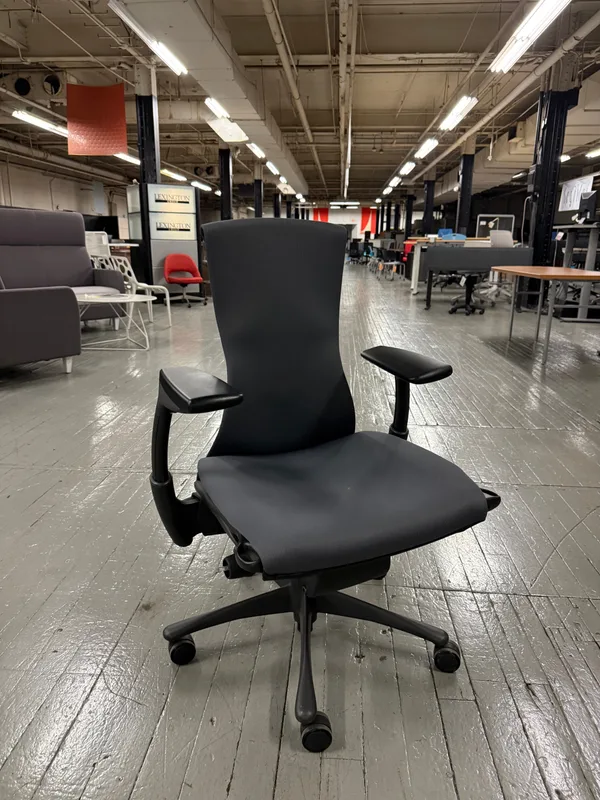
Herman Miller Embody Chair
Pros
- ✓ Pixelated Support system distributes pressure across hundreds of individual cells — eliminates the hard points that most mesh chairs create
- ✓ BackFit adjustment lets you align the backrest to your spine's natural S-curve, which makes a real difference for people with lumbar sensitivity
- ✓ Designed to move with you rather than lock you in — supports forward leaning, upright, and reclined postures equally well
- ✓ 12-year warranty covering 24/7 use up to 300 lbs with no excluded parts is the best coverage in the industry
Cons
- ✗ Starting at $2,095 new, it is genuinely expensive — this is a significant financial commitment
- ✗ Concave back curve can push shoulders slightly forward, which bothers some users with tight chest muscles or anterior shoulder issues
- ✗ No headrest on the standard model — tall users or those who recline often will want to add one (extra cost)
The Embody launched in 2008 as a collaboration between Bill Stumpf (who co-designed the Aeron) and Jeff Weber. Its core premise was different from every other ergonomic chair at the time: instead of building a chair that held your body in a correct posture, design one that responds to your body’s constant micro-movements and supports them all.
The result is a chair that looks unlike anything else in an office.
The Pixelated Support System
The backrest is the Embody’s defining feature and the thing most people either love immediately or find visually alarming. It consists of a narrow central spine with four “ribs” extending to each side. Attached to those ribs are hundreds of small, individual triangular pixels — each one capable of moving independently.
When you lean back, those pixels flex and distribute your weight across a much larger surface area than a standard mesh back. The pressure that would normally concentrate at your shoulder blades, mid-back, and lumbar region gets spread across dozens of contact points instead. For people who develop sore spots from sitting in other chairs, this difference is significant.
The pixels also respond to lateral movement. Twist slightly in your seat, shift your weight to one side, cross your legs — the backrest follows without creating resistance or awkward pressure points. This constant micro-adjustment is what Herman Miller means when they describe the Embody as designed for “computing postures” — the slight forward lean, frequent small movements, and variable sitting positions that characterize desk work.
BackFit Adjustment
Most chairs give you a lumbar support pad you can raise or lower. The Embody gives you a BackFit dial that changes the angle of the entire back panel to match your spine’s S-curve.
This sounds like a minor refinement, but it matters. A lumbar pad pushes against your lower back from a fixed point. The BackFit adjustment changes the relationship between the entire backrest and your spine — rotating the back panel forward or back by roughly 4 degrees in each direction. Correctly set, it creates full contact from your lumbar through your thoracic spine, with the natural inward curve supported rather than just pushed from below.
The trade-off: the concave shape of the back can feel like it’s pulling your shoulders slightly forward when the adjustment isn’t dialed in correctly. Some users — particularly those with tight pectoral muscles or anterior shoulder tilt — find the Embody aggravates this. If you already have forward shoulder posture, spend time with the BackFit adjustment before committing.
Seat and Adjustments
The seat depth adjusts from 15 to 18 inches in six locking positions. That’s a wider range than most chairs and handles frames from petite to tall reasonably well. The seat pan uses a similar pixel-based pressure distribution as the back — firmer than many chairs, which surprises people expecting plush cushioning.
Standard adjustments include:
- Seat height: 14.75” to 20.25”
- Fully adjustable arms (height, width, depth, pivot)
- Tilt limiter with three positions
- Tilt tension adjustment
- Forward tilt option for people who lean toward their work
The arms are 4D adjustable — you can dial them in precisely. The width adjustment mechanism, though, gets consistent criticism: it’s stiffer and less intuitive than the Aeron’s, and several users report it can slip out of position over time.
Build Quality and Longevity
The Embody is made in the USA at Herman Miller’s Holland, Michigan facility. The frame combines custom-molded aluminum and glass-filled nylon — it feels dense and substantial, which partly explains the 46 lb weight.
The 12-year warranty is the best in the industry. It covers everything — mechanism, base, cylinders, foam, fabric — for 24/7 use at up to 300 lbs. Herman Miller doesn’t exclude parts. When other brands offer “12 year limited warranties” with exclusions for “normal wear,” the Embody’s coverage is genuinely comprehensive. For a $2,000+ chair, that’s a meaningful differentiator.
The most common long-term issues are:
- Creaking from the pivot points in the backrest ribs, particularly in cool/dry environments
- Seat fabric wear near the front edges, usually after 3-4 years of heavy use
- Dust accumulation in the backrest pixel structure — it requires a vacuum brush attachment to clean properly
None of these are deal-breakers, but they’re worth knowing.
Who Should Buy the Embody
The Embody excels for:
- Forward-leaning workers — designers, developers, writers, anyone who leans into their screen
- Long-session sitters — 8+ hours at a desk, especially those who develop pressure point soreness in other chairs
- Variable posture sitters — people who shift between leaning forward, sitting upright, and reclining throughout the day
- Those with lower back sensitivity — the BackFit adjustment and distributed support are particularly effective for lumbar issues
The Embody is less ideal for:
- Very tall users (6’3”+) — the seat and back proportions don’t scale as cleanly as the Aeron Size C does
- Hot sleepers/warm office environments — the Aeron’s tensioned mesh is more breathable
- Users who want headrest support — you’ll need to budget for the add-on
- Those with anterior shoulder issues — the concave back curve can exacerbate forward shoulder posture
If you’re deciding whether the premium is justified at all, the are expensive office chairs worth it guide walks through exactly that question with data on long-term value.
Embody vs. Aeron: The Real Comparison
These two chairs occupy the same price range and both carry the Herman Miller name, but they’re built around different philosophies.
| Herman Miller Embody | Herman Miller Aeron | |
|---|---|---|
| Price | ~$2,095 | ~$1,445 (Size B) |
| Back type | Pixelated Support | Tensioned 8Z Pellicle mesh |
| Lumbar | BackFit + distributed support | Adjustable PostureFit SL |
| Breathability | Good | Excellent |
| Sizing | One size | Three sizes (A, B, C) |
| Best for | Forward lean, variable posture | Upright seating, hot environments |
| Headrest | Optional add-on | Optional add-on |
| Warranty | 12 years | 12 years |
The Aeron is the more versatile chair. It sizes to your body, breathes better, and suits a wider range of sitting styles. It’s also about $650 cheaper. For most people, I’d start with the Aeron and see if the Embody’s specific benefits justify the premium.
If you’ve already sat in an Aeron and found it creates pressure points at your shoulder blades or lower back, or you primarily lean forward while working, the Embody is the logical step up.
For a deeper look at how they stack up, see the Herman Miller Aeron vs Steelcase Leap comparison — it gives useful context on where the Embody fits in the premium chair ecosystem.
Comparison Table
| Feature | Details |
|---|---|
| Price | ~$2,095 (standard), up to $2,400+ configured |
| Seat height range | 14.75” – 20.25” |
| Seat depth range | 15” – 18” |
| Weight capacity | 300 lbs |
| Back type | Pixelated Support (independent-pixel backrest) |
| Lumbar support | BackFit adjustment + distributed pressure |
| Armrests | 4D fully adjustable |
| Headrest | Not included, optional add-on |
| Warranty | 12 years, 24/7 use, all parts |
| Made in | USA (Holland, Michigan) |
| Recycled content | 42% recycled materials |
Buying Guide: What to Know Before You Buy
Where to Buy
The Embody is available both on Amazon and direct from Herman Miller’s store. Amazon pricing runs $2,045–$2,095 for standard configurations through authorized sellers. Herman Miller direct offers more configuration options (frame finish, fabric color, base finish) and the same 12-year warranty.
Authorized resellers like BTOD, Relax the Back, and Office Logix Shop also carry the Embody — sometimes with better pricing than direct, especially on standard configurations.
Avoid third-party sellers offering new Embody chairs below $1,200. These are almost always gray market or counterfeit. The warranty transfers only from Herman Miller authorized dealers.
New vs. Refurbished
Herman Miller sells Certified Refurbished Embody chairs at $900–$1,200, typically with a 2-year warranty. These are professionally restored to like-new condition and represent strong value — the mechanism and backrest on a refurbished Embody in good condition perform identically to new.
If buying refurbished from a third party (not Herman Miller directly), verify the seller is authorized and that the chair hasn’t had major structural repairs.
Configuration Recommendations
The standard Black Rhythm fabric is the most popular choice — it’s durable, looks professional, and cleans easily. The Rhythm textile is the baseline configuration that most reviews reference.
If you run warm, consider the standard Rhythm over the foam seat pad of the Logitech G Gaming Edition — the standard is slightly more breathable for long daily sessions.
The Gaming Edition
The Logitech G x Herman Miller Embody Gaming Chair adds a foam layer over the standard seat for a softer initial feel. Two new colorways launched in October 2025 — “Ignite” (dark mineral grey with orange accents) and “Nova” (nightfall navy with purple accents) — though these are cosmetic additions on the same ergonomic platform. The foam layer has been reported to create a rigid sensation through extended sitting. If you’re using this for office work rather than gaming, the standard Embody is the better choice. If gaming is your primary use case, the additional foam and cable routing are worth considering.
For building a complete premium workspace around the Embody, see the luxury home office setup guide for desk, monitor, and accessory pairings that match this chair’s quality level.
FAQ
Is the Herman Miller Embody worth the price?
For people who sit 6+ hours daily and struggle with pressure point soreness or back fatigue in conventional chairs, the Embody’s combination of 12-year warranty, Pixelated Support system, and build quality makes it worth the investment. Amortized over 10 years of daily use, the cost works out to roughly $17–18 per month — less than most people spend on coffee. The warranty means you’re unlikely to need a replacement during that window. That said, if you only sit for a few hours per day or primarily sit upright without much forward lean, other chairs at half the price may serve you just as well.
How does the Embody compare to the Aeron?
The Aeron comes in three sizes (the Embody doesn’t), breathes better due to its tensioned mesh design, and costs approximately $650 less in a comparable configuration. The Embody’s Pixelated Support system distributes pressure more evenly than mesh, making it better for those who develop sore spots at their shoulder blades or lumbar. Choose the Aeron for breathability and sizing precision; choose the Embody for adaptive pressure distribution and forward-lean comfort. Read the full Herman Miller Aeron review for a detailed breakdown.
Does the Embody have a headrest?
The standard Embody does not include a headrest. An optional headrest accessory is available from Herman Miller — it attaches to the top of the backrest and adjusts for height and angle. It adds approximately $200 to the cost. If headrest support is important to you, factor that into your budget comparison against chairs that include one as standard.
What is the weight limit for the Herman Miller Embody?
The Embody supports up to 300 lbs and the 12-year warranty applies at that weight for 24/7 use. The single-size frame fits users from approximately 5’3” to 6’2” most comfortably. Very tall users (6’3”+) may find the seat pan and back proportions limiting compared to the Aeron Size C, which is built for larger frames.
How long does the Herman Miller Embody last?
With a 12-year warranty and Herman Miller’s build quality, the Embody is designed for a decade-plus lifespan under daily use. Many users report chairs remaining in excellent mechanical condition at 10–15 years. The components most likely to show wear first are the seat fabric (front edge wear around years 3–5 with heavy use) and potential creaking from backrest pivot points, which can be resolved with lubrication. The mechanism and structural frame typically outlast the seat pad materials.
Can I try the Embody before buying?
Herman Miller has retail showrooms in major cities where you can sit in the Embody and compare it to the Aeron side by side. This is strongly recommended before spending over $2,000. Several authorized dealers (BTOD, Office Logix Shop) also have return policies. Herman Miller direct offers a 30-day return with free return shipping — the most generous return policy in the premium chair market.
Conclusion
The Herman Miller Embody is a genuinely excellent chair for a specific use case. Its Pixelated Support system is unlike anything else in this price range — the distributed pressure across hundreds of individual cells eliminates the hard points and concentrated pressure that make conventional mesh chairs uncomfortable after hours. The BackFit adjustment, 12-year warranty, and forward-lean adaptability make it the best-engineered chair Herman Miller has ever built.
It is not, however, the right chair for everyone. If you run warm, sit primarily upright, are taller than 6’2”, or want the security of a sized fit, the Herman Miller Aeron will serve you better at a lower price. If you want to explore how premium chairs justify their cost against the alternatives, the best luxury office chairs roundup covers how it compares to Steelcase, Humanscale, and other premium options.
For forward-leaning, long-session desk workers who’ve been compromising on comfort in chairs that weren’t built for how they actually sit — the Embody is the answer. It’s expensive. It’s worth it.