Disclosure: PostureRanked is reader-supported. When you buy through links on our site, we may earn an affiliate commission at no additional cost to you. Our recommendations are based on independent research and testing.
| Product | Price | Rating |
|---|---|---|
| Steelcase Gesture with Headrest | $1,510 | 9.2 |
| Humanscale Freedom with Headrest | $2,036 | 9.0 |
| Herman Miller Aeron with PostureFit SL | $2,050 | 8.9 |
| Haworth Fern Executive with Headrest | $1,299 | 8.5 |
| Branch Ergonomic Chair | $299 | 8.7 |
Disclosure: PostureRanked is reader-supported. When you buy through links on our site, we may earn an affiliate commission at no extra cost to you. Learn more
Neck pain from sitting at a desk is one of the most common complaints among remote and office workers in 2026. The surge in video calls—often conducted on laptops with cameras positioned too low—has created a generation of desk workers with chronically strained necks from craning forward. Add eight to ten hours of sitting with no headrest support, and you have a recipe for persistent pain that follows you off the clock.
The good news: the right office chair makes a measurable difference. Not because a chair magically cures neck pain, but because it removes the postural stressors that cause it. The two biggest factors are lumbar support (which prevents the pelvic tilt that pulls your head forward) and headrest support (which takes weight off your neck muscles during extended sessions).
If you need one recommendation right now: the Steelcase Gesture with Headrest at ~$1,510 is the best all-around chair for neck pain. The headrest adjusts in three dimensions, the arms adapt to every device posture, and the LiveBack technology keeps your spine supported through whatever position you land in. If budget is your only constraint, the Branch Ergonomic Chair at $299 won’t give you a headrest, but its lumbar support alone will reduce the forward head posture that makes neck pain worse.
1. Steelcase Gesture with Headrest — Editor’s Pick
Steelcase Gesture with Headrest
Pros
- ✓ Best headrest adjustability of any chair at this price
- ✓ 360-degree arms adapt to every device and posture
- ✓ LiveBack flexes with your spine through every position
- ✓ Built to last 15+ years with commercial-grade components
Cons
- ✗ $1,510 is a real investment
- ✗ Headrest add-on cost raises price versus base Gesture
- ✗ Heavy at 51 lbs—not easy to move around
Best for: Anyone who wants the most adjustable headrest available in a premium office chair
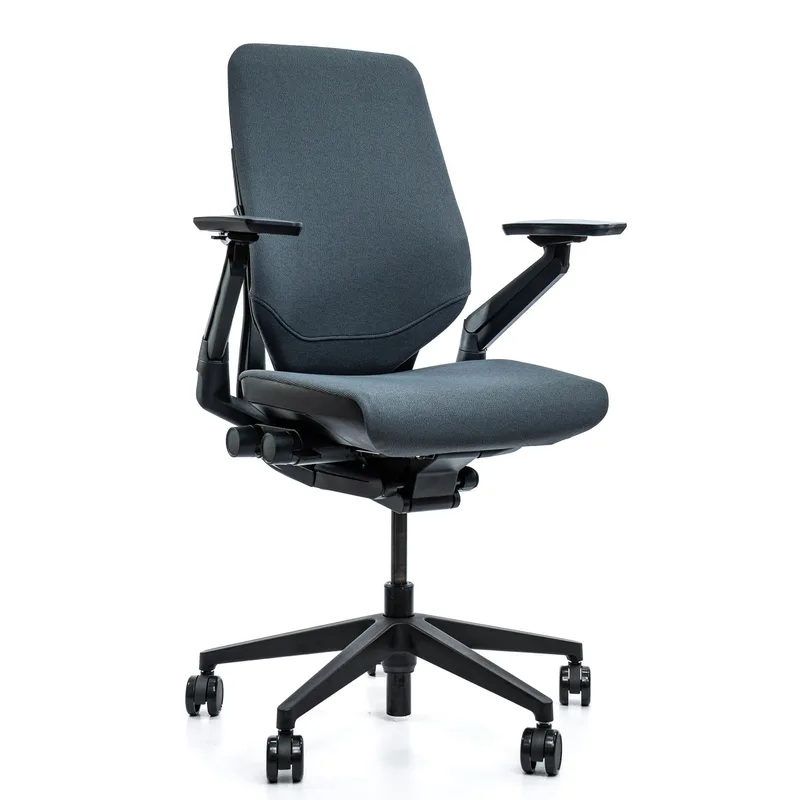
The Steelcase Gesture with headrest is the chair most ergonomists would recommend for neck pain, full stop. The headrest adjusts in height, angle, and depth—meaning you can actually dial it in to make contact with your head rather than just hovering behind it uselessly like so many cheaper designs do. It pivots to follow your head as you shift position throughout the day.
What makes the Gesture exceptional for neck pain isn’t just the headrest. It’s the 360-degree arm movement. Most people with neck pain are also dealing with shoulder tension that radiates upward—the Gesture’s arms can move out to the side, pivot forward, adjust in 4 directions, and adapt for phone use, tablets, mouse work, or keyboard. Removing arm and shoulder strain reduces the muscular load on your neck.
The LiveBack technology flexes with your spine as you move, which means the back never locks you into one position. Owner reports consistently note that the Gesture is one of the few chairs where you can shift posture constantly without losing support.
At $1,510 with the headrest configuration, the Gesture is expensive but not irrational. It’s the chair I’d buy if neck pain was affecting my workday.
2. Humanscale Freedom with Headrest — Best for Chronic Neck Pain
Humanscale Freedom with Headrest
Pros
- ✓ Articulating headrest follows your head as you recline
- ✓ Self-adjusting recline means zero manual fiddling
- ✓ Exceptional for people who recline frequently
- ✓ 15-year warranty—longest in this roundup
Cons
- ✗ $2,036 is a serious commitment
- ✗ Limited lumbar adjustability compared to Gesture or Aeron
- ✗ Only 300 lb weight capacity
Best for: People who recline frequently and want a headrest that moves with them automatically
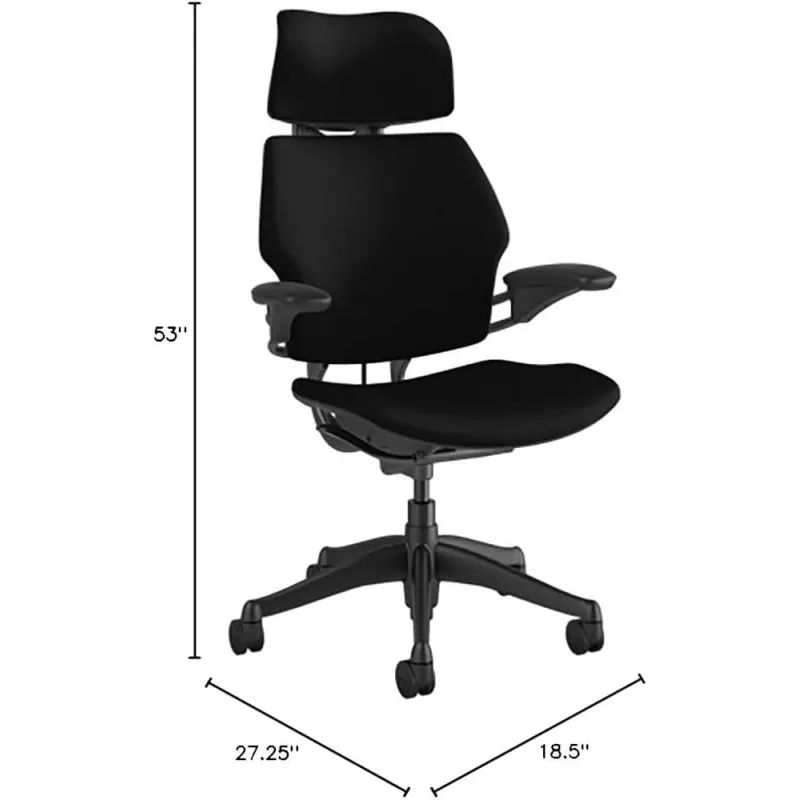
The Humanscale Freedom solves a problem no other chair in this roundup solves: the headrest that doesn’t move with you when you recline. On most chairs, you set the headrest position and it stays there—when you lean back, your head pulls away from it, defeating the purpose. The Freedom’s articulating headrest pivots forward as you recline so it maintains contact with your neck and head throughout the full range of movement.
Combined with the Freedom’s signature weight-balanced recline—which counterbalances your body weight automatically, requiring zero manual tension adjustment—you get a chair that just works. Sit down, recline, and the headrest is where your head lands.
The Freedom’s lumbar is less aggressively adjustable than the Gesture or Aeron, which may be a drawback for people with specific lower back requirements. But for neck pain specifically, the self-tracking headrest is the most biomechanically correct solution available outside of a physical therapy clinic.
At $2,036, it’s the most expensive chair in this roundup. The 15-year warranty helps justify the price over a long ownership window.
3. Herman Miller Aeron with PostureFit SL — Best for Posture
Herman Miller Aeron with PostureFit SL
Pros
- ✓ PostureFit SL addresses root cause of neck pain—forward pelvic tilt
- ✓ 8Z Pellicle mesh breathes perfectly, no sweating
- ✓ Holds value better than almost any chair on the market
- ✓ Proven 30-year track record with design that still leads the field
Cons
- ✗ No integrated headrest—neck support is indirect through posture
- ✗ $2,050 is top-dollar for a chair without a headrest
- ✗ Sizing is critical—wrong size makes it uncomfortable
Best for: People whose neck pain stems from poor lower-back support and forward pelvic tilt
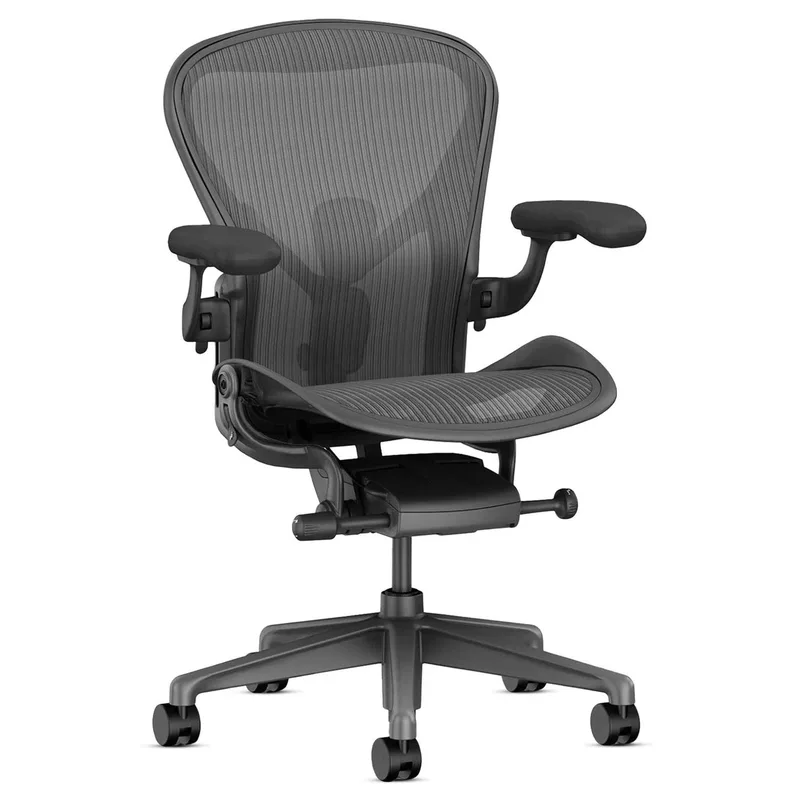
The Herman Miller Aeron doesn’t have a built-in headrest—and for many people with neck pain, it doesn’t need one. Here’s why: most neck pain at a desk doesn’t start in your neck. It starts in your pelvis.
When you sit without proper lumbar support, your pelvis tilts forward, your lower back rounds, your thoracic spine flexes forward, and your head juts out to compensate. The result is forward head posture—and for every inch your head moves forward from neutral, the weight of your head on your neck muscles effectively doubles.
The PostureFit SL lumbar system addresses both sacral and lumbar zones independently—something most chairs only half-accomplish. By holding your pelvis in a neutral position, the Aeron eliminates the root cause of forward head posture for a significant portion of neck pain sufferers.
The 8Z Pellicle mesh breathes exceptionally well and the chair holds its value over time better than any other office chair on the market. If you buy an Aeron and find neck pain persists, aftermarket headrest attachments are available—but according to many owner reports, the PostureFit SL alone resolves the issue.
At $2,050, the Aeron is priced similarly to the Freedom. For people who don’t recline much and want the chair that addresses posture at its foundation, the Aeron edges it out.
4. Haworth Fern Executive with Headrest — Best Design
Haworth Fern Executive with Headrest
Pros
- ✓ Stunning design—actually looks good in a home office
- ✓ Back flexes naturally like a leaf structure, no rigid sections
- ✓ 4D headrest with genuine multi-axis adjustment
- ✓ Digital Knit finish is soft, breathable, and professional
Cons
- ✗ Less lumbar adjustability than Steelcase or Herman Miller
- ✗ Less established in the ergonomics community than competitors
- ✗ Headrest can be tricky to dial in for taller users
Best for: People who want a beautiful, well-adjusted headrest chair that doesn’t look clinical
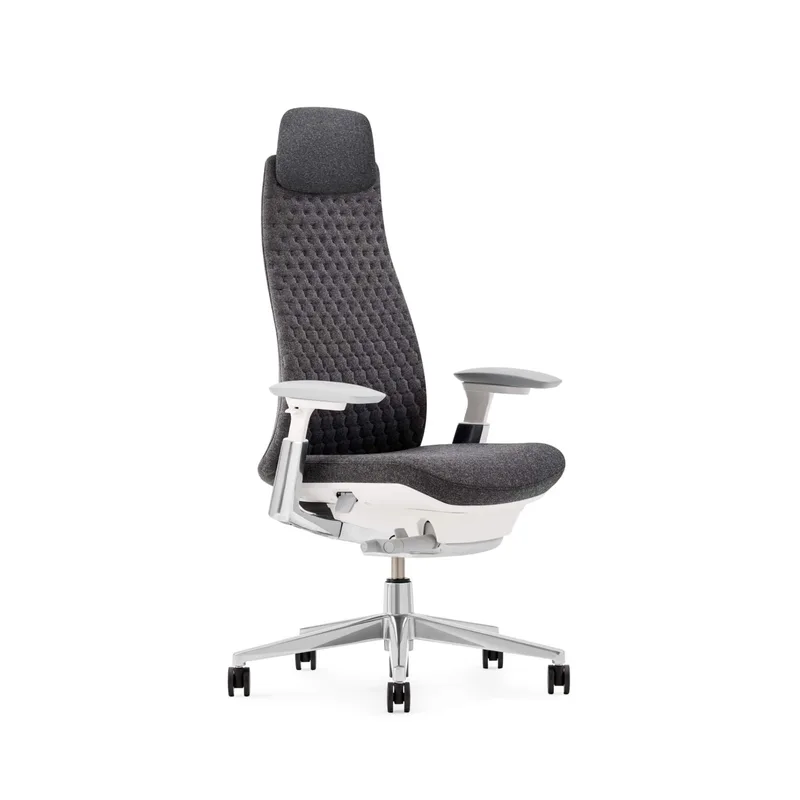
The Haworth Fern is the most visually distinctive chair in this roundup—its frond-inspired back structure looks genuinely different from every mesh chair that’s come before it. The leaf-like back segments flex independently rather than as one rigid panel, which means the chair follows your back’s natural movement through micro-adjustments you’d never achieve by twisting a knob.
The Executive version adds a 4D adjustable headrest with height, angle, pivot, and depth adjustment. It’s a full-featured headrest that competes with the Gesture’s in terms of adjustability, and it’s the only chair in this roundup that comes with a 12-year warranty, aluminum base, and this level of visual sophistication for under $1,500.
Where the Fern loses ground is lumbar. The back support is achieved through the flexing frond structure rather than a discrete lumbar mechanism, which means users who need targeted lumbar adjustment (high vs. low, firm vs. soft) may find it less satisfying than the Gesture or Aeron.
For people buying for home offices where aesthetics matter and neck pain is the primary concern, the Fern Executive hits a compelling middle ground.
5. Branch Ergonomic Chair — Best Value
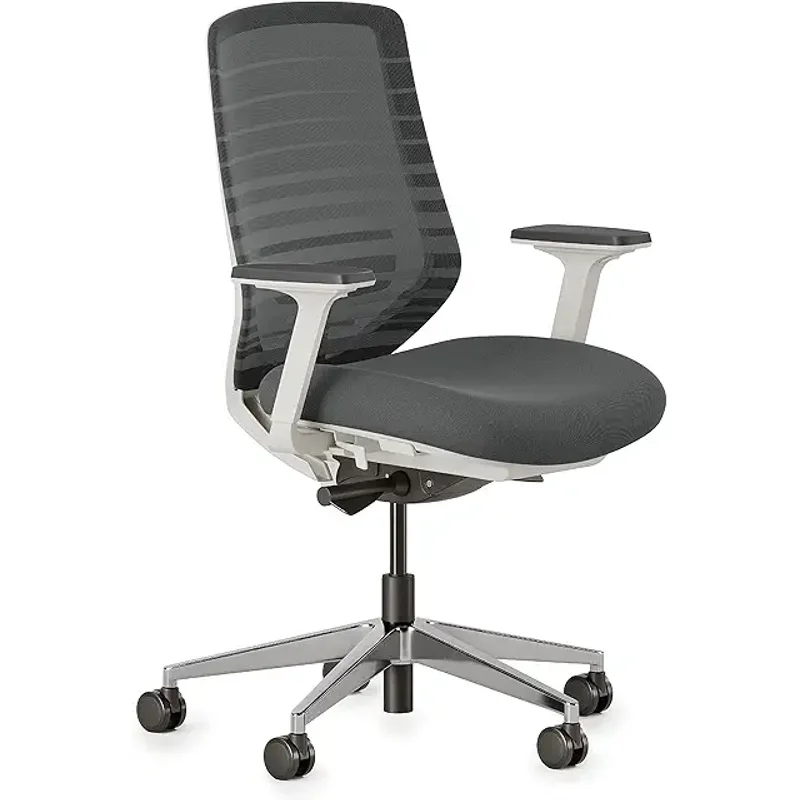
Branch Ergonomic Chair
Pros
- ✓ Outstanding lumbar support at a price that makes sense
- ✓ 3D arms adjust for nearly any desk setup
- ✓ Breathable mesh keeps you cool during long sessions
- ✓ 7-year warranty on a $299 chair is unusually strong
Cons
- ✗ No headrest—neck support comes from lumbar only
- ✗ 300 lb weight limit lower than premium competitors
- ✗ Not in the same build quality league as Steelcase or Herman Miller
Best for: Budget buyers who want serious lumbar support to reduce forward head posture
No headrest. Let’s be direct about that up front. But the Branch Ergonomic Chair earns its place in this roundup because for $299, it delivers the lumbar support quality that removes the postural root cause of neck pain—and that matters more than a headrest for many people.
The adjustable lumbar support on the Branch moves up and down along the back panel to match your exact lumbar curve, unlike many chairs at this price where the lumbar is fixed or barely adjustable. The mesh back breathes well, the 3D arms are genuinely useful (not the fixed-position arms that plague most budget chairs), and the 7-year warranty is exceptional for the price.
If you’re buying your first ergonomic chair and have $299 to spend, the Branch is the answer. If neck pain persists after a month of using it with good lumbar support, that’s when the $1,510 Gesture starts to make sense.
Comparison Table
| Chair | Price | Headrest | Lumbar | Weight Cap | Warranty | Best For |
|---|---|---|---|---|---|---|
| Steelcase Gesture + Headrest | $1,510 | 3D adjustable | Excellent | 400 lbs | 12 yr | Most people |
| Humanscale Freedom + Headrest | $2,036 | Self-tracking | Good | 300 lbs | 15 yr | Recliners |
| Herman Miller Aeron (PostureFit SL) | $2,050 | None (posture-based) | Excellent | 350 lbs | 12 yr | Posture-first buyers |
| Haworth Fern Executive | $1,299 | 4D adjustable | Moderate | 325 lbs | 12 yr | Design-focused |
| Branch Ergonomic Chair | $299 | None | Very Good | 300 lbs | 7 yr | Budget buyers |
Buying Guide: What to Look for in a Chair for Neck Pain
Understand the root cause first
Neck pain from desk work has two main origins: forward head posture (which starts in the lumbar and thoracic spine) and direct neck muscle fatigue from holding your head up without support. A headrest addresses the second. Good lumbar support addresses the first. Ideally your chair handles both.
A headrest won’t fix neck pain caused by poor lumbar support. And excellent lumbar support won’t fix neck pain caused by three hours of staring at a monitor that’s too low. Before spending $1,500 on a chair, check your monitor height first—the top of your screen should be roughly at eye level. A monitor arm that brings your screen up costs $40-80 and may eliminate the problem entirely.
Headrest types: what actually works
Fixed headrests (common on gaming chairs and budget office chairs) are the least useful. They sit where they sit, and if your head doesn’t land there naturally, they’re useless decoration.
Height-adjustable headrests are better. You can set the vertical position so it actually contacts your head. Most chairs in the $500-1,000 range offer this.
Multi-axis headrests (height + angle + depth) are what the Gesture and Fern Executive have. The angle adjustment is key—it lets you bring the headrest forward toward your head rather than leaving it vertical while you sit reclined.
Self-tracking headrests (Humanscale Freedom) are the best engineering solution. The headrest tracks your head position through the recline arc without manual adjustment. This is the mechanism physical therapists typically recommend.
Lumbar support and neck pain
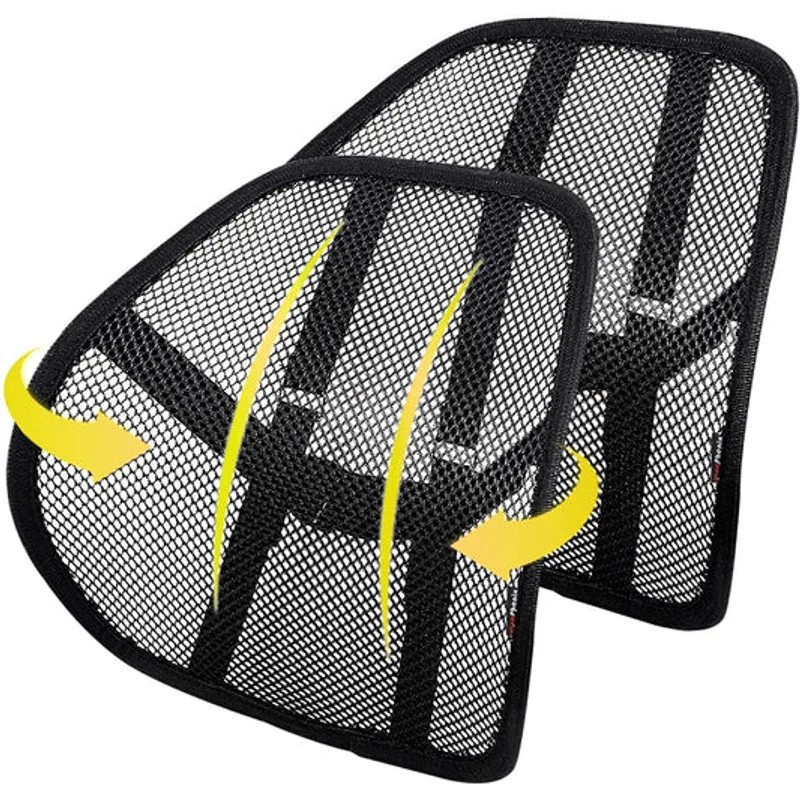
This connection is underappreciated. When you sit without proper lumbar support, your pelvis rotates backward (posterior pelvic tilt), your spine curves the wrong way, and your neck cranes forward. Every centimeter of forward head posture adds significant load on your neck muscles.
Chairs with adjustable lumbar (the Gesture’s lumbar dial, the Aeron’s PostureFit SL, the Branch’s movable lumbar pad) let you position the support at your exact lumbar curve. Don’t just set it and forget it—take 10 minutes to dial in your lumbar until your lower back feels supported without pressure.
Budget expectations
- Under $500: You’re getting lumbar support but no premium headrest. Branch at $299 is the best in this tier.
- $800-1,400: This is a gap in the market for neck pain specifically. Chairs in this range often have simple headrests with limited adjustability.
- $1,500+: The Gesture with headrest and Freedom both live here, and this is where you get the full engineering treatment.
If budget is a real constraint, spend $299 on the Branch and $40 on a monitor arm. That combination will do more for neck pain than a $500 chair without either.
FAQ
What is the best office chair for neck and shoulder pain?
The Steelcase Gesture with headrest. It’s the most adjustable combination of arms (which reduce shoulder tension), back support, and headrest on the market. The 360-degree arms alone help many shoulder pain sufferers significantly by supporting arms in positions that standard chairs can’t accommodate.
Does an office chair headrest actually help neck pain?
Yes, if adjusted correctly—and that’s the key. A headrest that doesn’t make contact with your head does nothing. For a headrest to reduce neck muscle load, it needs to be positioned so your head can lightly rest against it, taking the weight off your cervical muscles. Multi-axis headrests like the Gesture’s make this much more achievable than fixed designs.
Can a chair fix neck pain completely?
A chair addresses postural contributors to neck pain—it won’t fix an existing injury or herniated disc. If you have persistent neck pain, see a physical therapist. A good chair, combined with proper monitor height, regular movement breaks, and targeted stretching, reduces the daily load on your neck and prevents pain from accumulating.
What’s the difference between neck pain support and headrests on gaming chairs?
Most gaming chair headrests are cervical cushions—a pillow you strap around the top of the chair back. These are positioned behind your neck, not behind your head, and tend to push your head forward rather than supporting it. Ergonomic office chair headrests are designed to cradle your skull and allow neutral neck position, which is fundamentally different. For neck pain specifically, avoid gaming chairs.
Is the Herman Miller Aeron good for neck pain without a headrest?
Yes, for many people—specifically those whose neck pain originates from poor lumbar support and forward head posture rather than direct neck fatigue. The PostureFit SL lumbar system eliminates the postural foundation of forward head posture in a way most lumbar systems don’t. According to manufacturer specs and owner reports, many users find neck pain resolves through lumbar correction alone. See our full guide to ergonomic chairs for lower back pain for more on this.
Are expensive ergonomic chairs worth it for neck pain?
For chronic neck pain that affects your work and quality of life, yes. A $1,500 chair that eliminates neck pain is less expensive than ongoing physical therapy, chiropractic visits, or lost productivity. Read our are expensive office chairs worth it guide for the full breakdown on when premium ergonomics justify the cost.
Conclusion
For most people with desk-related neck pain, the Steelcase Gesture with Headrest is the answer. The combination of a genuinely adjustable headrest, 360-degree arms, and LiveBack technology addresses neck pain from multiple angles simultaneously.
If you recline frequently and want a headrest that tracks your head without adjustment, the Humanscale Freedom is worth the premium. If your neck pain stems from poor posture rather than neck muscle fatigue, the Herman Miller Aeron with PostureFit SL addresses the root cause better than anything else.
For those on a budget who want serious lumbar support without the premium price, the Branch Ergonomic Chair at $299 remains the most sensible starting point.
Before upgrading your chair, make sure your monitor is at eye level. A properly positioned screen combined with a good chair is more effective than either alone. If you’re spending serious money on ergonomics, pair it with a quality monitor arm for the full setup.
For more on premium ergonomic options, see our best luxury office chairs roundup and our luxury home office setup guide.