Your lower back has been complaining for months. You’ve tried a lumbar pillow, a seat cushion, and a higher monitor. Still hurts. A kneeling chair attacks the problem from a different angle, literally. It tips your pelvis forward, which pulls your spine toward its natural curve and takes load off the lower discs. For people who’ve run out of other options, that can be the change that finally helps.
The catch: plenty of kneeling chairs aren’t worth buying. Cheap ones wreck your shins before they help your back. This guide covers the five worth considering in 2026, from a $100 entry point to the $479 Norwegian original.
Quick pick: the Varier Variable Balans is the best kneeling chair you can buy. If $479 is too steep, the Sleekform Austin delivers most of the benefit for well under half the price.
Varier Variable Balans: Best Overall

Varier Variable Balans Original Kneeling Chair
Pros
- ✓ The original kneeling chair — proven design since 1979
- ✓ Rocking motion encourages constant micro-movement while seated
- ✓ Beautiful Norwegian ash wood construction built to last decades
- ✓ 10-year warranty reflects genuine confidence in build quality
Cons
- ✗ Expensive at $479 — significant commitment if you've never tried kneeling
- ✗ No height adjustment — not ideal for desks outside 28–34 inch range
- ✗ Takes 1–2 weeks to adapt; knee discomfort is normal early on
The Variable Balans started this whole product category. Norwegian designer Peter Opsvik created it in 1979, and the core design hasn’t changed because it hasn’t needed to. The rocking ash base doesn’t lock you into one position. You shift constantly as you work, so your spine gets gentle movement all day instead of sitting fixed for hours.
That continuous motion is the main advantage over adjustable-base kneeling chairs. A fixed posture still fatigues muscles and compresses the spine. Rocking keeps your core lightly engaged and redistributes weight on its own.
The cushions are firm by design. You want to feel the tilt, not sink into a cloud. The wood frame is built to last decades, and Varier backs it with a 10-year warranty. Pricing varies by finish and retailer, with the standard list price at $479.
The honest limits: no height adjustment, and the 240 lb capacity is the lowest on this list. If your desk isn’t roughly 28 to 34 inches tall, measure before ordering. And $479 is a real commitment, not an impulse buy.
Who should buy it: remote workers spending 4+ hours a day at a desk who want a long-term fix. Who should skip it: anyone near the weight limit, or anyone who hasn’t yet tried kneeling.
Sleekform Austin: Best Value

Sleekform Austin Kneeling Chair
Pros
- ✓ 4-inch memory foam cushions outlast the thin pads found on cheaper chairs
- ✓ 20-ply birchwood frame with triple cross bars — genuinely rigid
- ✓ Clean, modern look that fits a home office without looking clinical
- ✓ 265 lb weight capacity for a rocking wood chair is solid
Cons
- ✗ No height adjustment — requires desk in the 28–32 inch range
- ✗ Memory foam can compress with very heavy daily use over years
- ✗ Assembly takes about 20 minutes; instructions are functional but not great
The Austin hits a sweet spot that’s hard to find. It looks good, feels solid, and costs a fraction of the Varier, with Amazon pricing between about $132 and $176 at last check. The 4-inch memory foam cushions are the differentiator. Most chairs in this range use thin foam wrapped in fabric that compresses within months.
The 20-ply birchwood frame with three cross bars is noticeably more rigid than the thin-wood designs from competitors. No flexing, no creaking. At 265 lbs the capacity beats the Varier’s, and the clean Scandinavian look doesn’t fight with a home office.
Like the Varier, it rocks and doesn’t adjust, so you need a desk around 28 to 32 inches. Sleekform also sells the East Austin variant with a padded backrest, worth a look if you want lumbar support while kneeling.
Who should buy it: home office workers who want a quality rocking chair without the Varier price. Who should skip it: anyone with a non-standard desk height.
BetterPosture Jazzy by Jobri: Best for Mobility
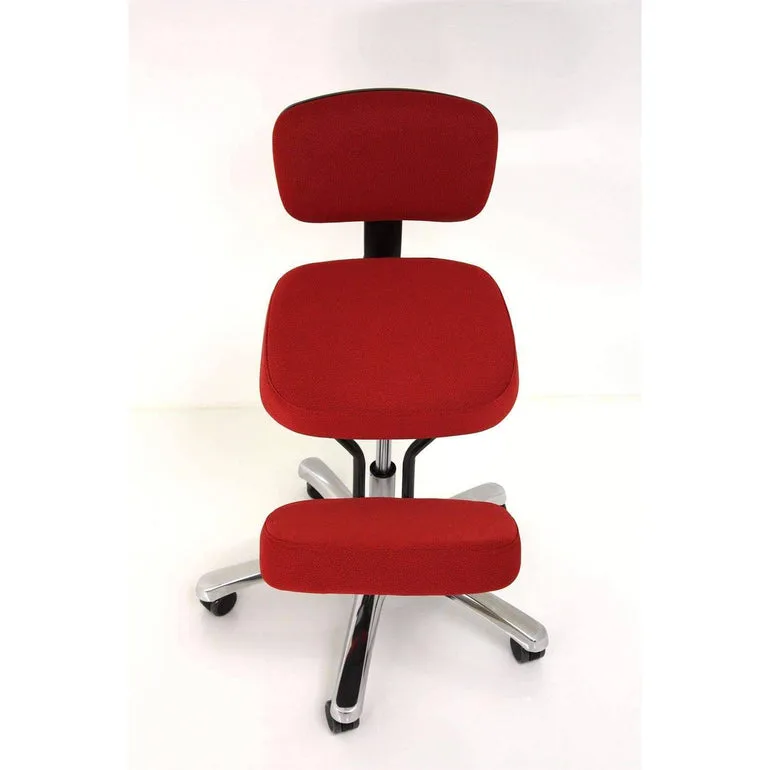
BetterPosture Jazzy Kneeling Chair by Jobri
Pros
- ✓ Rolling casters make it the most mobile kneeling chair on this list
- ✓ Adjustable height works across a wider range of desk setups
- ✓ Polished aluminum 5-star base feels substantial and looks professional
- ✓ 275 lb capacity with well-padded knee platform
Cons
- ✗ At $349, premium alternatives offer more for similar money
- ✗ Casters roll on hard floors if you shift your weight suddenly
- ✗ Bulkier footprint than rocking designs — takes up more floor space
The Jazzy takes a different approach. Instead of a rocking wood base, it sits on a polished aluminum five-star base with casters, the same layout as an ordinary office chair. That makes it the most practical option if you roll around your desk or share a workspace.
Height adjustment is the other real advantage. You can dial it to your proportions instead of hoping a fixed rocker lands at the right angle. The memory foam is thick, the knit cover wipes clean, and a backrest version exists if pure kneeling proves too demanding.
Prices vary a lot across retailers, and recent listings put it around $295. At that price you’re paying for adjustability and casters specifically. If you need them, the Jazzy is the best choice in the category. If you don’t, the Sleekform gives you comparable build quality for less.
Who should buy it: shared workspaces and anyone who moves around a lot. Who should skip it: buyers on hardwood floors who shift weight suddenly, since casters can roll.
DRAGONN Ergonomic Kneeling Chair: Best Budget

DRAGONN Ergonomic Kneeling Chair
Pros
- ✓ Under $100 — lowest-risk way to try kneeling chairs without a big commitment
- ✓ 21–28 inch height range is one of the widest in the category
- ✓ Casters with brake locks give mobility on demand
- ✓ Steel X-frame handles 250 lbs without flexing or wobbling
Cons
- ✗ 3-inch foam pads are thin — knee discomfort sets in faster than premium models
- ✗ Mesh exterior compresses faster than solid foam over time
- ✗ Clearly a budget product aesthetically — won't blend into a polished home office
The DRAGONN is the right pick if you want to try kneeling without spending $200. It adjusts from 21 to 28 inches, has casters with brake locks, a steel X-frame rated to 250 lbs, and ships mostly assembled. It checks every functional box at around $100.
You feel the budget in the cushions. Three inches of foam under a mesh cover is fine for one or two hours. Stretch that to four to six hours and the knee pads start to feel thin. A gel pad on the knee platform helps a lot if this becomes your main chair.
DRAGONN is a VIVO sub-brand with real support behind it, not a nameless import. For a first kneeling chair, it’s a legitimate product.
Who should buy it: first-timers who want to test active sitting cheaply. Who should skip it: anyone planning all-day use or wanting a polished look.
Boss B248 Ergonomic Kneeling Stool: Commercial Workhorse

Boss B248 Ergonomic Kneeling Stool
Pros
- ✓ Gas lift height adjustment is smooth and reliable
- ✓ 275 lb capacity exceeds most chairs in the sub-$150 range
- ✓ 6-year warranty is exceptional for a no-frills stool
- ✓ Compact footprint works in tight office spaces
Cons
- ✗ Fabric cushions are thin — gel knee pad recommended for long sessions
- ✗ No design ambition — looks institutional
- ✗ Knee pad height isn't independently adjustable from the seat
The B248 is a commercial-grade kneeling stool with no extras. Gas-lift height adjustment (20 to 25 inches), a tubular steel frame rated to 275 lbs, and a 6-year warranty that’s unusual at this price. Amazon shows it as unavailable, so the link goes to HD Supply, where it currently lists around $158. That’s more than the DRAGONN, which makes it a harder sell than it once was.
It looks institutional: black steel, commercial fabric, nothing that flatters a home office. Add a gel knee pad and it works exactly as advertised. One limitation: the knee pad height isn’t adjustable separately from the seat, so you get one fixed relationship between the two. If you fall between standard sizes, the DRAGONN’s wider range gives you more control.
Who should buy it: people who want a heavier 275 lb rating and a long warranty. Who should skip it: anyone who cares how it looks, or who wants the cheapest option.
Kneeling Chair Buying Guide
Should You Actually Buy One?
Kneeling chairs aren’t a cure-all. They work best as one tool among several. Alternating between a kneeling chair, a standing desk, and a conventional chair beats relying on any single option. If you have knee problems, bursitis, or past knee surgery, kneeling can aggravate them. Ankle flexibility matters too. If your shins can’t rest comfortably on the pad, it will feel wrong immediately.
For healthy adults with chronic lower back pain from long sitting, the mechanics are sound: tilt the pelvis, restore the lumbar curve, reduce disc compression. For the wider picture, see the complete guide to ergonomic chairs for lower back pain.
Rocking Base vs. Adjustable Base
Rocking bases (Varier, Sleekform) encourage constant micro-movement, which is better for your core. The trade-off is no height adjustment, so your desk needs to be around 28 to 34 inches.
Adjustable bases (DRAGONN, Boss, Jazzy) let you match your desk and body exactly, which suits shared spaces. You lose the continuous rocking motion.
Knee Pad Thickness
The most underrated spec. Pads of 1 to 2 inches cause knee and shin discomfort within 30 to 60 minutes. Good chairs use 3 to 4 inches of dense foam. If you buy a thinner-padded model, a $20 to $30 gel cushion extends your comfortable time considerably.
Weight Capacity
Most chairs here are rated 250 to 275 lbs. The Varier’s 240 lbs is the lowest. If you’re close to that, pick the Jazzy or the Boss (both 275 lbs).
Who Should Avoid Kneeling Chairs
- Anyone with knee injuries, bursitis, or past knee surgery
- Pregnant users, since balance changes make kneeling less safe
- People with ankle flexibility or shin circulation issues
- Anyone who expects to sit 8+ hours without changing position
FAQ
How long does it take to get used to a kneeling chair?
Most people feel knee and shin discomfort for the first one to two weeks. Start with 30 to 45 minute sessions and alternate with your regular chair. By week three, two to three hours is usually comfortable. Full adaptation often takes four to six weeks.
Are kneeling chairs good for lower back pain?
For many people, yes. The forward pelvic tilt encourages the lumbar spine’s natural curve, which can ease the dull ache from slouching. They don’t work for everyone and don’t replace movement breaks.
Can you use a kneeling chair all day?
Not recommended. A common guideline is two to four hours a day, alternating with standing or conventional seating. If you’re weighing a premium kneeling chair against a traditional one, see are expensive office chairs worth it.
Do kneeling chairs have back support?
Traditional ones don’t. The open hip angle is meant to support itself. The BetterPosture Jazzy offers an optional backrest, and DRAGONN sells a separate model with one. If you need continuous lumbar support, a conventional ergonomic chair is a better fit.
What desk height works best with a kneeling chair?
Roughly 28 to 33 inches for most. Rocking models like the Varier and Sleekform are the least flexible. Measure first, because a poor fit means you won’t use the chair.
What’s the difference between a kneeling chair and a balance stool?
Kneeling chairs have a shin platform that bears part of your weight, so your core works less. Balance stools have a single angled seat and rely on your core to stabilize. Kneeling chairs are easier for longer sessions.
Conclusion
For the best kneeling chair without compromise, get the Varier Variable Balans. The rocking motion, ash wood build, and 10-year warranty justify the price if posture is a real priority and not a passing experiment.
Not ready for $479? The Sleekform Austin is the best value: good cushioning, solid wood construction, and a look that fits a home office. Need to roll around or share a workspace? The BetterPosture Jazzy’s casters and adjustable height make it the practical choice. Trying kneeling on a tight budget? Start with the DRAGONN. Add a gel knee pad and you have a usable daily setup for around $120.
Whichever you pick, the benefit compounds when you rotate positions. Two to three hours kneeling, plus standing breaks and a good ergonomic chair for the rest of the day, does more for your spine than any single seat used all day.