You’ve done the research. You’ve narrowed it down to two chairs. Now you’re staring at a choice between the Humanscale Freedom with headrest at $1,939 and the Steelcase Gesture at $1,499 — and neither decision is obvious.
The ergonomic chair market has evolved significantly heading into 2026, with manufacturers competing on “dynamic ergonomics”: chairs that move with you rather than holding a fixed position. Both the Freedom and the Gesture represent this philosophy, but through completely different engineering approaches. The Freedom uses self-adjusting, weight-calibrated recline. The Gesture uses 3D LiveBack flex technology paired with the most adjustable arms available.
Quick verdict: The Steelcase Gesture wins for most buyers — it accommodates more body types, has better adjustability, and costs $440 less. The Humanscale Freedom is the right pick for people who want a chair that reclines effortlessly without fiddling with knobs, and who plan to use the headrest constantly.
Both are covered in detail below. See our full Steelcase Gesture review and Humanscale Freedom review for deeper dives into each.
Steelcase Gesture — Maximum Adjustability
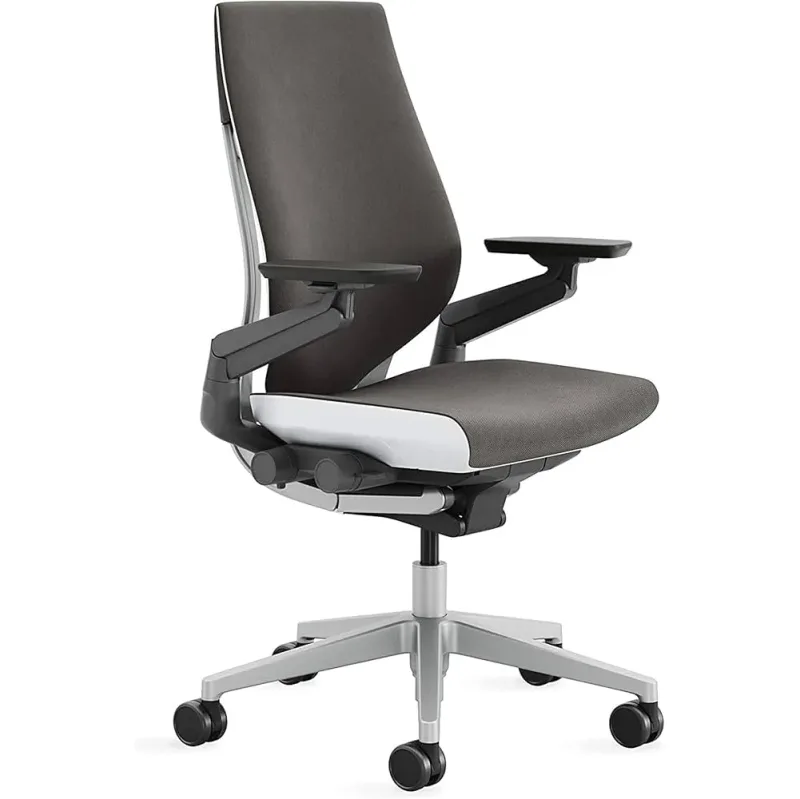
Steelcase Gesture
Pros
- ✓ 360-degree 4D arms pivot, rotate, extend, and raise — the best armrest range of any premium chair
- ✓ 3D LiveBack technology flexes with your spine through every posture shift, providing consistent support when upright or reclined
- ✓ 400 lb weight capacity and wider seat dimensions accommodate a broader range of body sizes than most competitors
- ✓ Ships fully assembled with no tools required — ready to configure straight from the box
Cons
- ✗ Upholstered back retains heat — no mesh option available, which is a real disadvantage in warm offices
- ✗ Standard lumbar is widely criticized; the properly supportive adjustable lumbar is a paid upgrade
- ✗ Heavy at roughly 70 lbs — harder to reposition than most competitors
The Gesture is Steelcase’s answer to how modern workers actually sit: leaning back with a phone, hunching forward at a screen, resting arms on a desk, shifting between tablet and laptop. The arms were redesigned from scratch in 2013 after Steelcase analyzed thousands of hours of observed seating behavior, and the result is still the best arm system on any chair at any price.
At $1,499 for a properly configured model (wrapped back, adjustable lumbar), it sits at the accessible end of flagship ergonomic pricing. The 400 lb weight capacity and three cylinder height options (standard, low, high) mean it fits a genuinely wide range of body sizes.
The 3D LiveBack flex mimics the natural motion of the lumbar spine — as you shift, the back flexes and contours dynamically. It is not as dramatic as the Freedom’s automatic recline, but it supports good posture consistently across positions without requiring the user to make a decision.
The main real weakness is heat retention. The Gesture has no mesh option. If your office runs warm or you run warm, you will feel it over a long session. The standard lumbar unit is also underwhelming — plan to add the adjustable lumbar upgrade at order.
Humanscale Freedom Chair with Headrest — Effortless Recline
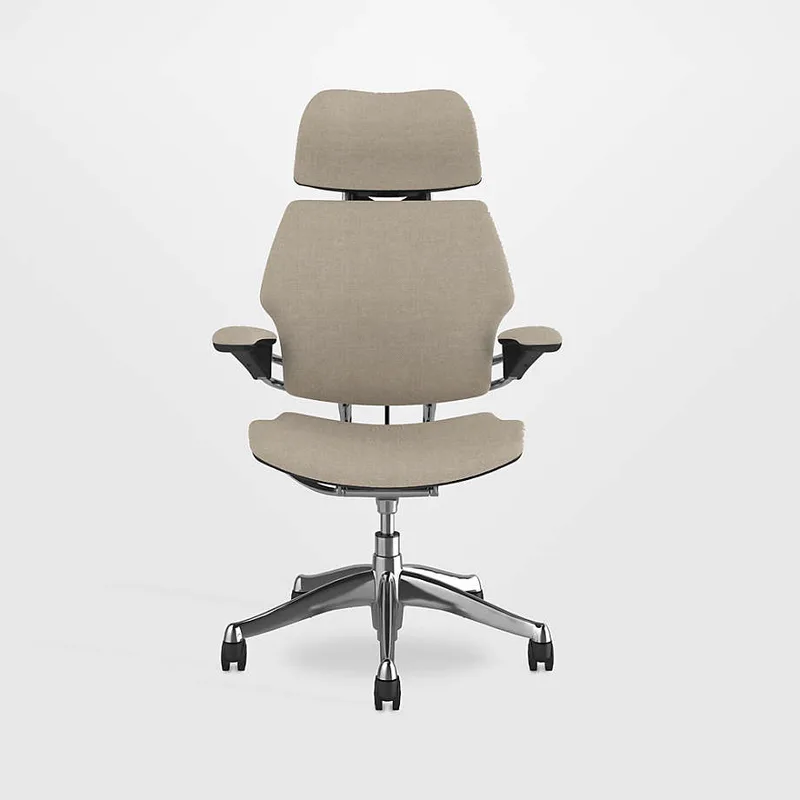
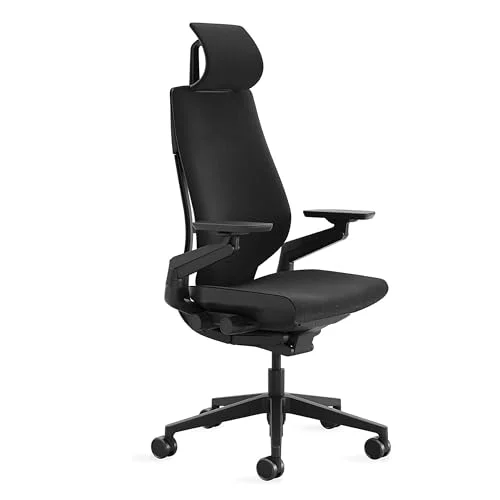
Humanscale Freedom Chair with Headrest
Pros
- ✓ Self-adjusting recline with no tension knobs — the chair calibrates resistance to your body weight automatically
- ✓ Dynamic headrest pivots forward and tracks your recline angle without any manual adjustment
- ✓ Arms move with the sitter during recline, maintaining elbow support at every angle
- ✓ Under 90 total components — exceptionally minimal design with less to break or adjust
Cons
- ✗ Weight capacity of 300 lbs is below most competitors at this price point
- ✗ Passive lumbar provides no height or firmness adjustment — if the built-in curve does not fit your spine, you cannot fix it
- ✗ Arms lack full 360-degree rotation; lateral range is more limited than the Steelcase Gesture
The Freedom Chair has been in production for 25 years and its core concept has not changed: one lever locks the seat, everything else is automatic. The recline mechanism reads your body weight and calibrates the return resistance accordingly. There is no tension knob to set, no tilt angle to select. You recline, the chair supports you.
The headrest is included — not an add-on — and it is genuinely excellent. It pivots forward during recline to maintain neck contact without any adjustment. This is the best headrest integration available in a chair at any price, which is why it earns the “Best for Recliners” badge here.
At $1,939 for a mid-spec configuration, it costs more than the Gesture. The weight limit (300 lbs) is lower. The lumbar support is passive and non-adjustable — if the fixed curve does not align with your spine, that is a significant problem. And customized chairs are made to order, meaning 3–4 week delivery windows and no returns on custom configs.
If you do not plan to recline regularly, or if you need detailed lumbar control, the Freedom is the wrong chair. But if reclined work is central to how you operate — reading, video calls, focus work — the automatic mechanism is genuinely better than any manual system.
Head-to-Head Comparison
| Feature | Steelcase Gesture | Humanscale Freedom |
|---|---|---|
| Price (mid-spec) | $1,499 | $1,939 |
| Weight Capacity | 400 lbs | 300 lbs |
| Seat Height | 16–20.5 in | 16–21 in |
| Seat Width | 19.25 in | 20 in |
| Armrests | 360° 4D (best available) | 4D synchronous (recline-following) |
| Lumbar | Adjustable (paid upgrade) | Passive, non-adjustable |
| Headrest | Optional add-on (+$236) | Included, dynamic auto-tracking |
| Recline | Manual tilt, 3-position lock | Self-adjusting weight-sensitive |
| Back Material | Upholstered (no mesh) | Upholstered (no mesh) |
| Warranty | Lifetime frame; 12 yr parts | 15 yr frame; 5 yr fabric |
| Amazon | Available | Direct from Humanscale |
Recline Mechanism
This is the most important difference between these two chairs. The Gesture uses a standard manual tilt — you set the tension knob, lean back, and the chair returns with a resistance you chose. There are three tilt-lock positions. It works well and you get used to it fast.
The Freedom uses a weight-sensitive mechanism that automatically sets return resistance based on how much you weigh. You do not set it. You never adjust it. You just lean back and it feels calibrated to you specifically. For people who recline frequently, this is a meaningfully better experience. For people who sit upright 90% of the time, the difference disappears.
Armrests
The Steelcase Gesture wins, and it is not close. The arms move in every direction — height, width, depth, and full 360-degree pivot. They were designed specifically for workers who switch between devices. The Freedom’s arms are 4D but lack the full rotational range; they follow your recline angle automatically, which is useful, but the overall range of lateral adjustment falls short of the Gesture.
If arm adjustability matters to your workflow, the Gesture is the right answer here.
Lumbar Support
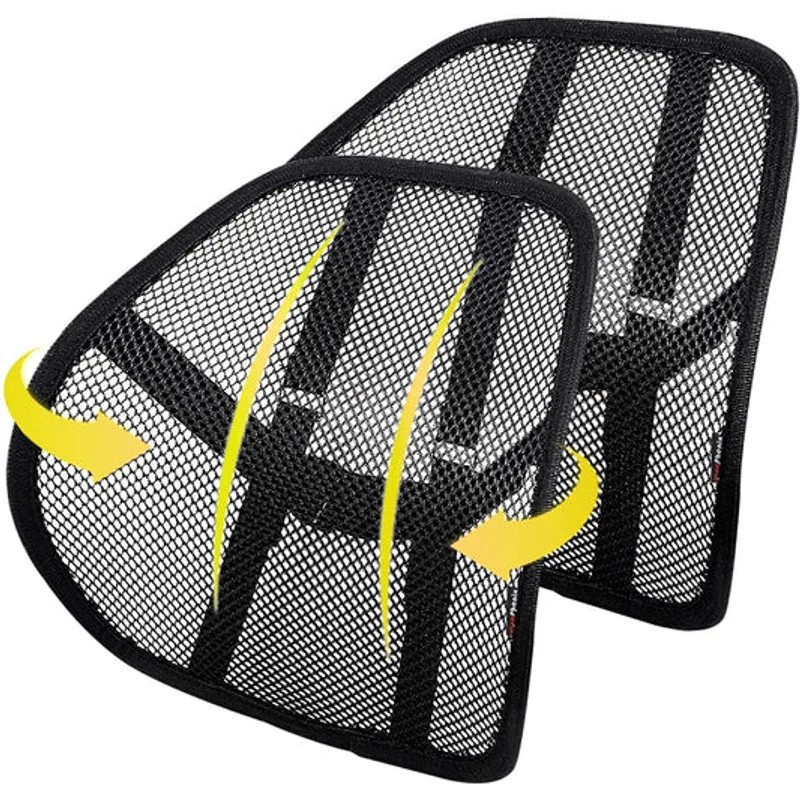
Neither chair offers exceptional lumbar support out of the box. The Gesture’s standard lumbar has been called the weakest part of an otherwise strong package — you will want the adjustable upgrade. At that point, you have excellent height and firmness control.
The Freedom’s lumbar is passive. It is a fixed curve that either fits your spine or it does not. For buyers who know their lumbar needs, the Gesture’s adjustable system is more reliable.
Headrest
The Freedom includes a genuinely excellent headrest. It auto-tracks during recline. It is the right reason to pay the premium if neck support is important to you.
The Gesture can be ordered with a headrest, but it adds roughly $236 to an already $1,499 base. At that point you are comparing $1,735 (Gesture + headrest) against $1,939 (Freedom). Closer, but the Freedom’s headrest integration is still better.
Warranty
Both are strong. The Freedom’s 15-year warranty on the frame and arms is longer on paper. The Gesture’s lifetime frame warranty technically has no end date for the original owner. For practical purposes, assume both will outlast most office furniture.
Who Should Buy the Steelcase Gesture
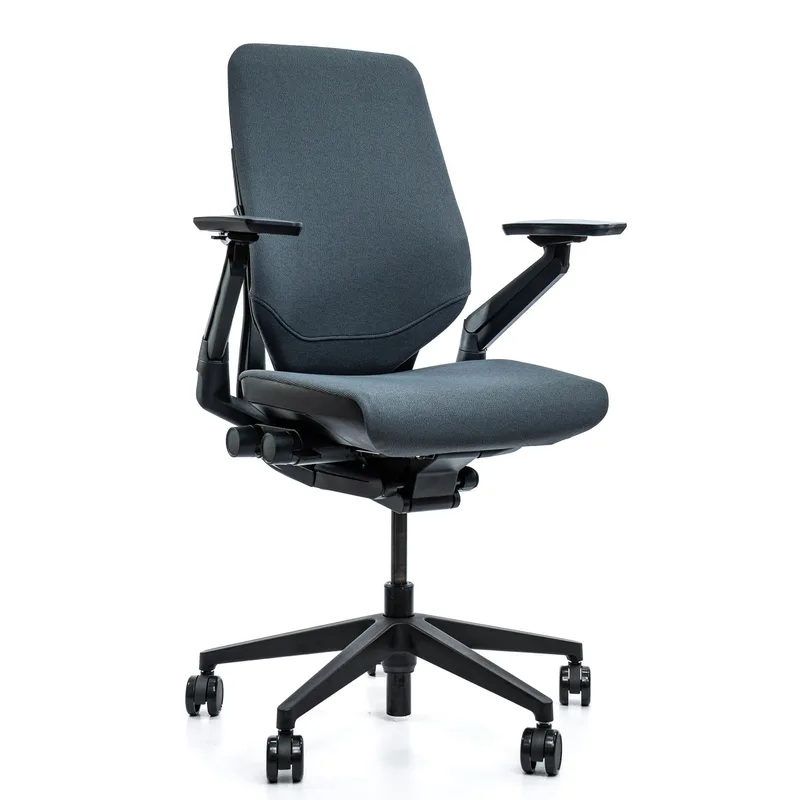
- You need a high weight limit (over 300 lbs)
- You want maximum arm adjustability for multi-device work
- You prefer detailed manual control over your lumbar and tilt settings
- Your office runs warm and you want the flexibility to add accessories
- You want to buy on Amazon with standard delivery windows
At $1,499, the Gesture is the more versatile chair. For a comparison of how it stacks up across the full luxury tier, see best luxury office chairs.
Who Should Buy the Humanscale Freedom
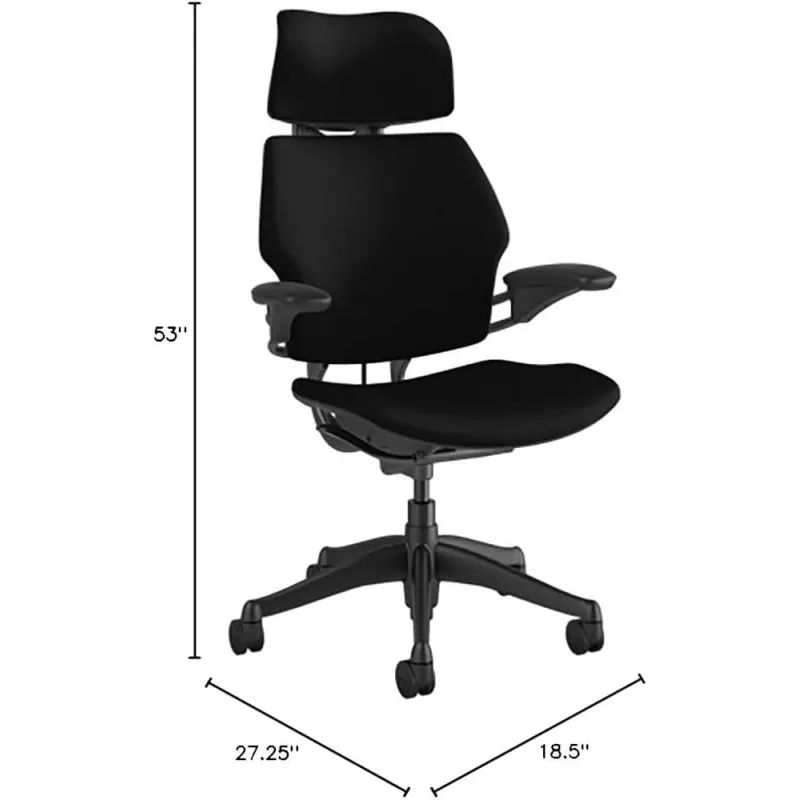
- You recline regularly and want zero-effort recline resistance
- The included headrest is a priority — you use it all day
- You prefer minimal controls and a chair that “just works”
- You are under 300 lbs and fit within the standard size range
- Sustainability and design simplicity matter to you
The Freedom’s advantages are most pronounced for people who work in reclined positions frequently. If you primarily sit upright and only occasionally recline, those advantages largely disappear and the Gesture’s better lumbar control becomes more valuable.
Buying Guide: What to Know Before Spending $1,500+
Configuration traps. Both chairs have base prices that do not reflect real-world costs. The Gesture at $1,216 gets you the shell back with a fixed lumbar — upgrade to the wrapped back with adjustable lumbar and you are at $1,499+. The Freedom’s $1,317 base price is for the minimal configuration; the full headrest executive version reviewed here runs $1,939 at most resellers. Always price the configuration you actually want.
Return policies. Amazon makes Steelcase Gesture returns straightforward. Humanscale custom orders are non-returnable. If you have not sat in the Freedom before, find an authorized dealer or showroom first. The chair’s passive lumbar is either right for your body or it is not, and you cannot know without sitting in it.
Lead times. Steelcase Gesture ships within standard timeframes on Amazon. Humanscale custom orders run 3–4 weeks. Plan accordingly if you need the chair by a deadline.
Who should consider something else. If $1,500+ feels like too much, the are-expensive-office-chairs-worth-it guide breaks down the actual ROI case. For a full premium workspace, the luxury home office setup guide covers the complete picture.
FAQ
Is the Humanscale Freedom really better than the Steelcase Gesture?
Not overall — but it is better in specific ways. The Freedom has a superior headrest and a genuinely unique automatic recline mechanism. The Gesture has better armrests, higher weight capacity, more lumbar adjustability, and costs less. For most buyers, the Gesture’s advantages matter more.
Does the Steelcase Gesture come with a headrest?
No. The headrest is an optional add-on that costs approximately $236 extra. The standard Gesture comes without a headrest. If neck support is essential, factor that cost into your comparison — at $1,735, the gap with the Freedom ($1,939) is narrower.
What is the weight limit on the Freedom Chair with Headrest?
The Freedom Chair with Headrest is rated to 300 lbs. For buyers above that limit, the Steelcase Gesture (rated to 400 lbs) is the right choice at this price tier.
Is the Humanscale Freedom available on Amazon?
A base configuration of the Freedom is listed on Amazon, but the fully specified version with headrest that most buyers want is best ordered direct from Humanscale or an authorized reseller like UPLIFT Desk. Custom configurations allow fabric, base, and arm choices not available on Amazon.
Which chair has a better warranty?
Both are excellent. The Freedom offers a 15-year warranty on the frame and arms (5 years on fabric). The Gesture offers a lifetime frame warranty for the original owner, with 12-year coverage on all mechanical components. For practical purposes they are equivalent — both chairs will outlast most office environments.
Should I consider a mesh chair instead?
If heat retention is your primary concern, a mesh-back alternative in the same price tier is worth evaluating alongside these two. Mesh breathes significantly better than the upholstered backs on both the Gesture and the Freedom. The trade-off is that mesh typically provides less structured lumbar contouring and a different recline feel. If you run warm or your office lacks climate control, it is a real consideration — but both chairs reviewed here are upholstery only, so factor that in before ordering.
Conclusion
For most buyers: the Steelcase Gesture is the better chair. It accommodates more body types, has the best armrests in any premium chair, offers meaningful lumbar control, and costs $440 less. If you spend most of your time upright — coding, writing, designing — the Gesture’s adjustability serves that posture well.
The Humanscale Freedom earns its premium for a specific user: someone who reclines frequently and wants a headrest that tracks without adjustment. The automatic recline mechanism is unlike anything else in this price tier, and the 15-year warranty reflects genuine build quality confidence.
Neither chair is a bad choice at this level. The question is whether you value effortless, automatic ergonomics (Freedom) or maximum manual control with the best arms available (Gesture).
If you are still deciding, start with our Steelcase Gesture in-depth review and Humanscale Freedom review before committing.