Ergonomic chair conversations in 2026 have mostly stayed focused on traditional office chairs — mesh backs, lumbar adjustments, price wars between budget brands and the Herman Miller tier. A smaller, more persistent group of desk workers skipped that debate entirely and gave up on chairs with backs at all. Kneeling chairs and saddle chairs are both built around the same idea: open your hip angle and let your pelvis tilt forward naturally, instead of folding into the closed 90-degree hunch a flat office chair seat encourages. They solve that problem in very different ways, and picking the wrong one for your body and your workday can leave you worse off than the chair you replaced.
Quick answer: if you want the cheapest way to test whether active sitting works for you, the Sleekform Alpha kneeling chair gets you there for under $80. If chronic lower back or pelvic strain is the actual problem and budget isn’t the limiting factor, the Salli SwingFit is the one worth the wait and the price.
Kneeling Chairs: Forward Pelvic Tilt Without a Backrest
Kneeling chairs remove the backrest and tilt the seat pan itself forward. Your shins rest on a lower pad, your weight splits between your sit bones and your knees, and your pelvis rotates into a position that preserves your lower spine’s natural curve instead of flattening it. The tradeoff is real: you’re loading your knees and shins with weight a standard chair never asks them to carry, which is why almost nobody recommends a kneeling chair as your only seat for a full workday.
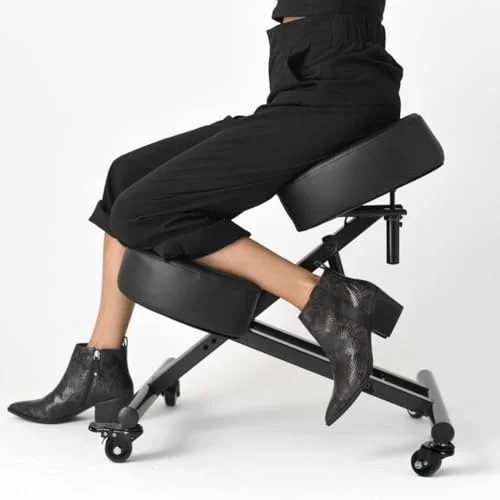
Sleekform Alpha Adjustable Kneeling Chair
Pros
- ✓ Adjustable seat angle and height fit a wider range of bodies and desks than fixed kneeling chairs
- ✓ Rolling casters make it easy to reposition without breaking the rocking motion
- ✓ Rocking base encourages small movements instead of locking you into one static position
- ✓ Lowest price of any chair in this comparison, an easy way to test kneeling posture before spending more
Cons
- ✗ Knee pad cushioning compresses noticeably faster than higher-end kneeling chairs under daily use
- ✗ No back support at all, so it doesn't work as a chair you lean back in periodically
- ✗ Shin and knee pressure builds up during long, uninterrupted sessions
The Sleekform Alpha is the cheapest legitimate entry point into kneeling posture, and it earns that role rather than just being the least expensive option on a list. The adjustable angle and height mean it fits more desks and more body sizes than fixed-position kneeling stools twice its price, and the rolling base keeps the rocking motion intact even when you shift positions. What you give up is durability at the cushion level — expect the knee pad foam to soften faster than it would on a wood-and-fabric chair built for a decade of use — and there’s zero back support for the moments you want to lean back and stretch.
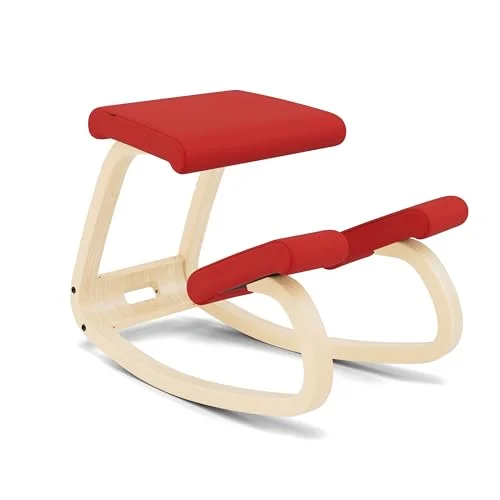
Varier Variable Balans Original Kneeling Chair
Pros
- ✓ Peter Opsvik's original 1979 balans design is still the reference point other kneeling chairs copy
- ✓ Solid ash wood base with a curved runner allows a fuller, smoother rocking range than pad-and-wheel budget designs
- ✓ Fabric and finish options let it look like real furniture instead of a piece of exercise equipment
- ✓ Backed by Varier's long-standing warranty coverage on the frame
Cons
- ✗ At $359, it's a steep jump over budget kneeling chairs for the same basic kneeling mechanic
- ✗ Still no back support, so the same shin and knee fatigue limits apply over long sessions
- ✗ 240 lb weight rating is lower than some competing designs, including the saddle stools in this comparison
The Varier Variable Balans is the chair that started this category. Norwegian designer Peter Opsvik introduced the original Balans concept in 1979, and this version still uses his curved-runner rocking mechanism on a solid ash wood base instead of a wheeled frame. The rocking feels noticeably smoother and more continuous than the Sleekform’s caster-based motion, and the fabric and finish options mean it can sit in a real office without looking like gym equipment. It costs more than four times as much as the Sleekform for the same basic kneeling mechanic, and its 240 lb weight rating is actually lower than the saddle stools below — worth checking against your own weight before buying.
Saddle Chairs: Sitting Astride Instead of Tilting Forward
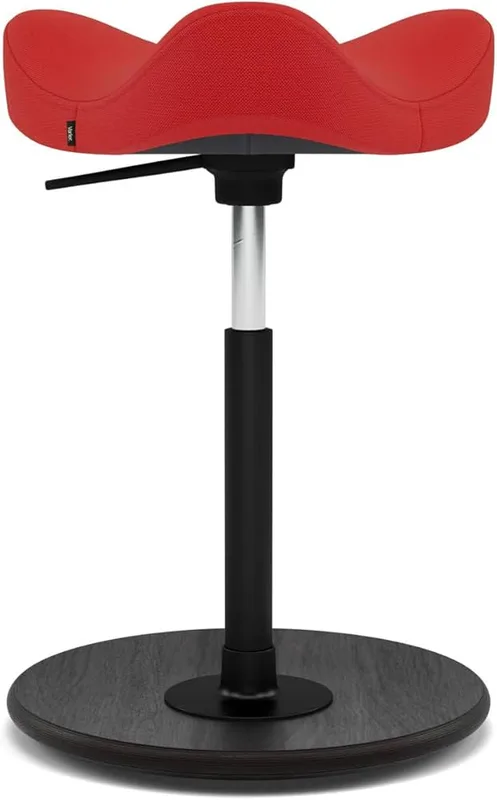
Saddle chairs solve the same hip-angle problem differently. Instead of kneeling on a pad, you sit astride a horn-shaped seat the way you would a horse or a bicycle. Your thighs angle down and out rather than forward, which opens the hip angle without putting any weight on your knees or shins at all. That makes saddle chairs the more realistic option for full workdays, and it’s why they show up constantly in dental offices, surgical suites, and tattoo studios where the person sitting needs both mobility and hours of upright posture.
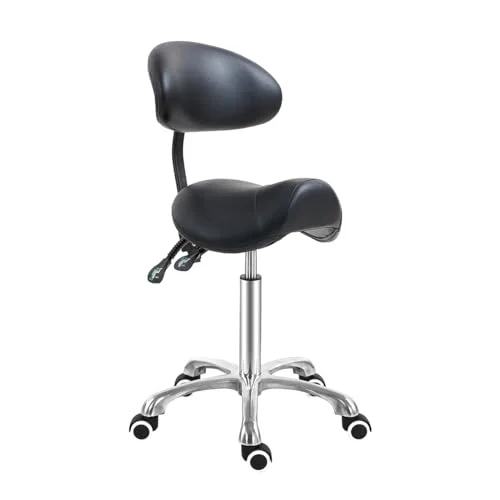
Antlu Saddle Stool Chair with Back Support
Pros
- ✓ Adjustable backrest gives saddle sitting a recline option most dedicated saddle chairs skip entirely
- ✓ 400 lb weight capacity is well above most home-office seating at this price
- ✓ 21"–28" height range covers most desk heights without buying a separate cylinder
- ✓ Casters and a swivel base make it easy to move around a desk or shared workspace
Cons
- ✗ Designed and marketed mainly for salons and clinics, so it looks more clinical than typical office furniture
- ✗ Foam cushioning is noticeably firmer than a purpose-built ergonomic saddle seat
- ✗ Swivels but doesn't rock forward and back the way a true saddle chair moves with your body
The Antlu saddle stool is built for exactly those clinical and salon settings, which is precisely why it works as a budget home-office pick — it’s engineered for people who sit on it eight hours a day, every day, and needs to survive that. The adjustable backrest is the standout feature here; most dedicated saddle chairs skip a backrest entirely, so having one to lean into during calls or reading is a genuine advantage over the Salli below. The 400 lb weight rating and 21”–28” height range cover more people than either kneeling chair in this comparison. The compromise is motion: it swivels on casters but doesn’t rock forward and back the way a purpose-built saddle chair does, so you get the hip-angle benefit without the same degree of active movement.
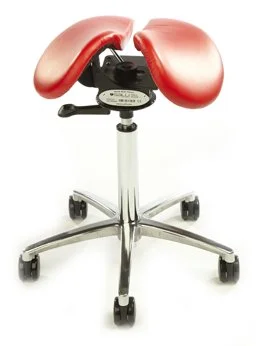
Salli SwingFit Saddle Seat
Pros
- ✓ Patented split-seat design with an adjustable center gap is a genuine anatomical feature, not a marketing label
- ✓ Heavy-duty 3mm steel seat plate under contoured foam is built to hold up over years of daily use
- ✓ Rocks and tilts with the body, encouraging natural pelvis movement instead of locking you into a fixed position
- ✓ 10-year warranty covers the seat, casters, tilt mechanism, lift, and base
Cons
- ✗ $1,425 puts it well outside impulse-purchase territory for most home offices
- ✗ Ships in 2–3 weeks from Finland instead of arriving same-week like the other three chairs
- ✗ The split seat and narrow profile take real adjustment time before they feel natural
The Salli SwingFit is a different category of product entirely, and the price reflects it. The split-seat design — two separate cushioned halves with an adjustable center gap — is a real anatomical feature aimed at relieving tailbone and pelvic floor pressure, not a spec-sheet buzzword. It rocks and tilts under a 3mm steel plate the way a saddle does under a rider, which is the closest a chair gets to matching the movement saddle chairs are named for. It’s handmade to order in Finland, which means a 2–3 week wait instead of next-day Amazon shipping, and at $1,425 it’s a purchase you make because you’ve already tried cheaper active-sitting options and know this is the mechanic that works for your body.
Kneeling vs Saddle: Which Mechanic Fits Your Body
The two styles aren’t interchangeable, and the right pick depends more on your joints than your budget.
Choose a kneeling chair if: you have healthy knees and want the simplest, cheapest way to try active sitting. The kneeling position is more intuitive to sit in correctly on day one — there’s less of a learning curve than finding the right saddle position. It’s also the better pick for short, focused sessions rather than an all-day chair, and pairing it with a sit-stand stool or a traditional ergonomic chair for the rest of the day is a common setup.
Choose a saddle chair if: you have knee, shin, or ankle issues that rule out kneeling entirely, or you’re dealing with lower back or pelvic floor discomfort that a kneeling chair won’t touch. Saddle chairs put zero load on your knees, and the hip-abduction angle gives your pelvis more room to move than a kneeling chair’s fixed forward tilt allows. They’re also the more realistic full-day option — that’s why professionals who sit for entire shifts gravitate toward them.
If you’re not sure a chair is even your problem, our guide to why your back hurts at your desk walks through diagnosing the actual cause before you spend money on a new seat. And if active sitting turns out not to be for you at all, a properly adjusted traditional chair from our guide to ergonomic chairs for lower back pain is a safer default than forcing yourself onto a kneeling or saddle chair you don’t get along with.
What to Look For Before You Buy Either Type
Weight capacity with margin. The 240 lb rating on the Varier is the lowest in this comparison — check your own weight against the stated capacity rather than assuming all active-sitting chairs handle the same load as a standard office chair.
Backrest availability. Most kneeling chairs have none, and most dedicated saddle chairs skip one too. If you know you’ll want to lean back periodically, the Antlu’s adjustable backrest is worth the tradeoff even at a lower price point than the Salli.
Adjustability. Seat height and angle adjustment matter more on these chairs than on a standard office chair, because there’s less forgiveness if the fit is wrong. A fixed-height kneeling chair that doesn’t match your desk height will fight your posture instead of helping it.
Budget expectations. Budget kneeling chairs run $70–$150. Premium designer kneeling chairs like the Varier land in the $300–$500 range. Repurposed clinic and salon saddle stools cost $100–$200. Purpose-built ergonomic saddle chairs from brands like Salli start well over $1,000 and can climb higher with custom upholstery. There isn’t a well-reviewed mid-tier saddle chair between those two price bands right now — it’s either a budget stool or a four-figure investment.
Return policy. Both chair types feel unfamiliar for the first week or two. Buy from a retailer with a real return window rather than assuming you’ll adjust — some people never do, regardless of price.
FAQ
Are kneeling chairs bad for your knees?
They can be if you use one for long, uninterrupted stretches. Kneeling chairs shift some of your body weight onto your shins and knees, which is fine in short sessions but can cause discomfort or joint strain over full workdays. Most ergonomics guidance treats kneeling chairs as a part-time seat, not a full replacement for your main chair.
Can I use a saddle chair or kneeling chair as my only office chair?
Saddle chairs hold up better to full-day use since they put no load on your knees. Kneeling chairs are better suited to shorter sessions mixed with a standard chair or a sit-stand stool for the rest of the day.
Which is better for lower back pain, a kneeling chair or a saddle chair?
It depends on the cause. Kneeling chairs help people whose lower back pain comes from a flattened lumbar curve caused by sitting with hips below knees. Saddle chairs go further for pelvic floor or tailbone-related discomfort, since the split-seat designs on chairs like the Salli SwingFit specifically relieve pressure that a solid seat pan can’t.
Do kneeling chairs actually improve posture?
They encourage a more open hip angle and a more neutral spine position than a standard chair seat, which is a real mechanical difference. They don’t fix posture on their own — like any ergonomic seat, the benefit depends on using it correctly and not overcompensating by leaning forward toward a monitor that’s positioned too low.
Why are saddle chairs so much more expensive than kneeling chairs?
The gap in this comparison is mostly about what the chair was engineered for. Budget saddle stools like the Antlu are adapted from salon and clinic equipment. Purpose-built ergonomic saddle chairs like the Salli SwingFit use a patented split-seat mechanism, medical-grade materials, and are handmade to order — closer to a piece of clinical equipment than furniture, which is reflected in the price.
Conclusion
Kneeling and saddle chairs both fix the same underlying problem — a closed hip angle from sitting in a standard chair for too long — but they get there through different mechanics with different tradeoffs. If you’re testing whether active sitting works for you at all, start with the Sleekform Alpha or the Antlu saddle stool — both are inexpensive enough to abandon without much lost if the position doesn’t suit you. If you already know kneeling works for your body and want a chair built to last, the Varier Variable Balans is worth the upgrade. And if a saddle position has already worked for you or your job keeps you seated for full shifts, the Salli SwingFit is the chair people who’ve tried the cheaper alternatives end up buying anyway.