Disclosure: PostureRanked is reader-supported. When you buy through links on our site, we may earn an affiliate commission at no additional cost to you. Our recommendations are based on independent research and testing.
Disclosure: PostureRanked is reader-supported. When you buy through links on our site, we may earn an affiliate commission at no extra cost to you. Learn more
The $500 Question at Herman Miller’s Top of the Line
You’ve decided to buy a Herman Miller chair. Now the harder decision: which one?
The Aeron runs about $1,445 for the Size B and has held the title of “best office chair” for three decades. The Embody runs about $1,945 — its price has shifted in 2026, narrowing the gap somewhat from its historic highs. Both carry the same 12-year warranty. Both have serious ergonomic science behind them. Both will outlast most of the furniture in your office.
The problem is they’re designed for completely different kinds of sitting. Pick the wrong one and you’ll own the most expensive disappointment you’ve ever assembled with an Allen key.
For most office workers, the Aeron is the right call. For developers, writers, and anyone logging 10-hour sessions in a single chair, the Embody has a real case. This comparison breaks down exactly why.
Quick pick: Standard office work with normal breaks → Aeron Size B. Marathon computing sessions or forward-lean work style → Embody.
Herman Miller Aeron Chair (Size B, Graphite)
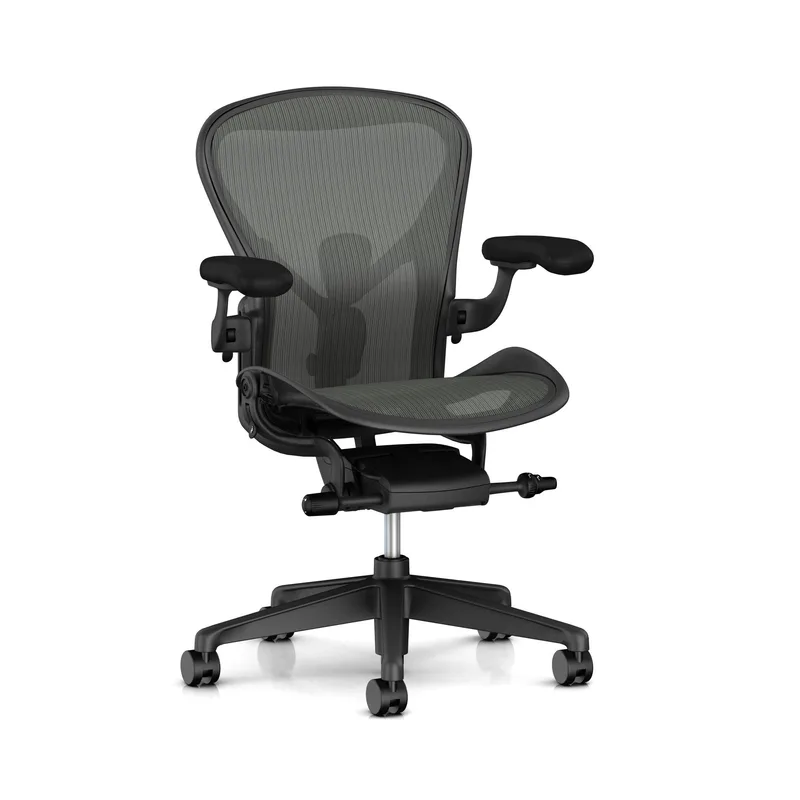
Herman Miller Aeron Chair (Size B, Graphite)
Pros
- ✓ Coolest-running seat of any premium chair — mesh never traps heat
- ✓ Three size options deliver a precise fit for almost any body type
- ✓ PostureFit SL independently supports sacrum and lumbar
- ✓ About $500 less than the Embody with the same 12-year warranty
Cons
- ✗ Pellicle mesh feels firm until fully broken in (2–4 weeks)
- ✗ Tilt mechanism is less dynamic than the Embody's adaptive back
- ✗ PostureFit SL upgrade adds cost over the base PostureFit version
Read our full Herman Miller Aeron review for the deep dive. Here’s how it stacks up in this comparison.
The Aeron is the default answer to “what’s the best office chair.” Originally released in 1994 and substantially updated in the 2016 Remastered revision, it’s the most studied and most replicated office chair ever made.
The core material is 8Z Pellicle mesh — eight zones of different tension across both the seat and back. It’s breathable enough that even in a warm room you can sit for hours without that overheated-cushion feeling. That alone makes the Aeron more practical than foam-seat alternatives for most climates.
The PostureFit SL lumbar mechanism is what separates the Aeron from most chairs at this price. Standard lumbar support addresses the inward curve of the lower back. PostureFit SL goes one step further — it attaches at both the sacrum (the flat plate at your spine’s base) and the lumbar above it, each adjustable independently. Since the sacrum’s angle determines lumbar position, this approach is more biomechanically targeted than anything that just presses on your lower back.
It comes in three sizes, which matters more than most reviews acknowledge:
- Size A — under 5’4” or under 140 lbs
- Size B — most users up to about 6’2”
- Size C — over 6’1” or over 200 lbs
A chair that fits your body beats a chair with better specs that doesn’t. The Embody can’t offer this.
The main critique: the tilt mechanism is functional but not dynamic. You’re choosing between upright, forward tilt, and recline — not getting the constant micro-accommodation of the Embody’s pixelated backrest. People who shift constantly may notice the Aeron as a slightly more static experience.
Herman Miller Embody Chair
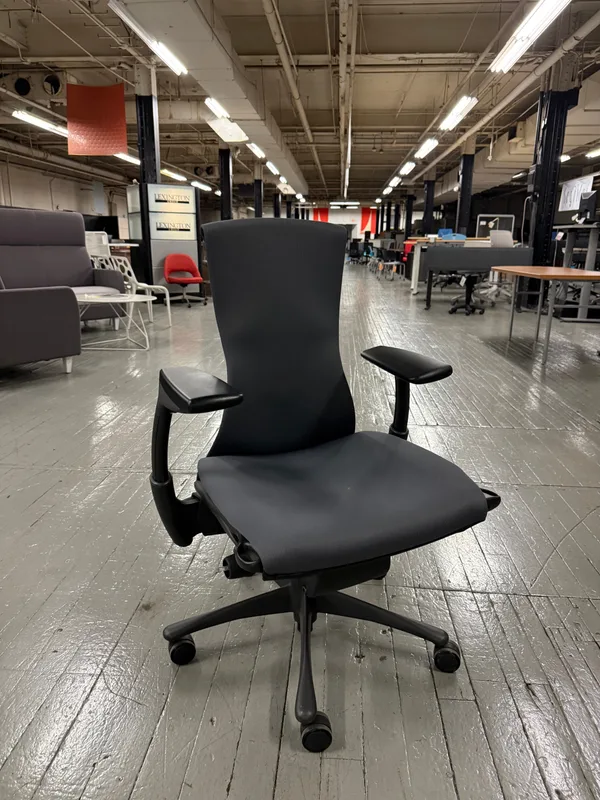
Herman Miller Embody Chair
Pros
- ✓ Pixelated backrest continuously adapts to every micro-movement
- ✓ Reduces lower back disc pressure during marathon work sessions
- ✓ Excellent support for forward-leaning computing and focus work
- ✓ Seat design promotes circulation better than traditional foam chairs
Cons
- ✗ Foam seat retains heat — uncomfortable in warm offices or summer
- ✗ $500 premium over the Aeron with diminishing returns for most users
- ✗ Single size is harder to dial in for very tall or very heavy users
See our Herman Miller Embody review for the full breakdown. Here’s the comparison context.
The Embody was built around one insight: most ergonomic chairs lock you into a “correct” posture. The body actually needs continuous micro-movement to stay comfortable. A chair that enforces stillness causes fatigue.
The answer is the pixelated backrest — a matrix of individual pixels on a copper-colored spine with nine zones of differential resistance. When you lean forward, shift side to side, or breathe deeply, the pixels flex to maintain contact with your back rather than pushing away from it. The effect is a backrest that feels alive — accommodating every subtle postural shift without requiring you to consciously readjust.
The seat is also engineered differently. It’s narrower than the Aeron’s to reduce hip compression, with layered foam and polymer support designed to distribute weight forward off the tailbone. The philosophy behind it is that reducing disc pressure in the lower back makes long sessions more sustainable. Users with chronic lower back issues who’ve gone through multiple chairs often land on the Embody as the one that finally helped.
Where it falls short: the foam seat retains heat. In a warm office or summer months, this matters significantly. The Aeron’s mesh wins on temperature hands-down. The Embody is also a single-size chair — extensive adjustability compensates reasonably well for most bodies, but it never fits as precisely as an Aeron sized specifically for your frame.
And it costs $500 more. That gap earns you the adaptive backrest. Whether that’s worth it depends entirely on how you sit.
Side-by-Side Comparison
| Feature | Aeron (Size B) | Embody |
|---|---|---|
| Price | ~$1,445 | ~$1,945 |
| Seat material | 8Z Pellicle mesh | Foam + polymer layers |
| Back support | PostureFit SL (sacral + lumbar) | Pixelated adaptive backrest |
| Temperature | Cool (mesh breathes freely) | Warmer (foam retains heat) |
| Sizing | Three sizes: A, B, C | Single size with adjustments |
| Weight capacity | 350 lbs | 300 lbs |
| Arms | 4-way adjustable | Fully adjustable |
| Warranty | 12 years | 12 years |
| Best for | General office, hot rooms, varied body types | Long compute sessions, forward leaners |
| Rating | 9.2/10 | 9.0/10 |
Buying Guide: Which Chair Is Right for You?
Buy the Aeron if:
- You work a typical 8-hour day with regular breaks and movement
- Your office runs warm or lacks reliable climate control
- You’re outside the “average” build and want precise size options
- Budget matters — $500 is real money, even at this tier
- You want the most proven, most reliable choice in premium office chairs
Buy the Embody if:
- You sit for 10+ hours without many breaks — developers, traders, writers
- You naturally lean forward into your work rather than sitting upright
- You’ve had persistent lower back issues that other chairs haven’t resolved
- Your office has good climate control (the foam seat is a real limitation otherwise)
- You want the most kinetically adaptive support available at any price
What about gaming?
Both work for gaming. The Embody’s forward-lean support makes it slightly more natural for the focused, hunched-in posture many gamers default to. The Aeron’s mesh is more comfortable during long sessions in warm rooms. Either way, see our guide on gaming posture — chair choice matters less than position and break frequency.
Can you buy refurbished?
Yes, and this is one of the best value plays in office furniture. Both chairs are built to last 15–20 years. A refurbished Aeron from a reputable dealer typically runs $500–$900; a refurbished Embody often goes for $900–$1,300. Herman Miller’s warranty doesn’t transfer, but the construction quality does.
FAQ
Is the Herman Miller Embody worth $500 more than the Aeron?
For most people, no. The Aeron handles the vast majority of ergonomic needs at $500 less. The Embody earns its premium specifically for users who sit 10+ hours daily and benefit from constant adaptive back support. Regular office workers who take normal breaks will be well served by the Aeron.
Which is better for lower back pain?
Both are genuinely effective, but differently. The Aeron’s PostureFit SL is more targeted — it directly adjusts sacral position, which controls lumbar curve. The Embody distributes pressure more broadly and handles constant movement better. If your pain comes from one specific tension point, the PostureFit SL is probably more directly useful. If you have diffuse fatigue across the whole back, the Embody’s adaptive support may help more.
Which chair fits tall people better?
The Aeron Size C is specifically engineered for users over 6’1” — taller back, longer seat dimensions. The Embody accommodates taller users through its adjustment range, but single-size precision is harder to achieve. Tall buyers are generally better served by the Aeron C.
Can I try both chairs before buying?
Yes. Herman Miller has authorized dealers and showrooms across the US. Given the price, sitting in both for at least 20 minutes before buying is worth the trip. Herman Miller also offers a 30-day return window through their direct store, which provides some safety net for online purchases.
Do both chairs have the same warranty?
Yes. Both carry Herman Miller’s 12-year, 24-hour, 365-day warranty — covering the chair for 12 years of around-the-clock commercial use, not just standard hours. This is significantly more comprehensive than competitors offering 5-year or “limited” coverage, and it’s a major reason these chairs hold their resale value.
Is the Aeron still worth buying in 2026?
Absolutely. The 2016 Remastered design remains the benchmark for breathable, adjustable office seating. Competitors have added adaptive features and new materials, but nothing has meaningfully surpassed the Aeron’s combination of mesh breathability, precise lumbar targeting, and sized-to-fit options. It’s not new — it’s proven.
The Bottom Line
Both chairs are legitimately excellent. Neither will disappoint. The decision comes down to what kind of sitting you do.
The Aeron wins on versatility, breathability, sizing precision, and price. It’s the chair to recommend to 80% of buyers at this tier.
The Embody wins on adaptive support and marathon-session performance. If you’re a developer or someone who genuinely sits for 10+ hours straight, the $500 premium is worth evaluating seriously.
For the full premium chair roundup — including the Steelcase Leap, Humanscale Freedom, and others at this price tier — see our Best Luxury Office Chairs guide. If you’re still weighing whether premium chairs are worth the investment at all, Are Expensive Office Chairs Worth It? breaks down the long-term math. And if you’re building out the rest of your workspace, our Complete Luxury Home Office Setup Guide covers pairing either chair with the right desk and accessories.