Wrist pain from typing or gaming doesn’t announce itself with a dramatic snap. It sneaks up on you — a dull ache after a long session, tingling that wakes you at 3 a.m., fingers that feel oddly clumsy after hours at the keyboard. By the time most people go looking for a wrist brace, they’re already dealing with carpal tunnel syndrome, RSI, or early-stage tendinitis.
In May 2026, FEATOL made waves by launching a new ergonomic wrist support line specifically designed for modern repetitive strain challenges — a direct response to the growing number of workers and gamers spending 8–12 hours a day at a desk. It’s a signal that the industry is finally taking typing-induced wrist injuries seriously as a distinct use case from general sports injury recovery.
This roundup covers the six best wrist braces for desk workers and gamers — products that provide genuine medical-grade support without being so bulky you can’t actually type with them on.
Quick Pick: The FEATOL 2 Pack is the best overall value — two braces (right and left hand) for $30.99, with a removable splint and breathable daytime design built for long work sessions.
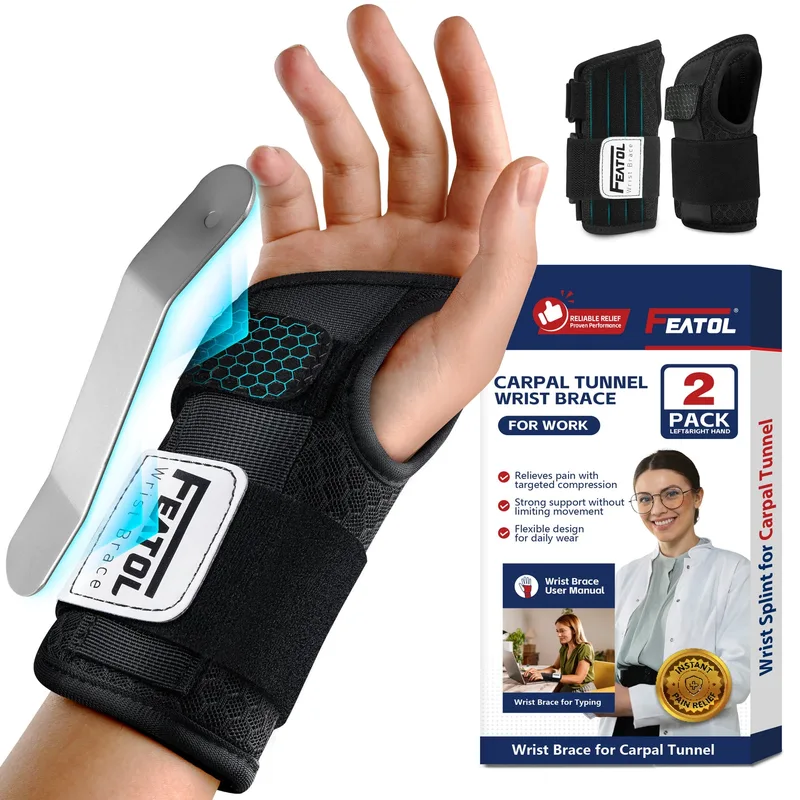
1. FEATOL 2 Pack Carpal Tunnel Wrist Brace For Work — Best Overall
FEATOL 2 Pack Carpal Tunnel Wrist Brace For Work
Pros
- ✓ Two braces for the price of one — covers both hands
- ✓ Removable aluminum splint lets you dial up or down on support
- ✓ Breathable fabric stays comfortable through long work sessions
- ✓ Three adjustable straps for a precise, personalized fit
Cons
- ✗ Metal splint can retain heat in warm environments
- ✗ Sizing runs specific — measure your wrist before ordering
- ✗ Best for mild to moderate symptoms, not severe carpal tunnel
The FEATOL 2 Pack earns the top spot because it solves the most common wrist brace problem: you need support on both hands but don’t want to pay twice. At $30.99, you get a right-hand and a left-hand brace, each with a removable aluminum splint and three adjustable velcro straps.
The daytime design is the key differentiator here. Where most braces default to a night-splint design (rigid, bulky, and awkward at a keyboard), FEATOL specifically engineered this brace for work hours. The aluminum splint holds your wrist in neutral position without locking your fingers out of action. Pull the splint out entirely and the brace shifts into a compression-only mode — enough support for mild symptoms, flexible enough for gaming.
The three-strap system is generous for this price. You can dial in the wrist, palm, and finger-end independently, which makes it actually possible to wear comfortably through a full workday rather than ripping it off after 20 minutes.
Manufacturer specs list it as suitable for carpal tunnel, tendinitis, arthritis, and pregnancy-related wrist swelling. Owner reports consistently mention all-day comfort as the standout trait — uncommon in a splinted brace.
At 4.6 stars from over 1,600 reviews on Amazon, this is the brace I’d hand a friend who just got a carpal tunnel diagnosis and wants to avoid surgery.
Best For: Desk workers and remote workers with early to moderate carpal tunnel or typing-related RSI who need support on both hands.
2. Vive Carpal Tunnel Wrist Brace with Splint — Best Value
Vive Carpal Tunnel Wrist Brace with Splint
Pros
- ✓ Reversible design works on either hand — no need to buy separately
- ✓ Triple splint system offers firm, stable wrist support
- ✓ Breathable neoprene blend stays cool during use
- ✓ Open-finger design keeps you functional while typing
Cons
- ✗ Slightly bulkier fit can feel restrictive during fast gaming
- ✗ Metal splint requires an adjustment period before feeling natural
- ✗ May be loose on smaller wrists even at tightest setting
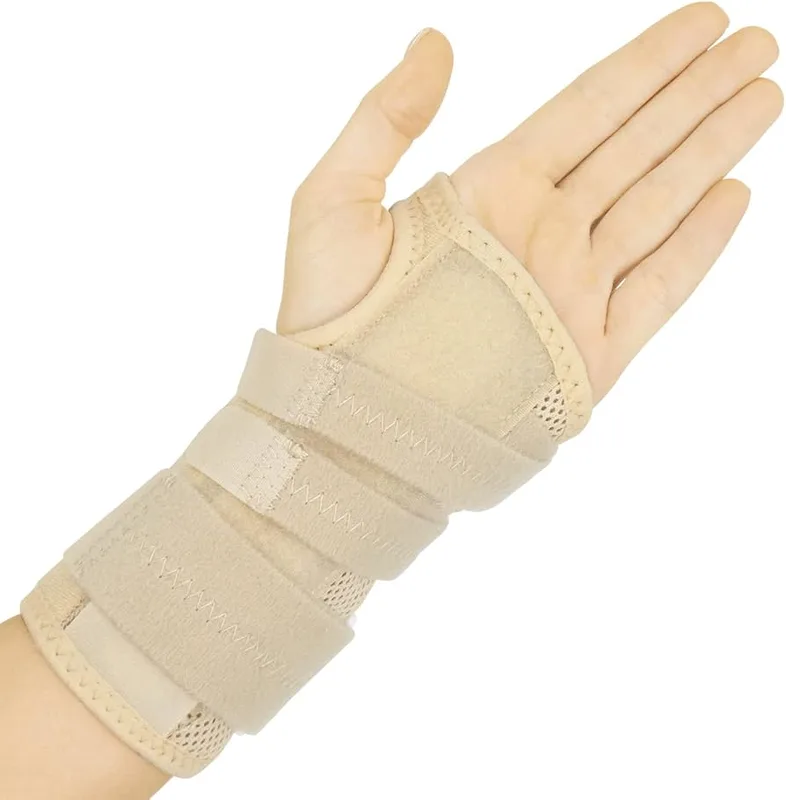
The Vive is the best single-brace value at $17.99 — and it earns that title by doing something most braces in this range don’t: giving you a triple splint system with real support options.
You get one steel splint running along the underside of your wrist and two composite splints on top. All three are removable independently. Use all three for maximum immobilization overnight, pull the top composites for daytime use, or remove everything for light compression when you’re gaming. This modular approach means one brace covers multiple use cases.
The reversible design is another practical win. A single brace works on either hand, which is exactly what you want when you’re not sure which wrist will need attention first — or if symptoms shift side to side during recovery.
Neoprene blend construction keeps it breathable. Three velcro straps lock it in place. The open-finger design leaves your full hand available for typing and mouse work.
The main trade-off is bulk. With all splints in, this brace is noticeable under a desk or during gaming — it restricts fast wrist movement more than lighter compression options. For night use or heavy-support periods during the day, that’s fine. For competitive gaming, you’d want to go with something thinner.
Best For: Budget-conscious desk workers who want a daytime-to-nighttime brace that covers both hands without buying two separate products.
3. Mueller Sports Medicine Adjustable Wrist Brace — Best for Active Use
Mueller Sports Medicine Adjustable Wrist Brace
Pros
- ✓ Trusted sports medicine brand with decades of use in athletic contexts
- ✓ Built-in steel springs for consistent, reliable support
- ✓ Wraparound design fits either hand without buying two versions
- ✓ Lightweight fabric keeps it comfortable for extended wear
Cons
- ✗ No removable splint option — support level is fixed
- ✗ Steel springs can feel stiff during the first few uses
- ✗ Limited adjustability compared to multi-strap designs
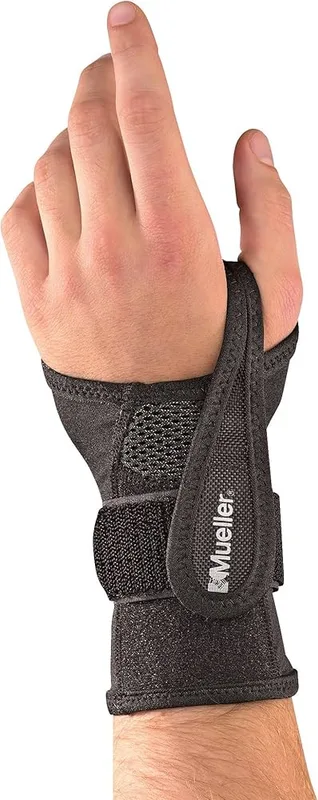
Mueller has been a go-to name in athletic wrist support for decades, and the Adjustable Wrist Brace ($27.77) shows why. It’s built around a different philosophy than the splinted braces above: instead of a removable rigid insert, it uses built-in steel springs to maintain wrist position dynamically.
The result is a brace that supports without restricting. The springs flex with your movement rather than locking against it, which makes this feel more natural during typing and gaming than most rigid splints. The single wraparound strap gets you a secure fit in one adjustment rather than fussing with three separate closures.
It fits wrists up to 10” circumference and works on either hand — no need to specify left or right at checkout, which matters when you’re ordering in a hurry or buying for someone else.
The limitations are clear: no removable splint means you can’t customize the support level, and the fixed steel springs are firmer than some people want for mild RSI prevention. If your symptoms are still early, the Futuro at the bottom of this list might be a better starting point.
Best For: Gamers and desk workers with mild to moderate wrist pain who want athletic-grade wrist support that moves with them rather than locking them in place.
4. Doctor Developed Copper Wrist Brace (Dr. Arthritis) — Best Medical-Grade Wrap
Doctor Developed Copper Wrist Brace (Dr. Arthritis)
Pros
- ✓ FDA-registered medical device — not just a generic brace
- ✓ Includes a doctor-written handbook with exercises and tips
- ✓ Copper lining adds mild compression support
- ✓ Works for arthritis and carpal tunnel simultaneously
Cons
- ✗ Wrap-style design offers less rigid support than a splinted brace
- ✗ Some users find the internal seams irritating on sensitive skin
- ✗ Not ideal if you need firm immobilization overnight
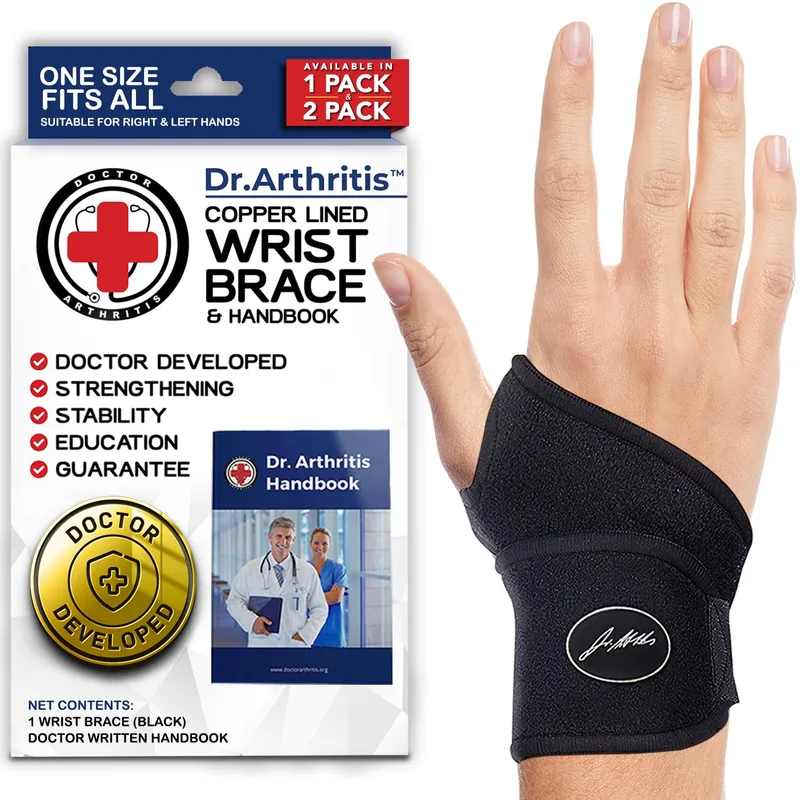
The Dr. Arthritis brand takes a different angle from the splint-based braces above. Their brace is an FDA-registered medical device — not just a “medical-grade” claim on the label — built from 65% neoprene and 35% nylon with a copper-lined inner surface.
The copper lining provides mild additional compression and is permanently integrated into the material. More importantly, every brace ships with a doctor-written handbook covering wrist anatomy, exercises for strengthening and recovery, and guidance on when to see a specialist. That’s a meaningful add-on for anyone navigating a new wrist injury without clear medical direction.
The wrap style makes this easier to put on one-handed than a three-strap splint, and the reversible design covers either hand. Trade-off: it doesn’t provide the firm immobilization of a metal-splinted brace. If you need your wrist held in a strict neutral position overnight or during heavy symptom flares, step up to the Vive or FEATOL.
For desk workers in the early stages of RSI, or those managing arthritis alongside wrist fatigue, this is a smart, medically credentialed option at a reasonable price.
Best For: Desk workers dealing with both arthritis and carpal tunnel, or anyone who wants an FDA-registered brace with professional guidance included.
5. Copper Compression Advanced Wrist Brace — Best for All-Day Wrist Support
Copper Compression Advanced Wrist Brace
Pros
- ✓ Copper is permanently infused into the fiber — doesn't wash out
- ✓ Low-profile design works under a desk setup without getting in the way
- ✓ Hook-and-eye straps give precise compression control
- ✓ Comfortable enough for night use and daily wear
Cons
- ✗ Sold as one hand only — buy separately for both wrists
- ✗ Some reviewers find support level too light for moderate carpal tunnel
- ✗ Higher price point for what is essentially a compression support
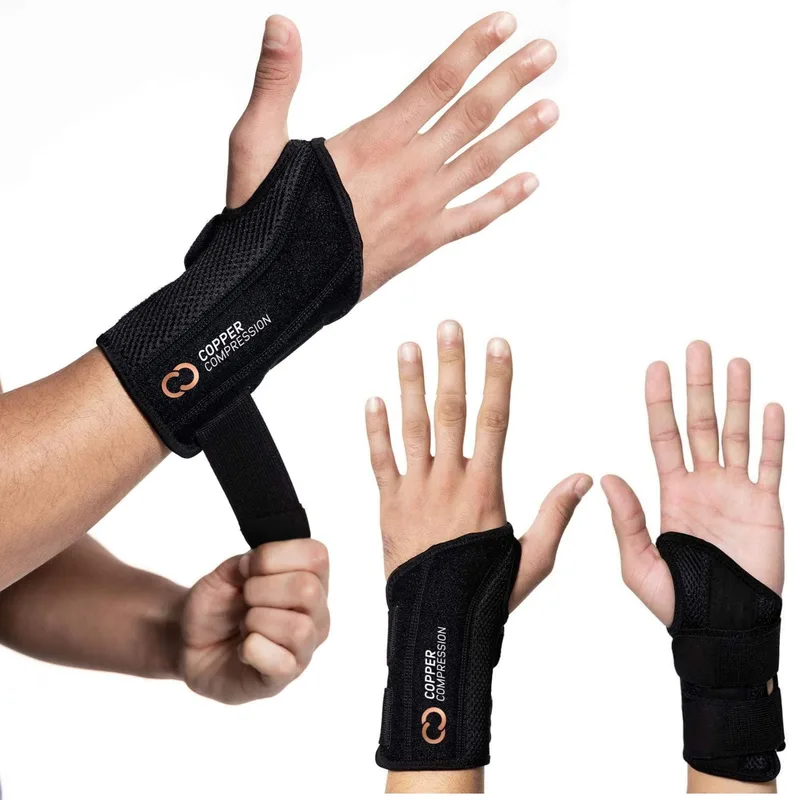
If you want the thinnest, most wearable option that still classifies as a brace rather than a compression sleeve, the Copper Compression Advanced ($28) is it. The copper-infused nylon fabric is the core technology here — copper embedded directly into the fiber rather than added as a coating, so it won’t wash out over time.
The orthopedic splint along the palm side of the brace holds the wrist in neutral position with more structure than a sleeve but less bulk than a full splint system. Hook-and-eye straps (rather than velcro) let you dial compression up or down with fine precision.
Where it falls short: the support level is on the lighter end of the spectrum. Reviewers with moderate to severe carpal tunnel regularly note it doesn’t provide enough immobilization. It’s also sold as a single hand brace — right and left hand versions are separate listings — which means you’re paying $28 per wrist if you need both.
This is the brace for someone whose symptoms are mild or who needs preventive support during marathon coding or gaming sessions before a diagnosis becomes serious.
Best For: Light to moderate carpal tunnel, RSI prevention, and all-day wearers who prioritize a low-profile fit over maximum immobilization.
6. Futuro Performance Comfort Wrist Support — Best Lightweight Option
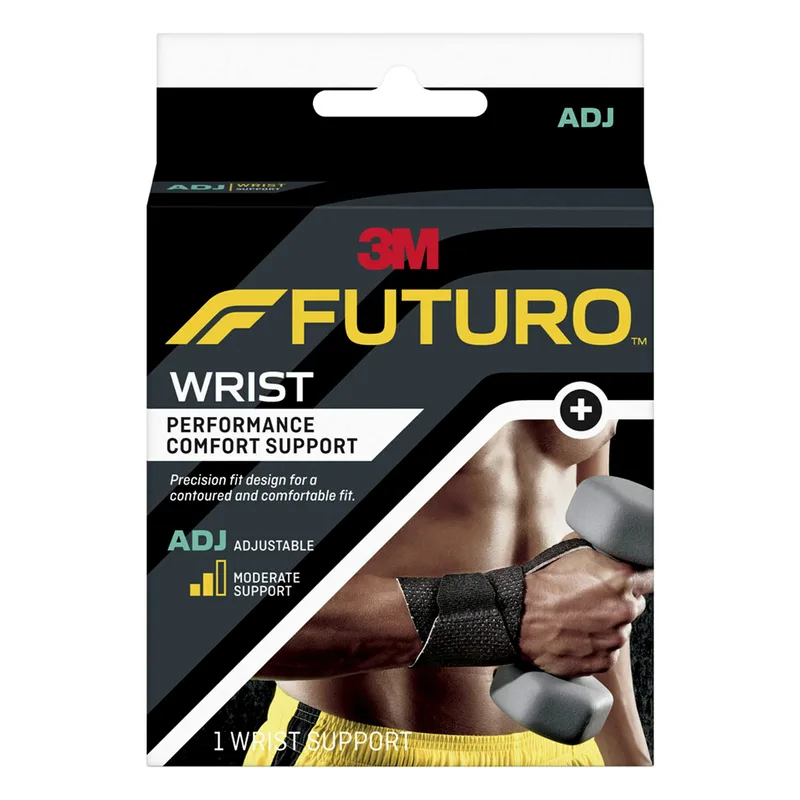
Futuro Performance Comfort Wrist Support
Pros
- ✓ Lightest, most discreet option on this list
- ✓ Thumb loop makes it easy to slip on and off quickly
- ✓ Open palm design provides full hand mobility for typing
- ✓ Breathable neoprene keeps wrist warm without trapping heat
Cons
- ✗ Mild support only — not sufficient for moderate to severe carpal tunnel
- ✗ No rigid splint means less immobilization
- ✗ Best as a preventive measure rather than an active RSI treatment
The 3M Futuro Performance Comfort Wrist Support is the most minimal product on this list, and that’s its entire value proposition. At $13.99, it’s the most affordable pick here — and it’s designed for people whose wrists aren’t severely symptomatic yet but who want to get ahead of the problem.
The neoprene-blend fabric provides mild compression and heat retention, which is genuinely useful for wrist fatigue during long desk sessions. The thumb loop design makes it fast to apply one-handed. The open-palm and low-profile construction mean you genuinely cannot feel it during normal typing — it’s that discreet.
But “lightweight” means tradeoffs. There’s no splint, no rigid support, and no serious immobilization. If you’re already experiencing numbness, tingling, or nighttime symptoms, this brace is not going to cut it. Step up to the Vive or FEATOL for real therapeutic support.
This one belongs on the wrist of someone who types for 10 hours a day, notices fatigue building toward the evening, and wants to take prevention seriously before it becomes an injury.
Best For: Prevention-focused typists and gamers with early wrist fatigue who want something they can wear all day without noticing it.
Wrist Brace Comparison Table
| Product | Price | Splint Type | Hands | Support Level | Best For |
|---|---|---|---|---|---|
| FEATOL 2 Pack | $35.99 as of Oct 18, 2026 | Removable aluminum | Both (included) | Moderate | All-day typing |
| Vive Dual Splint | Unavailable | Steel + 2 composite | Either (reversible) | Moderate–Firm | Day and night use |
| Mueller Adjustable | Unavailable | Built-in steel springs | Either | Moderate | Active/sports use |
| Doctor Developed | $14.95 as of Oct 18, 2026 | Copper-lined wrap | Either (reversible) | Mild–Moderate | Arthritis + carpal tunnel |
| Copper Compression | $27.95 as of Oct 18, 2026 | Orthopedic splint | Right or left (separate) | Mild–Moderate | All-day prevention |
| Futuro Performance | $13.66 as of Oct 18, 2026 | None | Either | Mild | Preventive use |
Buying Guide: What to Look for in a Wrist Brace for Typing and Gaming
Splint vs. Compression: Know the Difference
A splint-based brace holds your wrist in a fixed neutral position. A compression brace applies pressure without restricting movement. For carpal tunnel and tendinitis, you generally want a splint — the neutral wrist position reduces pressure on the median nerve. For RSI prevention and mild fatigue, compression may be enough.
The better braces on this list (FEATOL, Vive) offer removable splints so you get both options in one product.
Daytime vs. Nighttime Use
Most medical guidance recommends rigid splinting at night, when your wrists tend to curl into positions that aggravate carpal tunnel during sleep. Daytime use typically calls for something more flexible so you can actually work.
The FEATOL 2 Pack bridges both with its removable splint system. The Vive is a strong night brace too. If you only buy one brace, make sure it can handle both use cases.
One Hand vs. Both Hands
Carpal tunnel often starts in the dominant hand but frequently develops bilaterally — both hands, over time. The FEATOL 2 Pack and Vive reversible design both address this without requiring you to buy twice. The Copper Compression, by contrast, sells each hand as a separate product.
Breathability and Daytime Wear
Neoprene retains heat. That’s useful in cold conditions and for therapeutic warmth, but it can become uncomfortable after 4–6 hours if you’re in a warm office or gaming for long sessions. Look for products that describe breathable or moisture-wicking materials if you plan to wear the brace during active use rather than just at night.
Carpal Tunnel vs. RSI vs. Tendinitis
These three conditions feel similar but are distinct:
- Carpal tunnel syndrome: Median nerve compression causing numbness, tingling, and weakness in the thumb, index, and middle fingers. Splinting is the primary conservative treatment.
- RSI (Repetitive Strain Injury): Cumulative overuse injury in the tendons, muscles, or nerves. Compression and rest are key.
- Tendinitis: Inflammation of specific tendons, often causing localized pain and swelling. Compression with mild restriction helps most.
If you’re unsure which you have, see a doctor before self-treating. A wrist brace can help, but it won’t replace a proper diagnosis — especially if symptoms are severe or worsening.
FAQ
Can I type with a wrist brace on?
Yes, with the right brace. The products on this list are all designed with an open-finger construction so your fingers remain fully functional. The FEATOL, Vive, and Copper Compression work well during active typing sessions. A full rigid night splint (more than these products offer) would make typing nearly impossible.
How long should I wear a wrist brace each day?
That depends on your symptoms and the brace. For carpal tunnel prevention, wearing a brace during your highest-risk activities (long typing or gaming sessions) is reasonable. For active carpal tunnel treatment, many occupational therapists recommend wearing a splint during sleep and during aggravating activities throughout the day. If symptoms are severe, consult a doctor — a brace is not a substitute for medical treatment.
Are wrist braces effective for gaming?
They can help, particularly for preventing or managing RSI and carpal tunnel from repetitive mouse and keyboard use. Braces that provide mild to moderate support without restricting finger movement (like the Mueller or Copper Compression) are best for active gaming. Rigid splints work better for recovery periods between gaming sessions.
Does wearing a wrist brace actually prevent carpal tunnel?
A brace can help prevent the condition from worsening by keeping your wrist in a neutral position during high-risk activities. However, the best prevention comes from a combination of ergonomic adjustments (proper keyboard height, mouse position, monitor distance), regular breaks, and targeted strengthening exercises. A brace is one part of a prevention strategy, not the whole solution. Check out our complete standing desk setup guide for broader ergonomic recommendations that reduce strain across your entire upper body.
What’s the difference between a wrist brace and a wrist rest?
A wrist brace is a therapeutic device worn on your wrist to provide structural support and hold the wrist in a neutral position. A wrist rest is a pad that sits in front of your keyboard or mouse to raise your wrists during use. Both address wrist ergonomics but from different angles — wrist rests reduce strain during active use, wrist braces correct position and support healing during and after use. Many people benefit from both.
When should I see a doctor instead of buying a wrist brace?
See a doctor if: symptoms are severe or worsening rapidly, you experience significant weakness or muscle wasting in your hand, you’ve been wearing a brace for 4–6 weeks with no improvement, or you have numbness that persists even at rest. A wrist brace is appropriate for mild to moderate symptoms as a first-line measure — it’s not a replacement for diagnosis or treatment of a serious underlying condition.
Conclusion
The right wrist brace depends on where you are in the progression from “my wrist feels tired” to “I can’t sleep from the tingling.”
- Just starting to feel wrist fatigue? The Futuro Performance Comfort ($13.99) is a low-commitment starting point.
- Mild to moderate RSI or carpal tunnel? The FEATOL 2 Pack ($30.99) covers both hands and both daytime and nighttime use in one purchase.
- Budget-constrained but need real support? The Vive ($17.99) delivers a triple-splint system at a price that’s genuinely hard to argue with.
- Want something that doesn’t look medical? The Copper Compression ($28) is the most discreet option with a proper orthopedic support structure.
Prevention beats painkillers every time. Get ahead of the problem before your wrists start making that decision for you.
For broader ergonomic improvements, see our posture correctors for office workers guide — wrist health is only one piece of a complete desk ergonomics setup.