Your chair may have a great seat pan and armrests, but if it lacks proper lumbar support — or the built-in lumbar pad is in the wrong position — no amount of reclining will fix the ache you feel after four hours of work. A lumbar support cushion is the fastest, cheapest fix available: for $20 to $45, you can transform a mediocre task chair into something that keeps your lower back in proper alignment all day.
The challenge is that not all lumbar cushions work for all bodies or all chairs. A thick memory foam pillow that’s perfect for a mesh executive chair can push you uncomfortably forward in a bucket gaming chair. A cylindrical roll beloved by physical therapists might feel like torture if you’ve never used one before. This guide compares six of the most-recommended options across different materials, shapes, and price points to help you find the right match.
Quick pick: If you just want the most reliable all-around option, the Everlasting Comfort Original Lumbar Support Pillow does everything well for $29.99 — it’s the one I’d put in a drawer at work and a second one in my car.
1. Everlasting Comfort Original Lumbar Support Pillow — Editor’s Pick
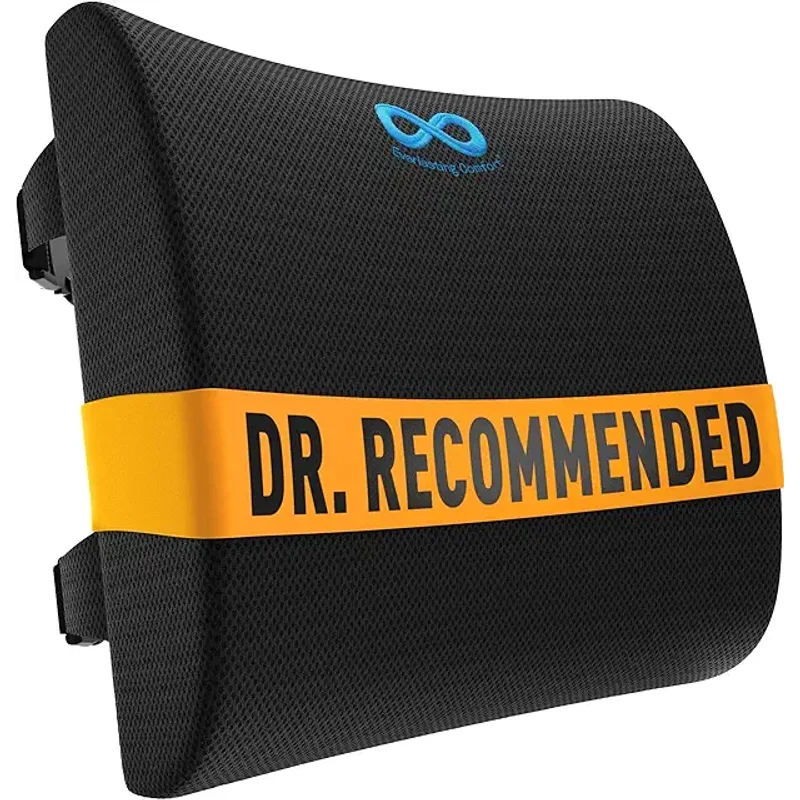
Everlasting Comfort Original Lumbar Support Pillow
Pros
- ✓ Dual straps lock it in place on chairs up to 32" wide
- ✓ Breathable mesh cover stays noticeably cooler than solid foam covers
- ✓ Lifetime replacement guarantee — no questions asked
- ✓ Works on office chairs, car seats, and recliners alike
Cons
- ✗ Can feel quite firm the first few days before the foam breaks in
- ✗ Slightly bulky for compact bucket car seats
- ✗ No height adjustment without repositioning the straps
The Everlasting Comfort is the lumbar cushion that shows up first in nearly every roundup for good reason: it balances supportive-but-not-rock-hard memory foam with a practical dual-strap design that actually stays put. Unlike single-strap models that slide down over the course of a workday, the two straps let you position it exactly where your lumbar curve sits and keep it there.
The mesh cover earns its keep in summer. Memory foam is an insulating material by nature, and the breathable mesh surface does a decent job of preventing the “hot back” effect you get with solid-covered pillows after an hour at your desk. The cover zips off and goes in the washing machine — useful if you’re the kind of person who spills coffee.
At $29.99 with a lifetime replacement guarantee, it’s hard to argue with. Owner reports across thousands of reviews consistently describe it as firm enough to make a real difference but not so rigid it creates new pressure points. Give it a few days to break in — fresh memory foam straight from packaging can feel surprisingly stiff.
Best for: Office workers who want a no-fuss solution that works across multiple chairs — desk, car, couch.
2. OPTP Original McKenzie Lumbar Roll — PT Recommended
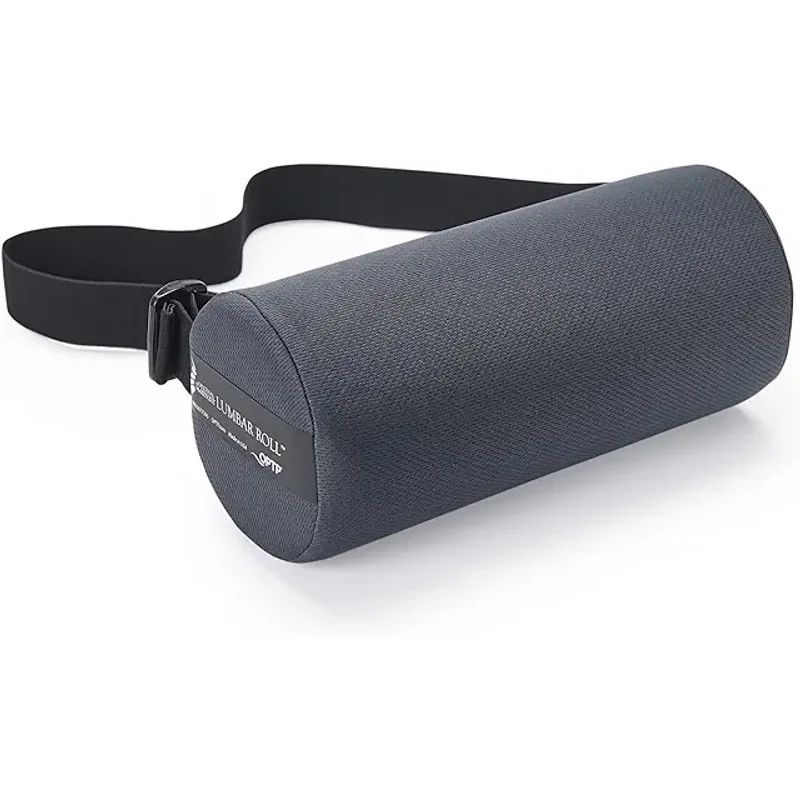
OPTP Original McKenzie Lumbar Roll
Pros
- ✓ The go-to pick of physical therapists and chiropractors for decades
- ✓ Cylindrical shape provides precise lumbar curve restoration
- ✓ Lightweight at under 0.5 lbs — great for commuters and travelers
- ✓ Made in the USA with durable polyurethane foam
Cons
- ✗ No memory foam — purely functional, not plush
- ✗ Only one size — may not suit very tall or petite users perfectly
- ✗ Takes adjustment time if you haven't used lumbar rolls before
The McKenzie roll is a different animal from everything else in this roundup. It’s not a pillow — it’s a firm cylindrical foam roll that tucks into the curve of your lower back, the same way physical therapists have been prescribing for back rehabilitation since Robin McKenzie developed his method in the 1950s. If your back pain has a clinical component, or a PT or chiropractor has recommended a lumbar roll, this is what they’re talking about.
At 11 inches long and 4.75 inches in diameter, it provides focused support right at the lumbar vertebrae rather than spreading pressure across the full lumbar-to-mid-back zone. That precision is the point — it restores the natural lordotic curve of your lower back, which is often flattened out by prolonged sitting. Owner feedback consistently describes an initial “wow, that’s different” reaction followed by genuine long-term relief for those who stick with it.
The tradeoff is comfort in the traditional sense. There’s no plush memory foam cushioning here, just dense functional foam doing a very specific job. If you’re looking for something that feels luxurious, this isn’t it. But if you want the clinician-approved solution, there’s a reason it has over 17,000 Amazon reviews at 4.4 stars.
Best for: Users recovering from or managing lower back pain, or anyone whose physical therapist has recommended a lumbar roll.
3. ComfiLife Lumbar Support Back Pillow — Best Value
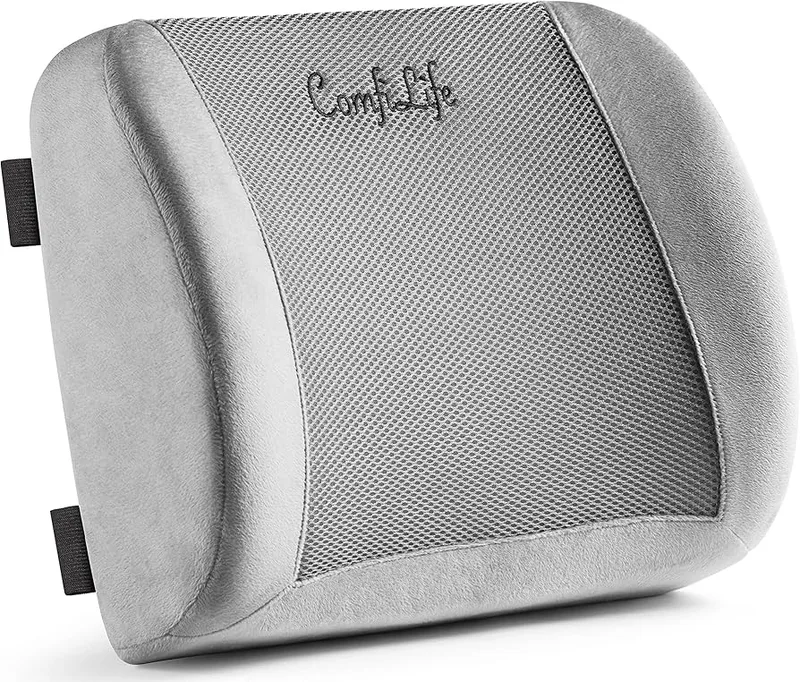
ComfiLife Lumbar Support Back Pillow
Pros
- ✓ Wider than most competitors — better coverage for broad-shouldered users
- ✓ 3D ventilated mesh cover stays breathable during long sessions
- ✓ High-density foam holds its shape over years of daily use
- ✓ Trusted by chiropractors and PTs, per owner reports
Cons
- ✗ Thicker profile may push you too far forward in bucket-style chairs
- ✗ Single strap occasionally shifts on chairs without flat backrests
- ✗ Not the most compact for travel
The ComfiLife earns its spot not through any single standout feature, but by executing every element well at a $32.99 price point. The 3D ventilated mesh cover is meaningfully more breathable than standard flat mesh, the 15 x 12.5-inch footprint gives it better coverage than the Everlasting Comfort for broader backs, and the high-density memory foam has proven durable enough in user accounts to maintain its shape after two-plus years of daily use.
Where it slightly edges out the Everlasting Comfort is lateral coverage. Taller or broader users who find the standard pillow too narrow get more back-to-chair contact with the ComfiLife. It’s also backed by a lifetime satisfaction guarantee, which puts it on equal footing with its main competitor in terms of buyer protection.
The one drawback worth noting: at 4.7 inches thick, it pushes you noticeably forward in your chair. In a flat-backed office chair, that’s ideal for encouraging a forward-tilted pelvis. In a deeply contoured gaming chair or bucket car seat, you may find yourself fighting the chair instead of working with it.
Best for: Users with larger frames or broader shoulders who need more lateral lumbar coverage.
4. QUTOOL Lumbar Support Pillow — Largest Coverage
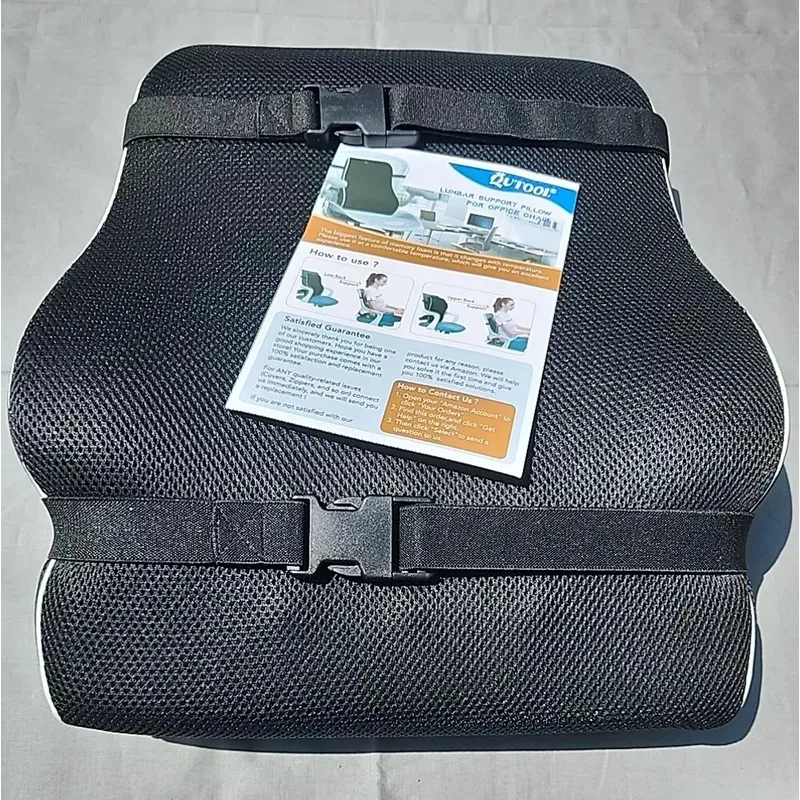
QUTOOL Lumbar Support Pillow
Pros
- ✓ Largest coverage area of any cushion in this roundup
- ✓ Dual straps provide secure attachment to a wide range of chairs
- ✓ Memory foam free of harmful substances — CertiPUR certified
- ✓ Machine-washable 3D mesh cover
Cons
- ✗ Size can be too large for compact or petite users
- ✗ Heat builds up faster than mesh-heavy competitors after 90 minutes
- ✗ Slightly heavier — less ideal for frequent travel
At 16.9 x 15.5 inches, the QUTOOL is the widest lumbar cushion in this roundup by a meaningful margin. If every other cushion you’ve tried seemed too small — leaving your lower back sides unsupported — this is the one to try. The dual adjustable straps keep it anchored to most chair backs, and the memory foam is certified free of harmful substances.
The size comes with a tradeoff: at 1.8 lbs it’s the heaviest option here, and the larger surface area means it retains heat faster than competitors. Owner feedback notes it becomes noticeably warm after about 90 minutes of continuous sitting, which is a real consideration if your office runs warm. In a climate-controlled environment or during shorter working sessions, this matters less.
At $26.99, it’s competitively priced for what you get.
Best for: Users who sit for shorter stretches and need wider lumbar coverage, or those who’ve found standard-sized cushions too narrow.
5. Samsonite Memory Foam Lumbar Support Pillow — Best Budget
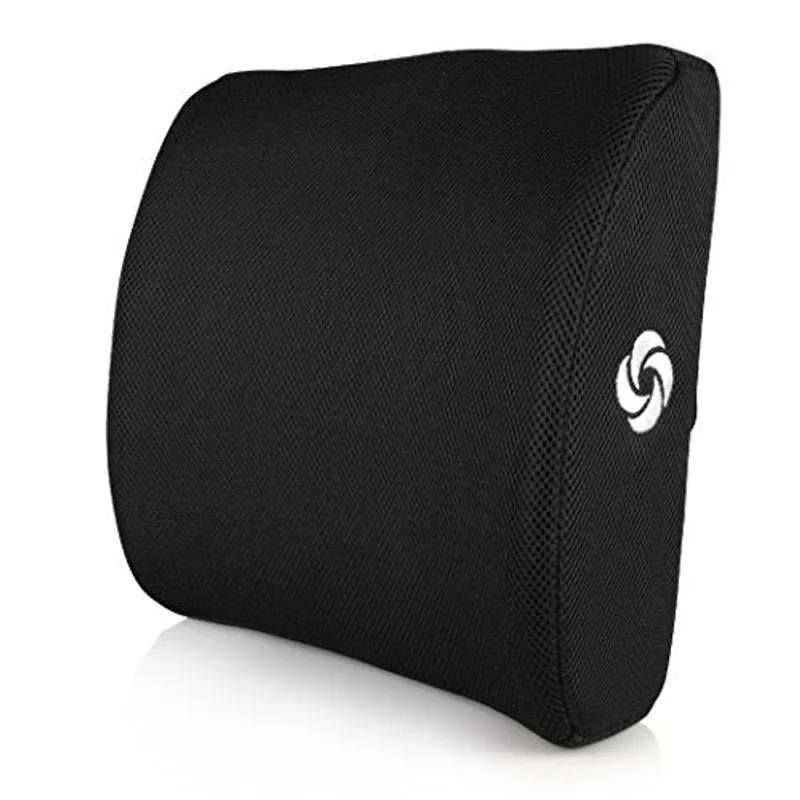
Samsonite Memory Foam Lumbar Support Pillow
Pros
- ✓ Under $20 makes it the most accessible pick in the lineup
- ✓ Compact profile works well in car seats and airplane seats
- ✓ Single-clip strap is fast to attach and reposition
- ✓ Samsonite brand recognized for travel-grade durability
Cons
- ✗ Lighter foam density than premium options — may compress faster over time
- ✗ Some owner reports note it feels too firm without a break-in period
- ✗ Less lumbar curve depth than dedicated ergonomic brands
At $19.99, the Samsonite is the most accessible entry point into add-on lumbar support. It won’t outperform dedicated ergonomic brands on foam density or breathability, but it covers the basics competently: memory foam that conforms to your back, a removable mesh cover, and a single-clip strap system that attaches and repositions quickly.
The compact dimensions (13.5 x 14 x 4.5 inches) make it particularly well-suited for car seats, airplane use, or commuters who want something they can toss in a bag without much thought. The Samsonite name carries practical baggage — it’s a travel brand, and the cushion reflects that orientation: portable, lightweight, functional.
Based on owner reports, some users find the foam feels on the firmer side and benefits from a few weeks of use before it softens appropriately. For $20, it’s a low-risk way to test whether lumbar support actually helps your particular pain pattern before committing to a pricier option.
Best for: Commuters, travelers, and anyone who wants to try lumbar support for the first time without a big investment.
6. Kensington Memory Foam Back Rest — Best for Corporate Offices
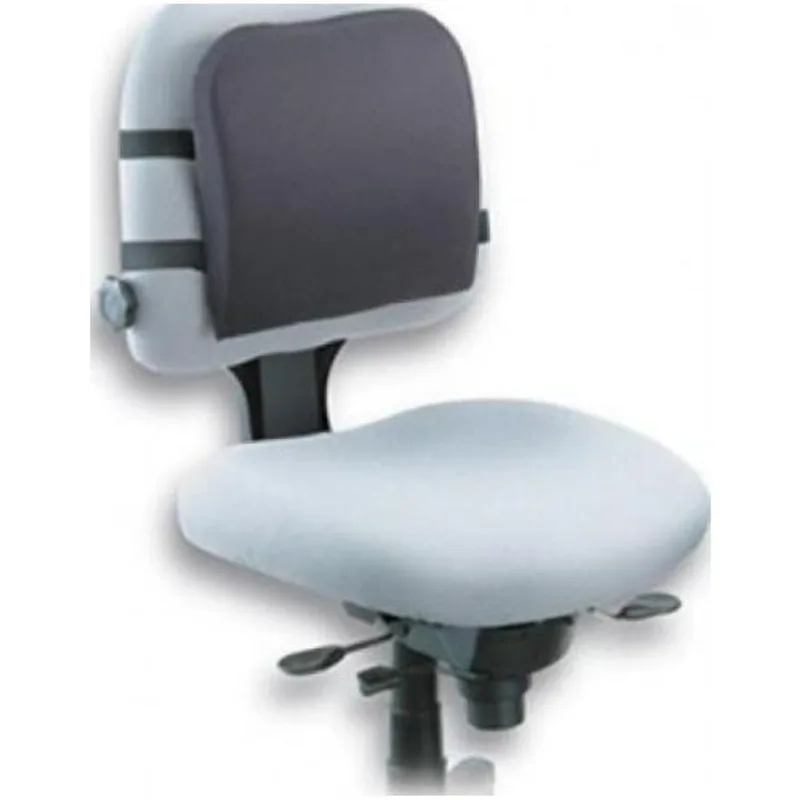
Kensington Memory Foam Back Rest
Pros
- ✓ SmartFit color-coded system makes finding your correct position fast
- ✓ Viscoelastic foam softens with body heat for personalized contouring
- ✓ Compact profile fits neatly into task chairs and conference room chairs
- ✓ Enterprise-grade build quality for office environments
Cons
- ✗ Fabric cover traps heat more than mesh alternatives
- ✗ Premium price for what is a relatively slim cushion
- ✗ Strap system is more complex than single-band competitors
Kensington built its reputation in enterprise-grade peripherals — monitor arms, docking stations, cable locks — and the Memory Foam Back Rest reflects that same “works reliably in a professional environment” sensibility. The SmartFit color-coded system helps you dial in the correct height position quickly, which is useful when you’re setting up multiple chairs across a team or rotating between desks.
The viscoelastic foam softens with body heat and conforms more gradually than standard memory foam, producing a personalized contour over time. At $44.99, it’s the most expensive pick in this roundup, and the fabric cover (rather than mesh) does trap heat — a meaningful downside for extended use.
The value proposition is best for corporate buyers outfitting shared workstations where the SmartFit system earns its keep, or for users who specifically want the Kensington brand’s build quality.
Best for: Corporate office environments and users who rotate between multiple chairs or workstations.
Comparison Table
| Product | Price | Material | Dimensions | Attachment | Best Use Case |
|---|---|---|---|---|---|
| Everlasting Comfort Original | $39.99 as of Oct 18, 2026 | Memory foam | 13.5” x 13” x 4” | Dual straps | All-around daily use |
| OPTP McKenzie Roll | $29.95 as of Oct 18, 2026 | High-density foam | 11” x 4.75” dia. | Elastic strap | Clinical/PT-recommended |
| ComfiLife Back Pillow | $36.99 as of Oct 18, 2026 | HD memory foam | 15” x 12.5” x 4.7” | Single strap | Broad backs, deep support |
| QUTOOL Lumbar Pillow | $26.99 as of Oct 18, 2026 | Memory foam | 16.9” x 15.5” x 4.2” | Dual straps | Max coverage area |
| Samsonite Lumbar Pillow | $24.99 as of Oct 18, 2026 | Memory foam | 13.5” x 14” x 4.5” | Single clip | Travel, budget entry |
| Kensington Back Rest | Unavailable | Viscoelastic foam | 12.5” x 10.5” x 3.5” | Dual + SmartFit | Corporate office fleets |
Buying Guide: What to Look for in a Lumbar Support Cushion
Memory Foam vs. Roll vs. Mesh
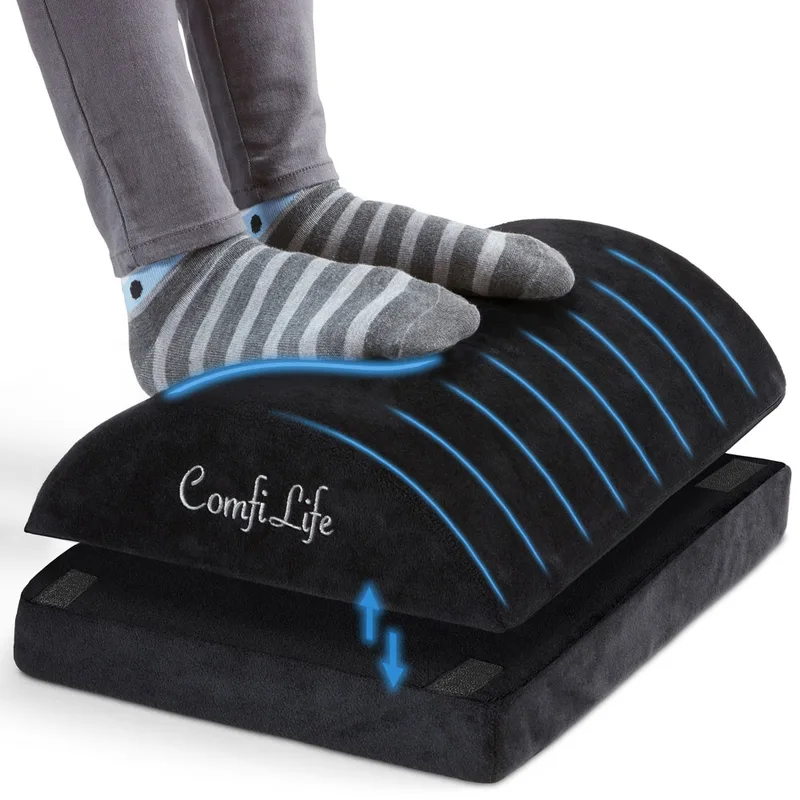
Memory foam pillows are the most popular category. They contour to your back and provide full lumbar-to-lower-back coverage. The tradeoff is heat retention — look for 3D mesh covers or ventilated designs.
Cylindrical rolls (like the McKenzie) are clinically oriented. They restore lordotic curve specifically and are the preferred tool in physical therapy. They feel nothing like a cushion and require an adjustment period, but owner and clinical feedback on their effectiveness for actual back pain is strong.
Mesh-heavy or hybrid designs sacrifice some foam density for better airflow. If you sit in a warm room or run warm, prioritize cushions with 3D ventilated mesh covers.
Strap Systems Matter
Single-strap cushions are easier to attach but more likely to slide down over the course of a long workday, especially on chairs with curved or padded backrests. Dual-strap designs add a few seconds to setup but hold their position far better. If you’re going to use this all day, every day, the dual-strap options (Everlasting Comfort, QUTOOL) are worth the minor extra effort.
Thickness and Your Chair Type
A 4.5 to 5-inch-thick cushion is ideal for flat-backed office chairs and task chairs — it pushes your lumbar forward to the correct lordotic position. But in deeply contoured chairs (racing-style gaming chairs, bucket car seats), thick cushions can feel like they’re pushing you out of the seat entirely. For those applications, a thinner profile or a cylindrical roll sits more naturally.
Price vs. Longevity
The difference between a $20 cushion and a $35 cushion is mainly foam density. Higher-density foam holds its shape longer under daily compression — typically 2 to 4 years versus 12 to 18 months for budget options. If you sit 8+ hours a day, the ComfiLife or Everlasting Comfort are better long-term bets. If you want to test the concept or need something for occasional use, the Samsonite at $19.99 is fine.
Who Needs a Lumbar Cushion
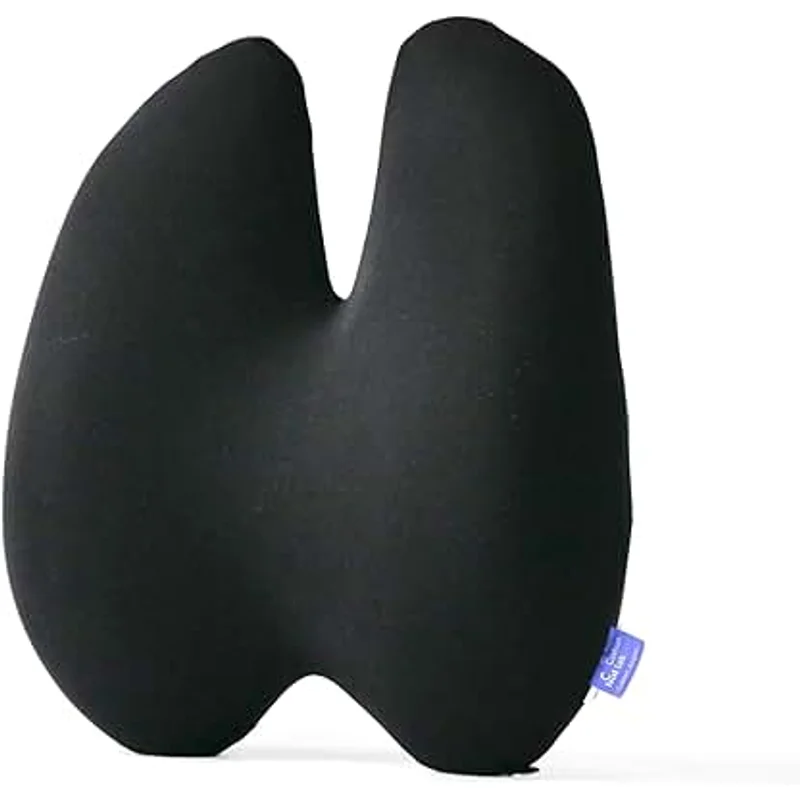
A lumbar cushion makes the most difference when your chair’s built-in lumbar support is:
- Adjustable but in the wrong position for your height
- Non-existent (many budget chairs and conference chairs)
- Worn out and no longer providing real resistance
If your chair already has excellent lumbar support you’ve properly dialed in — like a Steelcase Leap or Herman Miller Aeron — an add-on cushion may actually worsen your ergonomics by pushing you into the wrong position. See our guide to choosing the right ergonomic chair for more on this.
For chairs that do need help, a $30 cushion is far cheaper than a $400 ergonomic chair replacement. It’s often the smartest first step.
FAQ
How do I know if a lumbar cushion is positioned correctly?
When positioned correctly, a lumbar cushion should sit in the small of your back — the inward curve of your spine just above your belt line. Your lower back should feel gently supported without being pushed forward aggressively. Your shoulders should stay relaxed and dropped. If you feel pressure in your mid-back instead of lower back, the cushion is too high. If you’re leaning forward away from the chair, the cushion may be too thick for your chair type.
Will a lumbar support cushion fix my back pain?
A lumbar cushion addresses one specific cause of back pain: loss of natural lumbar curve during prolonged sitting. If poor seated posture is contributing to your pain, a cushion often helps noticeably within a few days. However, lumbar cushions don’t address all back pain causes — muscle weakness, disc issues, hip imbalances, and other factors also play roles. If pain is severe or persistent, consult a physical therapist or physician. Pairing a cushion with regular standing breaks (every 30 to 60 minutes) also produces better results than the cushion alone.
Can I use a lumbar cushion in my car?
Yes — most lumbar cushions work equally well in car seats. The McKenzie Roll and Samsonite are particularly well-suited to car use given their compact size. For driving, position the cushion at the correct lumbar height before starting your journey, as adjusting it while driving is impractical. Ensure the cushion doesn’t interfere with your seat’s adjustments.
How long do lumbar cushions last?
Higher-density memory foam cushions (ComfiLife, Everlasting Comfort) typically maintain their support for 2 to 4 years with daily use. Budget options may compress noticeably after 12 to 18 months. Signs that a cushion needs replacing: it no longer springs back when you press it, it stays flat rather than contouring to your back, or you notice your posture has worsened despite using it. Foam rolls (McKenzie) are durable for 5+ years since they’re dense enough to resist daily compression.
Do I need a lumbar cushion if I already have a good ergonomic chair?
Probably not. Chairs like the Herman Miller Aeron, Steelcase Leap, and Steelcase Series 2 have sophisticated lumbar systems designed to track your back’s position dynamically. Adding a foam cushion on top typically overrides those systems and can actually worsen your ergonomics. Where cushions shine is on chairs with fixed or minimal lumbar — mesh task chairs, executive chairs with a flat pad, basic office chairs, or any chair where the lumbar just isn’t doing its job. See our best ergonomic chairs under $500 roundup if you’re ready for a full upgrade.
Lumbar cushion vs. standing desk: which helps back pain more?
Both target back pain but from different angles. A lumbar cushion improves your seated posture during the hours you’re sitting. A standing desk reduces the total amount of time you spend sitting. For most office workers, the ideal answer is both — alternate between sitting with good lumbar support and standing throughout the day. If budget limits you to one, a lumbar cushion is typically the lower-risk, lower-cost starting point. See our best standing desks under $300 roundup for affordable height-adjustable options.
Conclusion
The right lumbar cushion depends heavily on your specific chair and body type. Here’s the quick breakdown:
- Best all-around: Everlasting Comfort Original at $29.99 — dual straps, lifetime warranty, works everywhere
- Best for back pain recovery: OPTP McKenzie Lumbar Roll at $27.99 — PT-recommended, clinically proven approach
- Best value: ComfiLife Back Pillow at $32.99 — wider coverage, durable foam, great for bigger frames
- Best budget entry: Samsonite Lumbar Pillow at $19.99 — low-risk way to test if lumbar support helps you
- Best for corporate offices: Kensington Back Rest at $44.99 — SmartFit system, enterprise durability
If you’re not sure whether the problem is your chair or your posture habits, our guide to adjusting your ergonomic chair walks through how to dial in every adjustment before spending money on accessories.