If you use a laptop at a standing desk, you already know the problem: the screen sits way too low. You end up hunching over, craning your neck downward, and undoing every ergonomic benefit the standing desk was supposed to give you. A laptop stand fixes that by bringing your screen up to eye level where it belongs.
But not all stands work the same way. Some are built for portability, folding down to nothing so you can toss them in a bag. Others sit permanently on your desk and look like they belong there. Some adjust to a dozen heights. Others give you exactly one — and hope it’s the right one.
We’ve researched and compared stands across every category to find the best options for standing desk users in 2026. Whether you want a travel-ready riser or a permanent desktop solution, here’s what’s actually worth buying.
Short on time? The Twelve South Curve Flex is the top pick — adjustable height up to 22 inches, folds flat for travel, and built from premium aluminum. On a budget? The BoYata Laptop Stand delivers 90% of the experience for $30.
1. Twelve South Curve Flex — Editor’s Pick
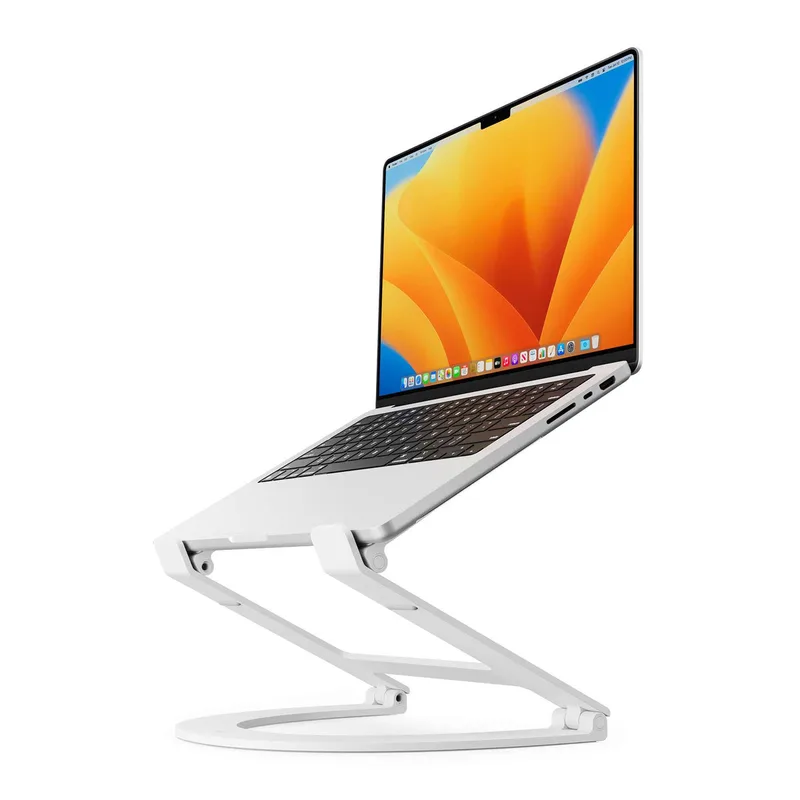
Twelve South Curve Flex
Pros
- ✓ Widest height and angle range of any stand reviewed
- ✓ Folds flat with included neoprene travel pouch
- ✓ Premium aluminum build matches MacBook aesthetic
- ✓ Silicone arm covers prevent scratches
Cons
- ✗ 7 lb weight limit rules out heavier gaming laptops
- ✗ At $80, only the Roost V3 costs more in this roundup
- ✗ Silicone arms can collect dust and pet hair
$80 | Buy on Amazon
The Curve Flex is the most versatile laptop stand in this roundup. It adjusts from 2 to 22 inches of height — that upper range matters for standing desks, where you often need more elevation than a typical riser provides. The angle is adjustable too, from flat to 45 degrees, so you can dial in a comfortable typing angle or go full vertical for an external-monitor-only setup.
Build quality is excellent. The aluminum arms are coated in textured silicone that grips your laptop securely without scratching it. The bent-arm design keeps the laptop stable even during aggressive typing. When you’re done for the day, it folds completely flat and slides into the included neoprene travel pouch — making it a rare stand that works both at your desk and at a coffee shop.
The 7 lb weight limit is the only real limitation. Most ultrabooks and MacBooks fall well under that, but if you’re running a beefy 17-inch gaming laptop, check the weight first. For everyone else, the Curve Flex earns its premium price.
Who should buy this: Standing desk users who want maximum adjustability and genuinely don’t want to compromise on build quality.
Who should skip this: Heavy laptop users (7 lb limit), or anyone who won’t use the portability and wants to save $35.
2. Roost V3 — Best for Portability
Roost V3 Laptop Stand
Pros
- ✓ At 6 oz, the lightest serious laptop stand available
- ✓ Patented rigid truss structure eliminates wobble
- ✓ Self-adjusting grips fit any laptop automatically
- ✓ Made in the USA
Cons
- ✗ No angle adjustment — vertical lift only
- ✗ Requires external keyboard and mouse
- ✗ Premium price for a plastic stand
$90 | Buy on Amazon
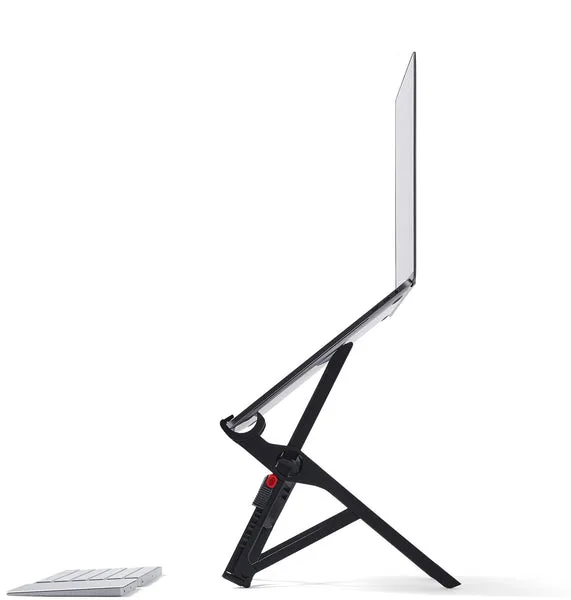
The Roost V3 weighs 6 ounces. That’s less than a phone. For remote workers and digital nomads who carry a laptop between desks, offices, and coffee shops, nothing else comes close.
Don’t let the weight fool you — this stand is rigid. The patented interlocking truss structure eliminates the flex and wobble you get with cheap folding stands. Self-adjusting grips lock onto any laptop from 12 to 18 inches without fiddling with clips or brackets. Set it down, your laptop clicks in, and it’s done.
Height adjusts from 6.5 to 12.5 inches of screen lift, which works well for most standing desk setups. The trade-off is vertical lift only — no angle adjustment. That’s fine if you’re pairing it with an external keyboard and mouse (which you should be for proper ergonomics at a standing desk). But it means the Roost is specifically an elevation tool, not an all-in-one workspace stand.
At $90, it’s not cheap for reinforced plastic. But it’s been the go-to for the laptop ergonomics crowd for years, and the build quality justifies the price if portability is your priority.
Who should buy this: Remote workers, digital nomads, and anyone who needs a stand that disappears into a bag.
Who should skip this: Desk-only users who don’t travel. The BoYata gives you more adjustability for less if you’re never leaving your desk.
3. Rain Design mStand — Best Desktop Stand
Rain Design mStand
Pros
- ✓ Iconic single-piece aluminum design looks stunning
- ✓ Rock-solid stability — no wobble, no flex
- ✓ Doubles as a heat sink to cool your laptop
- ✓ Built-in cable management
Cons
- ✗ Fixed height — no adjustment
- ✗ Too heavy for travel at nearly 3 lbs
- ✗ 5.9 inches may not be enough elevation for standing desk users
$45 | Buy on Amazon
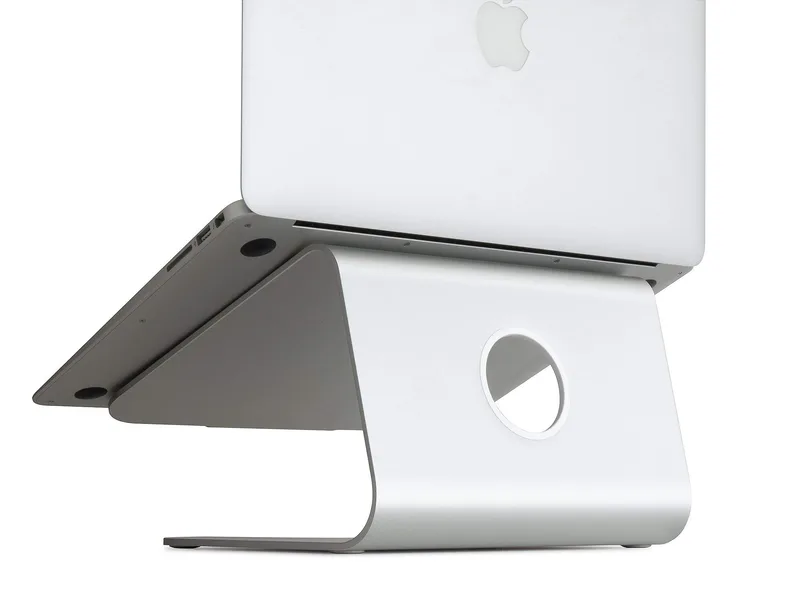
If your laptop lives on one desk and rarely moves, the mStand is the stand to beat. It’s machined from a single piece of aluminum that matches the MacBook aesthetic perfectly — silver, space gray, and other finishes are available. It looks like Apple designed it.
The single-piece construction means zero wobble. Nothing flexes, nothing rattles, nothing shifts. Your laptop sits in a gently curved cradle that also acts as a passive heat sink, drawing warmth away from the chassis. A 2-inch cable hole in the back keeps your charging cable tidy.
The limitation is straightforward: 5.9 inches of fixed elevation, no adjustment. For seated desk use, that’s usually perfect. For a standing desk, it depends on your height and monitor setup. Taller users may want more lift. But as a permanent fixture on a standing desk, the mStand delivers clean, stable elevation with zero maintenance.
At 2.89 lbs, this isn’t a travel stand. It’s a desktop fixture — and it excels at that job.
Who should buy this: Permanent desk setups where aesthetics and solid construction matter most.
Who should skip this: Anyone who needs adjustable height, or who stands tall enough that 5.9 inches isn’t enough lift.
4. BoYata Laptop Stand — Best Value
BoYata Laptop Stand
Pros
- ✓ Best build quality under $35
- ✓ Holds laptops up to 17 inches and 11 lbs
- ✓ Adjustable height and angle with firm Z-axis hinge
- ✓ Heat-vent design keeps laptop cool
Cons
- ✗ Hinge is stiff — takes two hands to adjust
- ✗ Not easily portable
- ✗ Generic design won't win any style points
$30 | Buy on Amazon
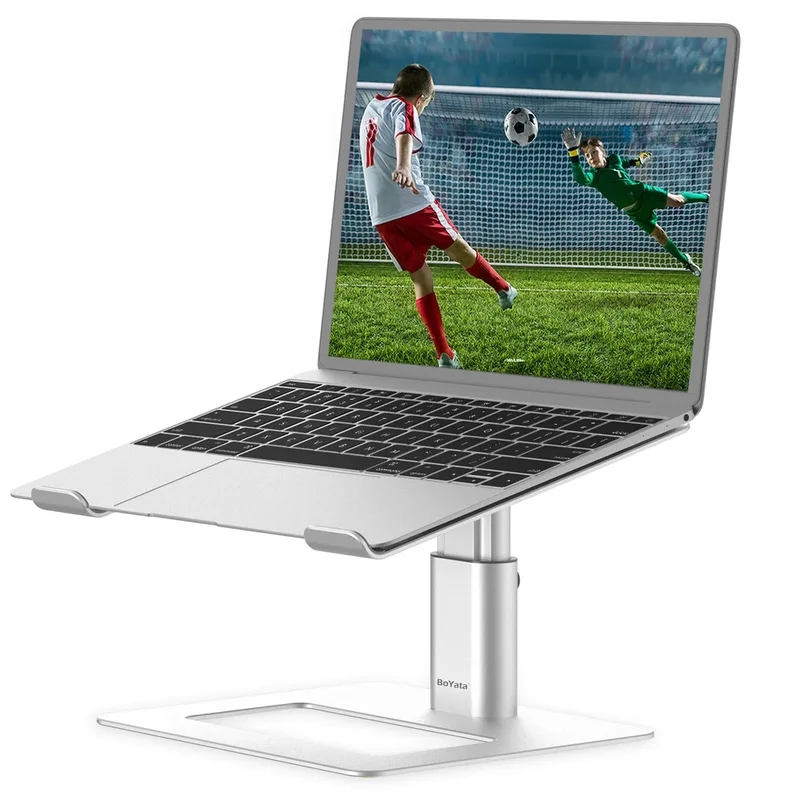
The BoYata is the answer when someone asks “what’s the best laptop stand under $35?” It’s aluminum, it’s adjustable, it holds laptops up to 17 inches, and it has tens of thousands of reviews on Amazon with a 4.8-star average. That’s not a coincidence.
The Z-axis hinge lets you adjust both height and viewing angle. It takes some force to move — the hinge is intentionally stiff so it stays put once you set it. That stiffness is a feature, not a bug. Cheap stands with loose hinges drift downward under the weight of a laptop. The BoYata stays exactly where you put it.
Heat-vent cutouts in the platform promote airflow, and anti-slip silicone pads on the feet and laptop cradle keep everything in place. The build quality feels like a $50-60 stand. At $30, it’s genuinely good value.
The downsides are real but minor. Adjusting the angle takes two hands. It’s not portable — at 1.6 lbs with no folding mechanism, it stays on your desk. And it looks like every other aluminum laptop stand on Amazon. For the money, though, nothing else matches this combination of build quality and adjustability.
Who should buy this: Budget-conscious buyers who use one desk and want adjustable height without spending $80–90.
Who should skip this: Travelers or commuters — look at the Nexstand K2 instead.
5. Nexstand K2 — Best Budget Portable
Nexstand K2 Laptop Stand
Pros
- ✓ Much cheaper than the Roost with similar portability
- ✓ Holds up to 20 lbs — handles any laptop
- ✓ 8 height positions for fine-tuning
- ✓ Folds to the size of a rolled-up magazine
Cons
- ✗ Slightly less rigid than the Roost V3
- ✗ Nylon construction feels less premium
- ✗ Front edge can dig into some laptop chassis
$35 | Buy on Amazon
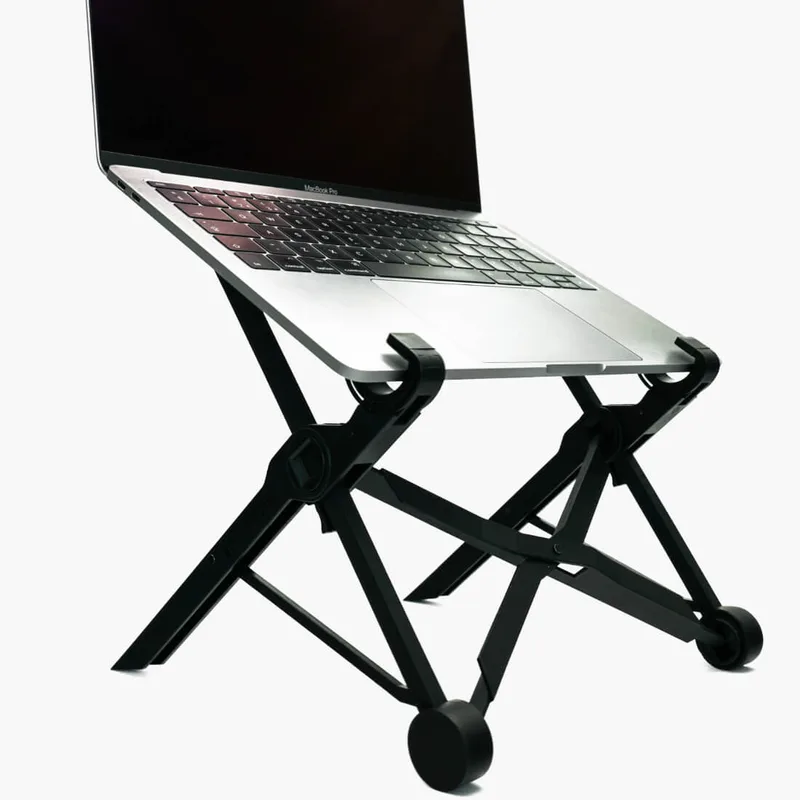
The Nexstand K2 is the Roost V3’s biggest competitor — and it costs less than half the price. At 8.2 ounces and folding down to the size of a rolled-up magazine (1.5 x 1.5 x 14 inches), it’s nearly as portable as the Roost while holding up to 20 lbs. That capacity handles gaming laptops that would buckle flimsier stands.
Eight height settings give you decent range for dialing in your screen position. The fiberglass-reinforced nylon construction is lightweight and strong, though it doesn’t feel as rigid as the Roost’s interlocking truss design. There’s a small amount of flex during heavy typing — not enough to be a real problem, but noticeable compared to the Roost.
The most common complaint from K2 users is the front lip: on some laptops, the edge where the stand grips the chassis feels a bit aggressive. Check your laptop’s front edge thickness before buying. For $35, the K2 is the best value in the portable stand category by a clear margin.
Who should buy this: Travelers and commuters who want Roost-level portability without the Roost-level price.
Who should skip this: If $55 more doesn’t matter, the Roost V3 is noticeably more rigid and polished.
6. Nulaxy C1 — Budget Entry Point
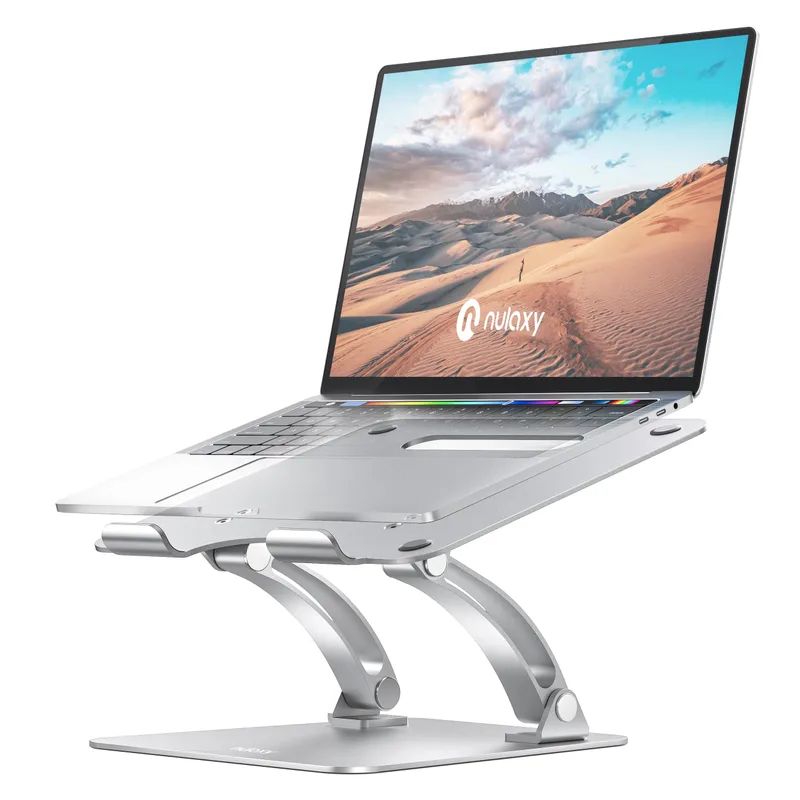
Nulaxy C1 Laptop Stand
Pros
- ✓ Hard to beat at $20
- ✓ Aluminum build at a plastic price
- ✓ Foldable for basic portability
- ✓ Heat-vent cutout helps with cooling
Cons
- ✗ Limited height adjustment range
- ✗ Plastic hinge joints wear over time with frequent adjustments
- ✗ Wobbles slightly under heavy typing
$20 | Buy on Amazon
At $20, the Nulaxy C1 is the entry point. It’s an aluminum dual-fold stand with a heat-vent cutout, and it does the job at this price. The dual-fold design gives you some height and angle adjustment — enough to improve your screen position, though not as much as the taller stands on this list.
The aluminum platform handles laptops up to 17 inches and 22 lbs, which is more capacity than most people need. It’s reasonably portable at 1 lb and folds down for basic transport, though it’s not in the same league as the Roost or Nexstand for actual travel.
Where the C1 shows its price is in the hinge joints. They’re plastic, and after months of regular use, they develop play. If you’re adjusting the angle daily, the hinges loosen faster. For a stand you set once and leave, that’s less of an issue. For one that gets constant adjustment, spending the extra $10 on the BoYata is worth it.
Who should buy this: First-time buyers, occasional laptop users, or anyone who genuinely needs to keep costs under $25.
Who should skip this: Daily users who adjust their setup regularly — the plastic hinges won’t hold up as well as the BoYata’s aluminum construction.
Laptop Stand Comparison Table
| Stand | Price | Weight | Height Range | Portable? | Best For |
|---|---|---|---|---|---|
| Twelve South Curve Flex | Unavailable | 1.75 lbs | 2–22” adjustable | Yes (folds flat) | Maximum adjustability |
| Roost V3 | $89.95 as of Oct 18, 2026 | 6 oz | 6.5–12.5” lift | Yes (ultra-light) | Travel and portability |
| Rain Design mStand | $34.00-$39.90 as of Oct 18, 2026 | 2.89 lbs | 5.9” fixed | No | Permanent desktop setup |
| BoYata | $29.99 as of Oct 18, 2026 | 1.6 lbs | Multi-angle adjustable | No | Budget adjustable |
| Nexstand K2 | Unavailable | 8.2 oz | 8 height positions | Yes (folds compact) | Budget portable |
| Nulaxy C1 | $17.99 as of Oct 18, 2026 | 1 lb | Limited dual-fold | Semi | Budget entry point |
Buying Guide: What to Look for in a Laptop Stand for Standing Desks
Height Range Matters Most
At a standing desk, your screen needs to be at eye level — roughly 15-20 inches above the desk surface for most people. Some stands only lift 4-6 inches, which is fine for seated use but not enough when you’re standing. Look for stands with at least 8-10 inches of lift, or pair a shorter stand with a monitor arm for more flexibility.
Portable vs. Fixed
Portable stands (Roost, Nexstand) fold small and weigh under half a pound, but they require an external keyboard and mouse. Fixed stands (mStand, BoYata) are sturdier and allow typing directly on the laptop keyboard, but they stay on your desk. The choice comes down to how you actually work — not how you think you’ll work.
Weight Capacity
Most laptop stands hold 10-22 lbs, which covers any standard laptop. Standard ultrabooks weigh 3-4 lbs, so nearly any stand handles them. If you’re running a 17-inch gaming laptop with a discrete GPU, check the spec sheet — a few stands on this list have meaningful weight limits worth noting.
Material and Cooling
Aluminum stands double as heat sinks, pulling warmth away from your laptop chassis. Open-platform designs with ventilation cutouts help too. If your laptop runs hot under load — and most do when docked — aluminum with vents is the better long-term choice.
Budget Expectations
- Under $25: Basic elevation, limited adjustability, plastic hinges
- $25–50: Solid aluminum, adjustable height and angle, good for permanent setups
- $50–80: Premium materials, wide adjustment range, portable specialty options
- $80+: Maximum height range, ultra-portable engineering, flagship portability
Frequently Asked Questions
Do I need a laptop stand for a standing desk?
Yes — unless your standing desk has a built-in laptop riser or you use an external monitor at eye level. Without elevation, you’ll hunch over your laptop screen, which defeats the purpose of standing. A stand brings the screen up to eye level where your neck stays neutral.
Can I type on my laptop while it’s on a stand?
On low-angle stands like the BoYata and Nulaxy, yes — the laptop angle stays manageable for direct typing. On taller vertical stands like the Roost and Nexstand, no — you’ll need an external keyboard and mouse. For standing desk ergonomics, the external keyboard setup is actually better because it lets you position your screen and keyboard completely independently.
How high should my laptop screen be at a standing desk?
The top of your screen should be roughly at eye level, or slightly below. For most people, that means the screen center sits 15-20 inches above the desk surface. Measure from your desk to your eye line while standing naturally, then pick a stand that gets you into that range.
Are portable laptop stands stable enough for daily use?
The good ones are. The Roost V3 uses an interlocking truss frame that stays rigid for its weight. The Nexstand K2 has minor flex but nothing that disrupts normal use. Both hold laptops securely with anti-slip grips. Just don’t lean on them — they’re designed to support your laptop’s weight, not yours.
Aluminum or plastic — does it matter?
For desktop stands, aluminum wins. It’s sturdier, looks better, and acts as a passive heat sink. For portable stands, reinforced plastic or nylon is preferred because it’s lighter. The Roost V3 is fiberglass-reinforced plastic specifically because aluminum would add weight without meaningful benefit for a travel stand.
Should I get a laptop stand or a monitor arm with a laptop tray?
If you use your laptop as your primary display, a stand is simpler and cheaper. If you have an external monitor and want to use the laptop as a secondary screen, a monitor arm with a laptop tray gives you more flexibility to position both screens independently. For standing desk users who dock their laptop daily, the arm-and-tray combo is often the better long-term investment.
The Bottom Line
For most standing desk users, the Twelve South Curve Flex is the best all-around pick. The height range goes up to 22 inches, it folds for portability, and the build quality is genuinely excellent for the price. If you travel constantly with your laptop, the Roost V3 is the portability king at 6 ounces.
Don’t want to spend $80–90? The BoYata at $30 is the best value on this list — sturdy, adjustable, and well-built for a fraction of the cost. And the Nexstand K2 at $35 is the pick if you need something that travels without paying Roost prices.
Whatever you pick, getting your screen to eye level is what matters. Your neck will thank you. A laptop stand pairs naturally with an ergonomic keyboard and a monitor arm — together they let you position your screen and input devices completely independently. If you’re setting up a full standing desk workspace, our best desk accessories for remote work guide covers every category, and our ergonomic workstation setup guide explains the fundamentals that make gear choices matter.