Standing desks were the CES 2026 story last year — smart height adjustment, app-connected controls, Bluetooth desk ecosystems. But the accessory that actually keeps you moving throughout the day? Still a simple plank of wood or aluminum sitting on a curved base.
Balance boards for standing desks have remained blissfully analog in a world obsessed with connectivity, and that’s exactly why they work. You step on, your body naturally shifts to stay balanced, and micro-movements engage your legs, hips, and core in a way that static standing never does.
With hybrid work now the default for most desk workers, more people are building out their home office ergonomics seriously. A balance board is one of the highest-value additions you can make after a good chair and a height-adjustable desk. Here are the six worth buying in 2026.
In a hurry? The FluidStance Level is the best board for most people who are serious about their standing setup. If you want the same motion at a lower price and on Amazon, the FluidStance Plane Cloud delivers it. For a budget entry point, the Gaiam Evolve at $79 is hard to beat.
FluidStance Level
FluidStance Level
Pros
- ✓ Military-grade die-cast aluminum base built to last decades, not years
- ✓ Smooth 360-degree tilt geometry feels completely natural within minutes
- ✓ Multiple deck options including padded closed-cell foam for all-day sessions
- ✓ Made in the USA with a lifetime warranty and 30-day risk-free trial
Cons
- ✗ At $289, it's significantly more expensive than every other option here
- ✗ Only available direct from FluidStance — not on Amazon
- ✗ 2.5" deck height is lower than some standing desk users prefer
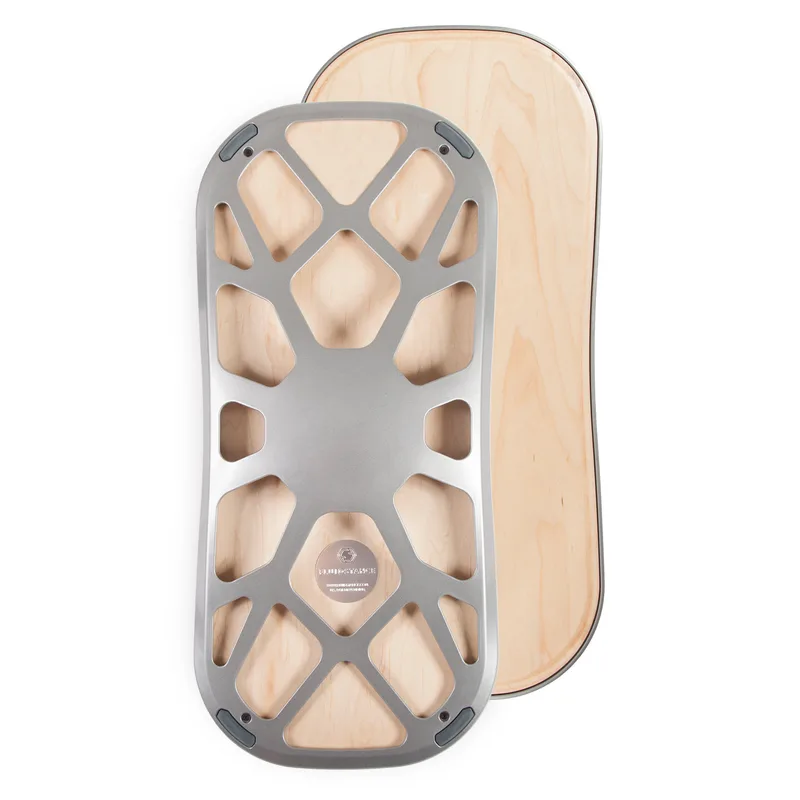
The Level is the balance board that converted skeptics into daily users. It’s not the cheapest option here — at $289 direct from FluidStance — but the construction quality and the feel of that die-cast aluminum base immediately explain the price gap.
The 360-degree tilt geometry means you can move in any direction: front-to-back, side-to-side, diagonal. It takes about two minutes to stop thinking about balancing and start just standing naturally. That’s the whole point — it should feel like an extension of standing, not a workout requiring conscious effort.
FluidStance’s deck options matter more than they look. The padded closed-cell foam top is the right call for anyone standing several hours a day — it’s significantly more comfortable underfoot than the matte hexagon deck. The foam is naturally non-microbial (no odor over time) and the whole board ships with a 30-day risk-free trial if you want to test the concept before committing.
The Level is direct-only from FluidStance’s website — no Amazon listing confirmed. The upside: a lifetime warranty from a company that has been making this exact product for a decade.
Best for: Anyone who wants the best balance board and doesn’t mind paying for it. Long-session standing desk users. Anyone who’s tried cheaper boards and found them uncomfortable.
FluidStance Plane Cloud
FluidStance Plane Cloud
Pros
- ✓ Same 360-degree tilt geometry as the premium Level at $100 less
- ✓ Recycled plastic base reduces environmental footprint vs. aluminum casting
- ✓ Foam top deck is naturally non-microbial and fully recyclable
- ✓ Available on Amazon for fast shipping; lifetime warranty still included
Cons
- ✗ Plastic base lacks the premium feel and weight of the aluminum Level
- ✗ 250 lb weight capacity — lower than the Level's 300 lbs
- ✗ Slightly narrower deck (24" vs. 26.5") gives a bit less foot room
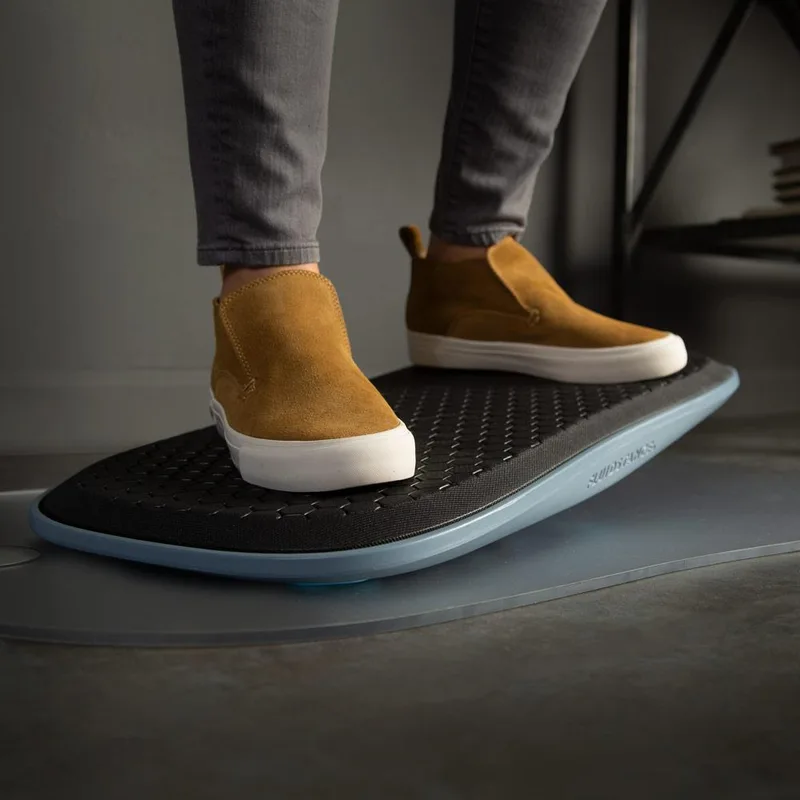
Same 360-degree tilt mechanism as the Level. Recycled plastic base instead of military-grade aluminum. $100 cheaper, and it’s on Amazon.
For most buyers, the Plane Cloud is the right call. The tilt geometry is identical — you get the same all-direction micro-movement that makes FluidStance boards worth buying. The recycled plastic base is lighter (about 5 lbs 15 oz vs. the Level’s 7 lbs 12 oz) and the eco-materials story is genuinely better: the base is made from 100% recycled plastic, and the foam top deck is fully recyclable.
The 250 lb weight limit is slightly lower than the Level’s 300 lbs, and the deck is 24” long versus 26.5” — you’ll notice the difference if you have larger feet or like to step around on the board. For most users, neither distinction matters.
What you lose at $199 vs. $289: the premium feel of aluminum underfoot, a slightly smaller deck, and direct-only access gets replaced by Amazon availability. That trade makes sense for most people.
Best for: Standing desk users who want FluidStance quality without the premium price. Anyone who prefers Amazon availability and faster shipping.
Whirly Board Wide
Whirly Board Wide
Pros
- ✓ Highest weight capacity on this list at 400 lbs
- ✓ True 360-degree spin motion (not just tilt) for maximum engagement
- ✓ 8-ply Canadian maple deck is extremely durable — this board will outlast your desk
- ✓ Made in Wisconsin, USA with a lifetime warranty
Cons
- ✗ 5" height makes it the most challenging board to balance on, especially for beginners
- ✗ 10" width is narrower than competitors — less room to shift foot position
- ✗ Active spin motion can be distracting during deep focus work
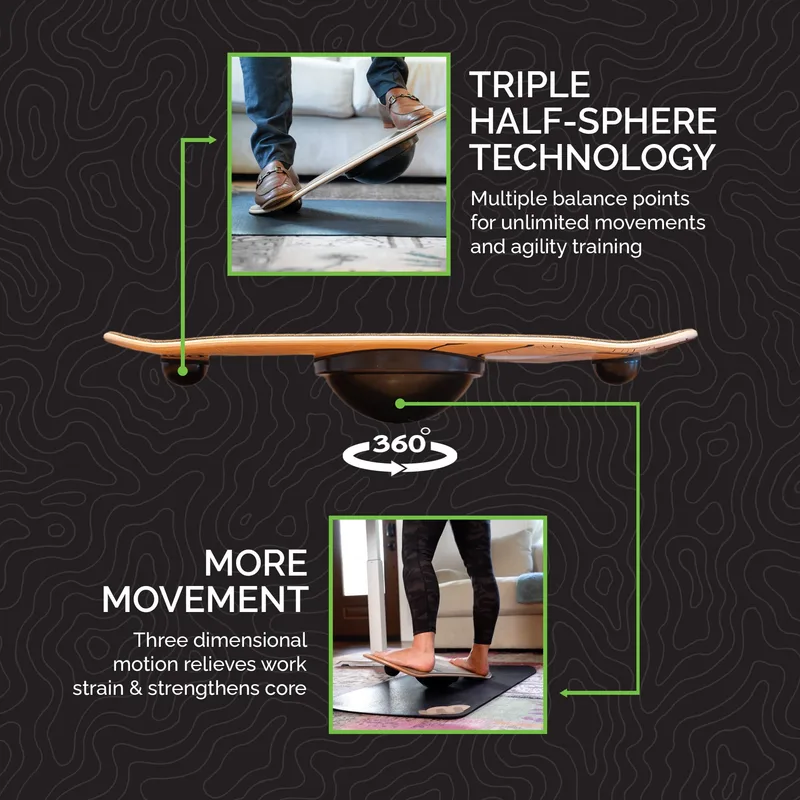
The Whirly Board is different from every other board on this list. Where FluidStance boards tilt, the Whirly Board spins — it sits on three semi-spherical points and rotates a full 360 degrees, like a skateboard deck on ball bearings.
That extra degree of freedom means more engagement, more muscle activation, and — in all honesty — more distraction. During calls or writing sessions, the spinning motion demands a level of active attention that a tilter doesn’t. That’s not a criticism if you want your standing time to genuinely feel like active movement; it’s just different.
The 8-ply Canadian maple construction is clearly built for durability — the same material skateboarders trust for impact resistance. Weight capacity is 400 lbs, the highest here. The deck is wide at 28” long, though it’s narrower (10”) than the FluidStance boards in the other dimension, which can feel limiting for users who stand with their feet wide.
Made in Wisconsin with a lifetime warranty. At $179, it’s competitively priced against the Plane Cloud for a meaningfully different product.
Best for: Users who want active, engaging standing rather than passive balance. Physical therapy use cases. Anyone who specifically wants 360-degree spin motion.
Topo Anti-Fatigue Mat by Ergodriven
Topo Anti-Fatigue Mat by Ergodriven
Pros
- ✓ Combines anti-fatigue cushioning with active terrain — one purchase does two jobs
- ✓ Balance bar and 27-degree wedges encourage natural foot shifting throughout the day
- ✓ PVC-free and PFA-free construction — cleaner materials than most mats
- ✓ Made in the USA with a 7-year warranty; widely recommended by occupational therapists
Cons
- ✗ Not a true balance board — the terrain is static, not a moving platform
- ✗ 200 lb weight limit is the lowest on this list
- ✗ Large footprint (29" deep) takes up significantly more floor space than a board
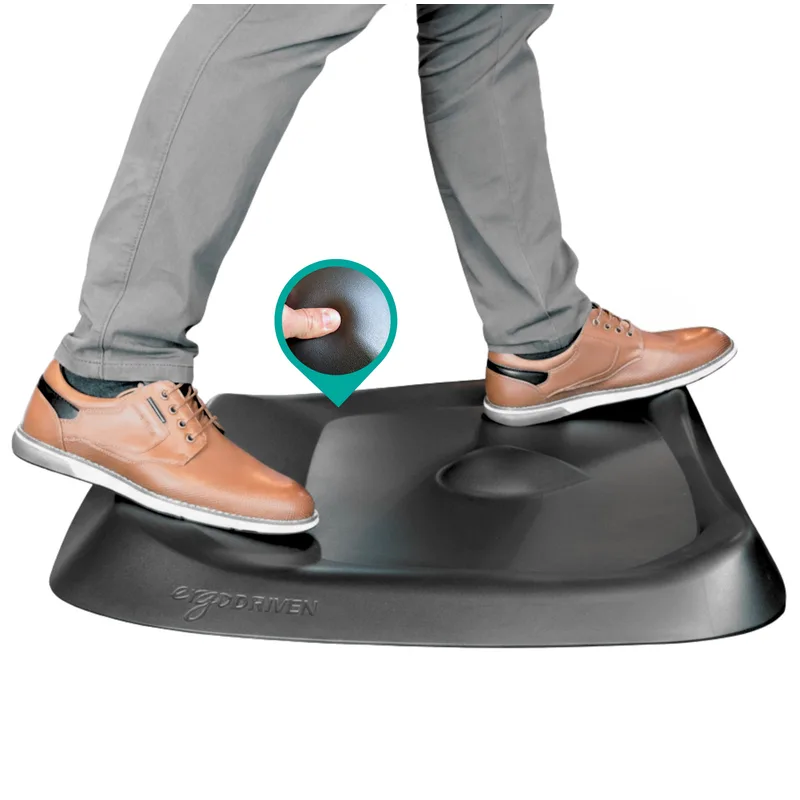
The Topo isn’t a balance board — it’s worth being direct about that. It doesn’t tilt or spin. What it does is terrain: three massage mounds, two 27-degree wedge inclines, and a central balance bar create a varied terrain that naturally prompts foot shifting throughout the day.
The result is something between a standing mat and a balance board. You get anti-fatigue cushioning (the dual-density polyurethane base is genuinely supportive) combined with terrain features that keep you moving more than a flat mat would. Occupational therapists frequently recommend it as a stepping stone before committing to a true rocker or tilt board.
The downside is the large footprint — 26.2” wide and 29” deep, it takes up more floor space than any actual balance board here. The 200 lb weight capacity is also the lowest on this list. And if you want genuine dynamic movement, a real balance board will deliver more.
At $99, it lands in useful territory: more functional than a flat mat, accessible to anyone nervous about balance boards, made in the USA with a 7-year warranty.
Best for: Standing desk beginners who aren’t ready for a balance board. Anyone who wants anti-fatigue cushioning AND active terrain in one product. Great complement to the best anti-fatigue mats comparison if you’re deciding between mat types.
Gaiam Evolve Balance Board
Gaiam Evolve Balance Board
Pros
- ✓ Best price-to-performance ratio under $100 — a solid first balance board
- ✓ 3.65" height is the sweet spot for most standing desk heights
- ✓ Non-slip honeycomb texture grips shoes and bare feet equally well
- ✓ Widely available on Amazon with fast Prime shipping
Cons
- ✗ Rocker motion only — no lateral or rotational movement
- ✗ PVC construction is less eco-friendly than wood or recycled-foam alternatives
- ✗ No premium finish; the plastic look doesn't match a nice desk setup
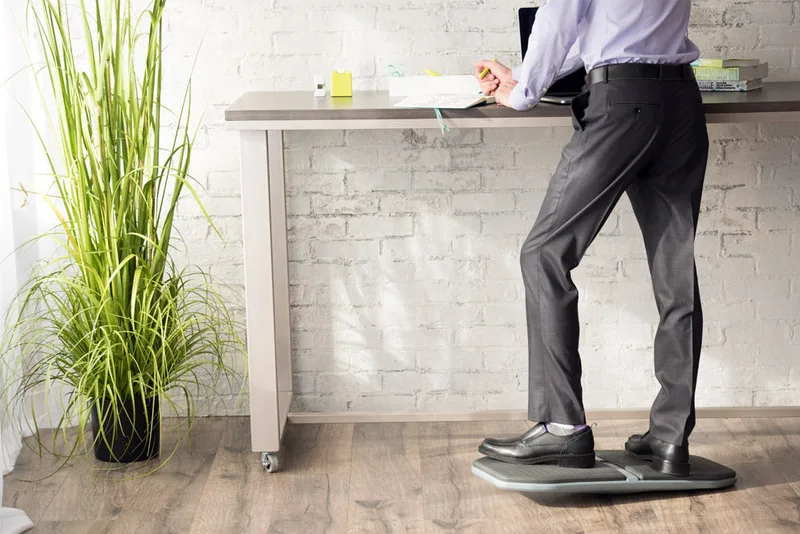
The Evolve is the right choice for most people who want to try a balance board without spending $199+. At $79, it’s a genuine balance board — it rocks front-to-back on a curved base, engages your stabilizer muscles, and ships from Amazon with fast Prime delivery.
The limitation is motion type: rocker only. You get front-to-back movement but no lateral or rotational range. That’s a real constraint compared to FluidStance’s 360-degree tilt, but it’s also completely appropriate for a first balance board or for users who prefer gentle movement during focused work.
The 3.65” height is the practical sweet spot for most standing desk setups — tall enough to feel the balance challenge, low enough that it doesn’t significantly change your relationship to desk height. The non-slip honeycomb surface works with shoes, socks, or bare feet.
Owner reports consistently describe it as comfortable for one to two hour standing sessions. Longer than that, the PVC construction can start to feel firm underfoot — the Yes4All rocker is harder, but neither board has the foam cushioning of the Topo or FluidStance’s padded deck option.
Best for: Budget buyers. First-time balance board users. Anyone who wants a simple, reliable rocker without committing to a premium board.
Yes4All Wooden Rocker Balance Board
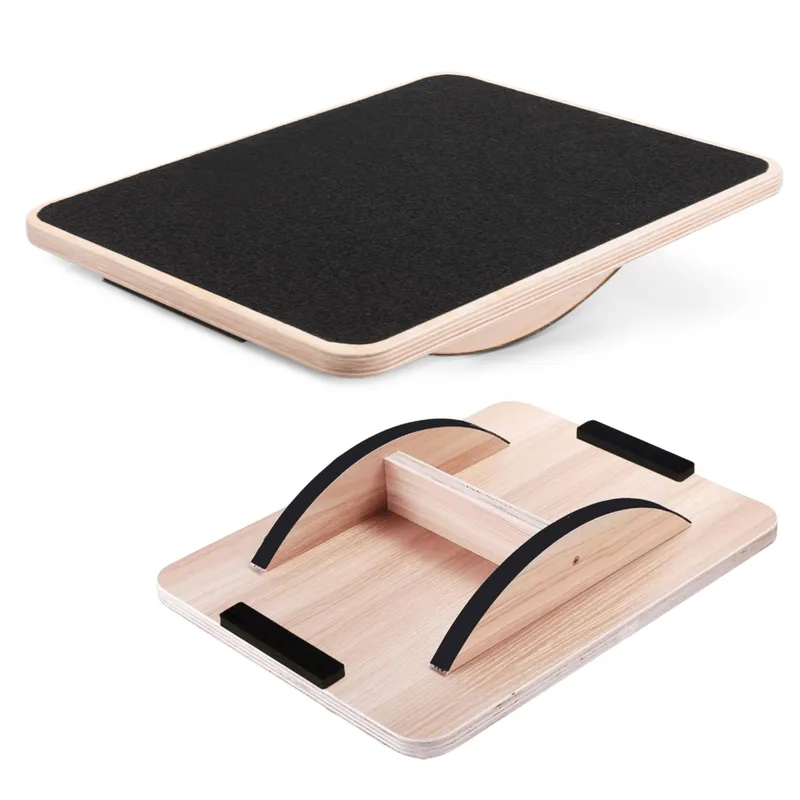
Yes4All Wooden Rocker Balance Board
Pros
- ✓ Most affordable option on this list at around $35
- ✓ High 350 lb weight capacity for the price
- ✓ Natural hardwood construction is durable and looks cleaner than plastic boards
- ✓ Low financial risk — a good way to find out whether you'll actually use a balance board
Cons
- ✗ Smaller deck (17.5" × 13.5") limits foot placement options
- ✗ Rocker motion only — front-to-back movement only, no lateral or spin
- ✗ No padding — hard underfoot during sessions longer than an hour
At $35, the Yes4All is the lowest-risk way to find out whether you’ll actually use a balance board. A lot of ergonomic accessories end up in a corner after a week — a $35 experiment is a reasonable test before spending $179+.
The 15-layer hardwood construction is surprisingly solid. It rocks front-to-back smoothly, the 350 lb weight capacity is generous for the price, and the anti-skid grip surface (essentially sandpaper texture) keeps your feet in place.
The downsides are the smaller deck (17.5” × 13.5”) and no padding. For users with larger feet, the deck feels cramped. And during long sessions, the hard surface is noticeably less comfortable than any board with a foam or padded top.
If you start with the Yes4All and find you use it daily, upgrading to the Gaiam Evolve or a FluidStance board is a natural next step.
Best for: Budget-first buyers. Anyone testing whether a balance board suits their work habits before investing more.
Comparison Table
| Product | Price | Motion | Height | Weight Cap | Rating |
|---|---|---|---|---|---|
| FluidStance Level | $289 | 360° tilt | 2.5” | 300 lbs | 9.2 |
| FluidStance Plane Cloud | $849.00 as of Oct 18, 2026 | 360° tilt | 2.5” | 250 lbs | 8.8 |
| Whirly Board Wide | $189.95 as of Oct 18, 2026 | 360° spin | 5” | 400 lbs | 8.6 |
| Topo by Ergodriven | $109.00 as of Oct 18, 2026 | Static terrain | 2.7” | 200 lbs | 8.4 |
| Gaiam Evolve | Check price | Rocker | 3.65” | 250 lbs | 7.9 |
| Yes4All Rocker | Unavailable | Rocker | 3” | 350 lbs | 7.4 |
Balance Board Buying Guide
Types of balance boards
Rocker boards (Gaiam Evolve, Yes4All) rock front-to-back on a single curved axis. Simple, low learning curve, appropriate for most desk use. The entry point for most buyers.
360-degree tilt boards (FluidStance Level and Plane Cloud) tilt in any direction on a curved aluminum or plastic base. More natural movement, more muscle engagement. FluidStance dominates this category for desk use.
Spin boards (Whirly Board) rotate on semi-spherical points for full rotational movement. The most active option — more like a fitness tool, less like a passive work accessory.
Terrain mats (Topo by Ergodriven) are flat-footprint mats with built-in terrain features. They don’t move dynamically, but the surface prompts natural foot shifting. Good hybrid option for anti-fatigue + light balance challenge.
Key specs to evaluate
Height: Taller boards require more balance effort and may require lowering your desk slightly to compensate. 2.5”–4” is the comfortable range for most standing desk setups.
Deck size: 26”–28” long and 10”–12” wide is the standard. Shorter or narrower boards feel cramped during longer sessions.
Weight capacity: Most boards handle 250–350 lbs. If you’re at the higher end, the Whirly Board’s 400 lb rating gives the most headroom.
Motion type: Match your working style. Focused, cognitive work (writing, coding) pairs better with a gentle rocker or tilt board. Physical task work or breaks are better suited to the more active Whirly Board.
Budget expectations
- Under $50: Yes4All Rocker — solid entry point, limited comfort for long sessions
- $75–$100: Gaiam Evolve or Topo Ergodriven — both are genuinely good daily-use products
- $150–$200: FluidStance Plane Cloud or Whirly Board — this is where quality becomes clearly apparent
- $289+: FluidStance Level — the best available if budget isn’t the constraint
Pairing with your standing desk
A balance board is most useful alongside a quality height-adjustable desk. If you’re still setting up your standing workspace, see our guide to the best standing desks in 2026 and the complete standing desk setup guide before adding accessories.
Frequently Asked Questions
Are balance boards actually useful for standing desks?
Based on owner reports and occupational health research, yes — with reasonable expectations. Balance boards reduce the static loading that makes plain standing uncomfortable by prompting constant micro-adjustments. They’re not a workout replacement, but they do increase lower-body muscle engagement compared to standing still. Most users report less fatigue during long standing sessions once they adapt to the board in the first week.
How long does it take to get used to a balance board?
Most users adapt within 2–5 days of regular use. The first session (10–15 minutes) will feel mentally taxing as your body learns to compensate. By day three, most people stop consciously thinking about balance and just stand. Start with 20–30 minute sessions and build up from there.
Do balance boards work with all types of standing desks?
Yes — any standing desk with a stable base works fine with a balance board. The height compensation is minimal (typically 2.5”–5” depending on the board), so most desks can accommodate it. If you’re already at the maximum height of your desk, a taller board like the Whirly Board (5”) could be a constraint.
What’s the difference between a balance board and an anti-fatigue mat?
An anti-fatigue mat provides cushioned standing support — it reduces the hard pressure of standing on a solid floor. A balance board actively engages your stabilizer muscles through movement. They address different problems: mats reduce discomfort, boards increase engagement. The Topo by Ergodriven is a hybrid that does both, though with a larger footprint than a pure board.
Can I use a balance board while on video calls?
Yes, with the right board. 360-degree tilt boards (FluidStance) allow subtle movement that’s imperceptible on camera. The Whirly Board’s spinning motion is more visually noticeable if your camera captures your upper body movement. Rocker boards are the most call-friendly since the front-to-back motion is minimal and doesn’t shift your torso much.
Is a $289 balance board worth it over a $79 one?
If you’re genuinely going to stand for two or more hours per day, yes. The FluidStance Level’s die-cast aluminum construction and 360-degree tilt geometry deliver a noticeably better experience than a basic rocker — less fatigue, more natural movement, better long-term durability. If you’re new to standing desks or unsure whether you’ll use a board consistently, start with the Gaiam Evolve at $79 and upgrade once you’ve confirmed the habit.
Conclusion
The best balance board for standing desks in 2026 depends on what you’re optimizing for.
For the best all-around experience: The FluidStance Level is the board to own. Lifetime warranty, die-cast aluminum build, and the smoothest 360-degree tilt motion available. The $289 price is significant, but amortized over a decade of daily use it’s a reasonable investment.
For most buyers: The FluidStance Plane Cloud delivers the same motion for $100 less and ships on Amazon. The recycled plastic base trades some premium feel for better sustainability credentials and more accessible pricing.
For active engagement: The Whirly Board Wide is the pick if you want your standing time to feel genuinely active. At $179, it’s competitively priced for a made-in-USA product with a 400 lb capacity.
For a hybrid mat/board: The Topo by Ergodriven at $99 is the right call if you want anti-fatigue cushioning and active terrain in a single product.
Budget starting point: The Gaiam Evolve at $79 is the most accessible balance board that’s genuinely worth using daily.